
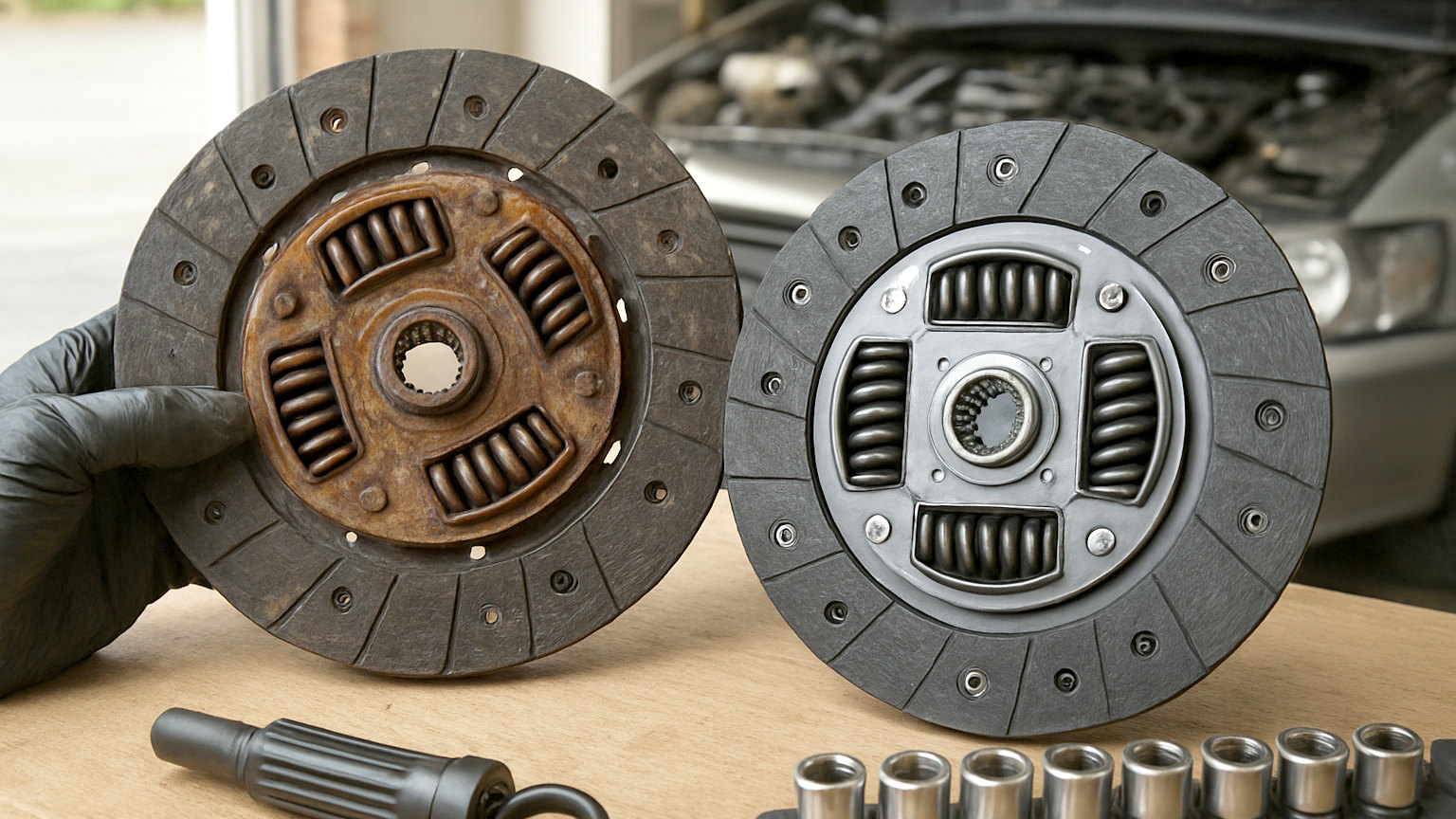
Crawling in traffic asks a car to do the thing it is least suited to: transmit a very small amount of power at very low speed while the engine turns far faster than the wheels. Every design manages that differently, and all of them do it by slipping something. That makes queueing traffic the condition where a marginal clutch, converter or mount reveals itself first.
What is happening mechanically at crawling speed?
On a manual, the clutch is partially engaged and slipping continuously. On a conventional automatic, the torque converter is doing the same through its fluid coupling. On a dual clutch gearbox, a computer is holding a clutch at its bite point. In every case something is deliberately slipping, generating heat, and any wear or contamination in that component shows up as a shudder.
What does clutch judder feel like?
A rapid shuddering as drive takes up, worst pulling away and on inclines, often accompanied by a smell of burning after a long queue. It comes from the clutch gripping unevenly, which usually means oil contamination from a leaking seal, a worn dual mass flywheel, or heat damage from previous slipping. It is felt through the whole car rather than the steering wheel.
Why do dual clutch gearboxes suffer in traffic?
Because they have no torque converter, so a friction clutch must slip for the entire time the car is crawling, generating heat with little airflow. Dry clutch versions have particularly limited thermal capacity. This is why urban commuting wears these transmissions far faster than motorway use, and why judder in stop start traffic is one of the earliest symptoms of clutch wear on them.
What about torque converter shudder?
The lock-up clutch inside a torque converter engages at low load to remove slip and save fuel, and on some cars it engages at surprisingly low speeds. When its friction material or the fluid degrades, it grips unevenly and produces a shudder often described as driving over rumble strips. Fluid condition matters enormously here, and a change with the correct specification sometimes resolves it entirely.
Could it be the engine instead?
Frequently. At crawling speed the engine is near idle and under load, which is where a misfire, a vacuum leak or a marginal idle control shows most clearly. If the shudder is present with the clutch fully engaged and the car simply rolling, or if it also occurs in neutral at a standstill, the engine is a stronger suspect than the transmission.
Do engine mounts contribute?
Considerably. Worn mounts allow the powertrain to rock with every small change in load, which at crawling speed happens constantly. The result feels exactly like a driveline judder while being a perished piece of rubber. Watching the engine move while someone blips the throttle with the handbrake applied usually identifies it in a minute, and it is among the cheapest possible causes.
Can driving technique reduce it?
To a degree, and it also reduces wear. On a manual, engaging the clutch more decisively rather than feathering it shortens the slipping period. Leaving a larger gap and moving in longer intervals rather than constantly creeping helps considerably. On a dual clutch car, selecting neutral in a long stationary queue takes load off the clutch, which is worth doing on a car already showing symptoms.
What should be checked?
The engine and gearbox mounts, the fault codes for any misfire, and on an automatic the fluid condition and a module scan. On a manual, whether there is any oil in the clutch bellhousing, since a leaking seal contaminating the clutch is the most common cause of judder and it must be repaired alongside the clutch or the new one will suffer the same fate.
Will it get worse?
Almost certainly, since every episode of judder involves something slipping and generating heat, and heat accelerates the wear that caused it. A judder that appears occasionally on a hill this month will appear on every departure within a few months, which is why acting early usually costs less.


