
A judder that began on the drive home from a garage is almost certainly connected to the work rather than a coincidence. That is genuinely useful, because it narrows the possibilities enormously, and most of the likely causes are quick to correct. It also means the conversation with the workshop should be straightforward rather than adversarial.
What gets disturbed during routine work?
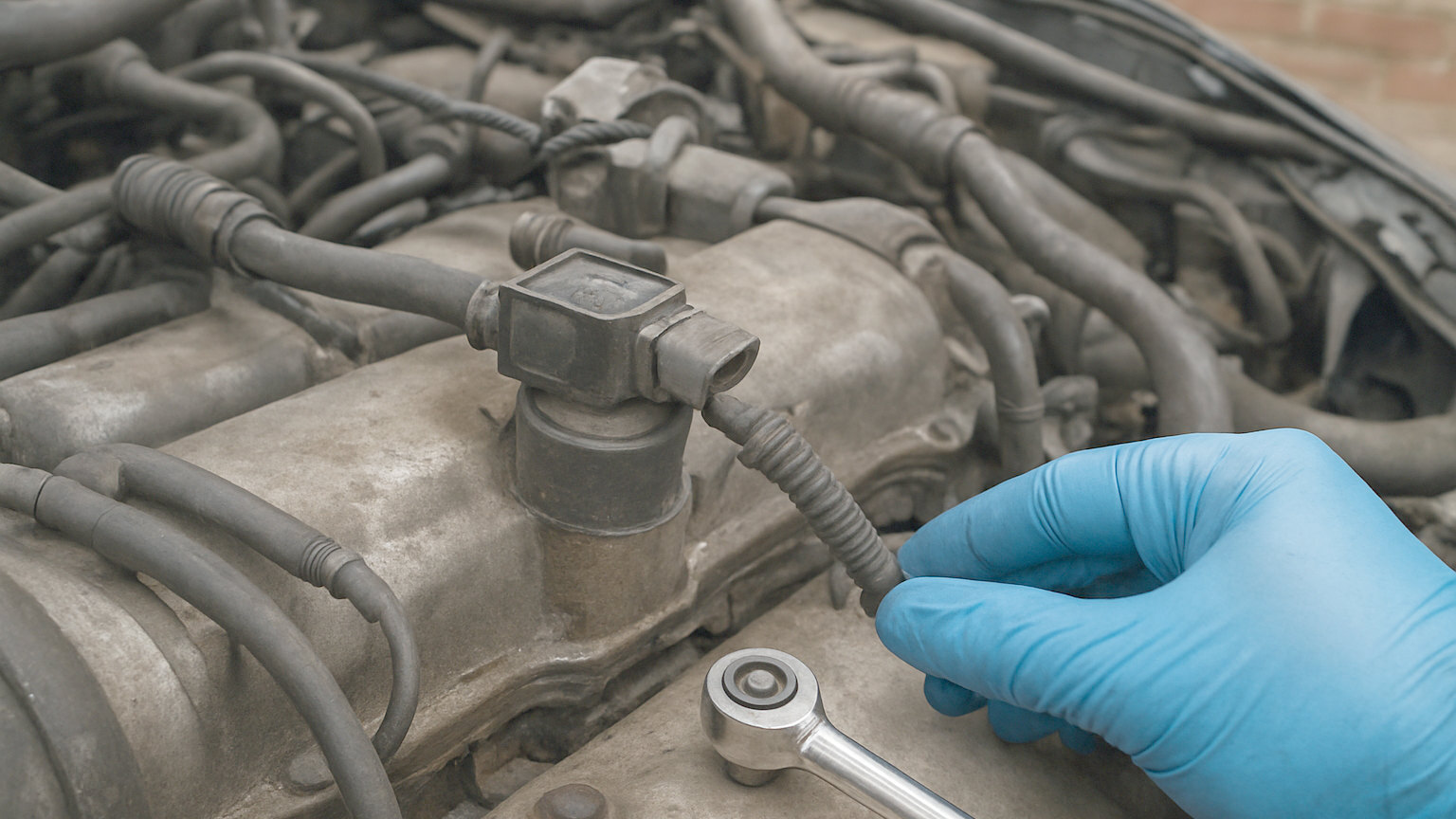
More than people expect. Reaching spark plugs, filters or belts means moving connectors, hoses and looms, and a connector that is not fully seated or a vacuum hose left off produces immediate running problems. An intake hose not clamped properly admits unmetered air. A breather pipe left disconnected does the same. All produce juddering and all take minutes to find.
Can new spark plugs cause it?
Yes, in several ways. A plug of the wrong specification or heat range runs incorrectly. One not torqued properly can seal poorly or work loose. A gap set incorrectly, where the plug requires setting, causes misfires under load. And a coil pack refitted without being pushed fully home is a very common cause of a misfire appearing immediately after a plug change.
What about a battery disconnection?
This one is frequently the whole answer and it resolves itself. Many cars lose their learned adaptations when power is removed, so the engine idle and the transmission shift points revert to default values. The car feels rough or shifts harshly for the first fifty to a hundred miles while it relearns. If work involved the battery being disconnected, driving normally for a week is the first thing to try.
Does transmission work need a relearn?
Often. After a fluid change, a repair or a clutch replacement on a dual clutch gearbox, the adaptations should usually be reset with a diagnostic tool so the module learns from a correct baseline. Skipping that step produces harsh shifts or judder that look exactly like a faulty repair. It is worth asking specifically whether it was carried out.
What if it followed a clutch replacement?
Judder after a clutch job usually means one of a small number of things: a leaking seal that was not replaced and has contaminated the new friction plate, a flywheel that was not machined or replaced, grease on the friction surface from over greasing the splines, or a pressure plate not tightened evenly. All of them are workmanship matters and all should be raised promptly.
Could the fuel filter be involved?
On a diesel, yes. Changing a fuel filter introduces air into the system, and if it has not been bled properly the car runs roughly and jerks until the air clears or, in some cases, until it is bled correctly. A filter fitted the wrong way round, which is possible on some designs, restricts flow and produces symptoms under load.
How should you raise it?
Promptly and factually, describing what the car does and when it started rather than suggesting what went wrong. The timing makes the connection obvious and most workshops will recheck their work without argument. Ask specifically whether adaptations were reset, whether anything was disturbed in the area, and what parts specification was used.
What if the garage says it is unrelated?
It occasionally is, since work sometimes coincides with a developing fault. Ask for the fault codes to be read and shown to you, since that moves the conversation onto evidence. If a code names a component that was disturbed during the work, the connection is difficult to dispute. If it names something entirely unrelated, that is useful to know as well.
Is there anything to try first?
If the battery was disconnected, drive normally for a hundred miles and see whether it settles, since lost adaptations resolve themselves. Beyond that, resist the temptation to start replacing parts elsewhere, because a fault that began with a specific job is very unlikely to be a coincidence and diagnosing it as a new problem wastes money.


