
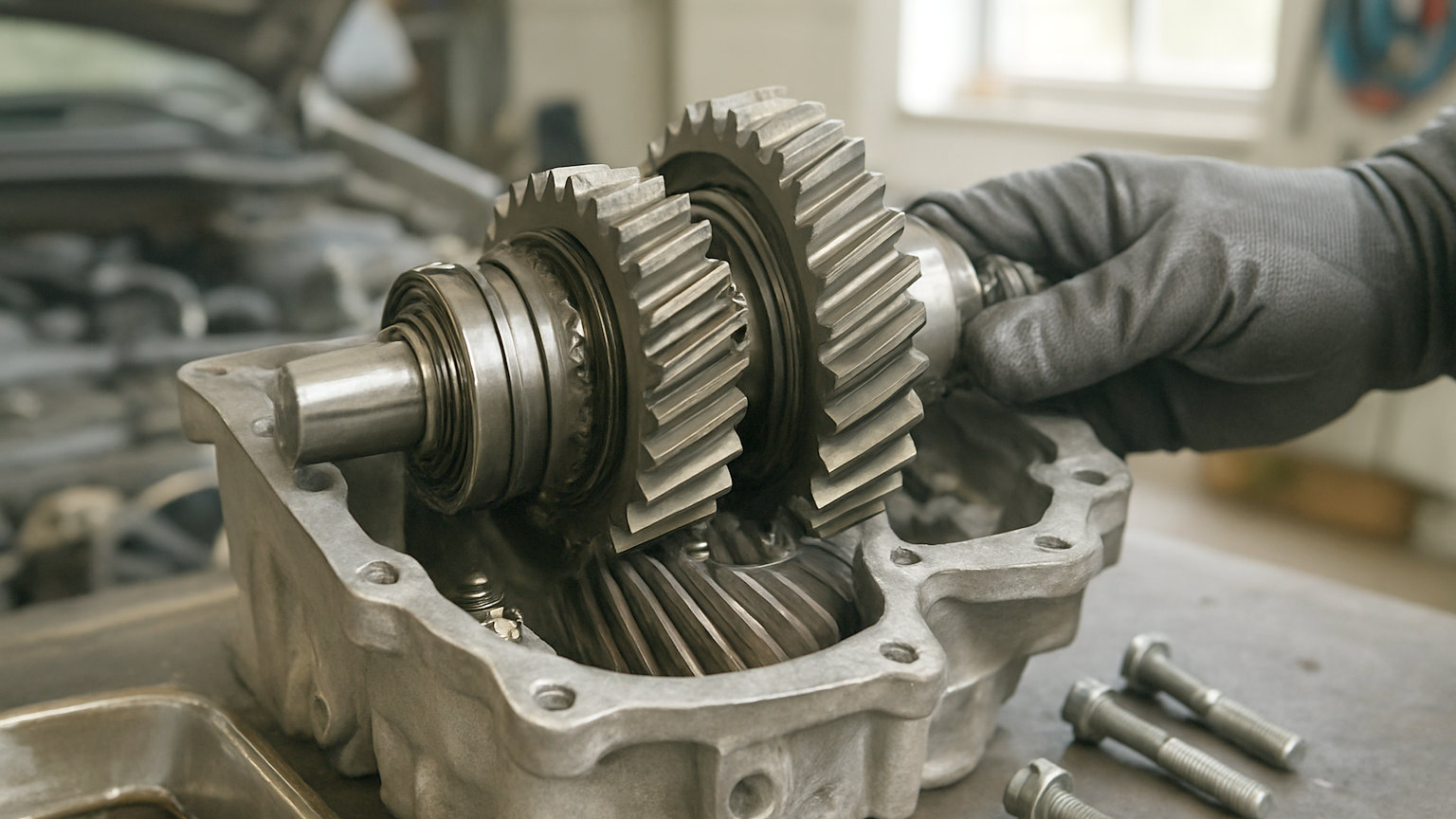
A whine present in one gear and completely absent in the others is unusually informative, because it has already located the fault. Each ratio in a manual gearbox uses its own dedicated pair of gears, so a noise confined to one of them points directly at those two components while exonerating everything else in the casing.
Why does each gear have its own pair?
Because the ratio is determined by the relative sizes of the two meshing gears. First gear has a small gear on the input shaft driving a large one on the output, giving high torque and low speed. Fifth reverses that relationship. Every ratio therefore has a unique pair permanently in mesh, with the selector deciding which pair is locked to the output shaft.
What causes one pair to become noisy?
Wear on the tooth surfaces, usually from years of load, from running low on oil, or from a manufacturing variation that was marginal from new. Pitting develops on the tooth flanks, the profile is no longer smooth, and the meshing produces a whine that rises with road speed. The gear pair that has done the most work usually goes first, which on most cars means second, third or fifth.
Why is fifth gear so often affected?
Because it carries sustained load for long periods at motorway speeds while being physically at the end of the shaft, often with less bearing support than the lower gears. On many gearboxes the fifth gear bearing is a known weak point. A whine that appears only at cruising speed in top gear and vanishes when you change down is the classic presentation.
How do you confirm which gear?
Drive at the same road speed in two different gears, which is possible in the overlap between ratios. If the noise appears in fourth at fifty and vanishes in fifth at fifty, the fourth gear pair is responsible, since the road speed is identical and only the gear selection has changed. That test is definitive and it takes one quiet stretch of road.
What if the noise is present in every gear?
Then it is not a gear pair but something turning all the time: the input or output shaft bearings, the differential, or the final drive. Those components rotate whenever the wheels or engine do, regardless of which ratio is selected. Noise in every gear including neutral with the clutch engaged narrows it further still, since only certain shafts turn in that condition.
Does it matter whether it changes on the overrun?
Yes, and it is a useful observation. A noise that alters noticeably between accelerating and coasting at the same speed suggests the loaded and unloaded tooth flanks are worn differently, which is typical of gear wear. A noise that is unchanged by load is more likely to be a bearing. Mentioning which applies helps a specialist considerably.
How serious is it?
Usually a slow decline rather than a sudden failure, provided the oil level is correct. Worn gear teeth get progressively noisier over months or years and the car remains usable. What changes the assessment is any grinding rather than whining, difficulty selecting that gear, or metal particles on the drain plug magnet, all of which suggest material is actually breaking away.
Can it be repaired without a full rebuild?
Technically a single gear pair can be replaced, but the box must come out and be dismantled to do it, and once open the sensible approach is to renew the bearings and seals too. Fifth gear on some designs is at the end of the casing and accessible with an end cover removed, which occasionally makes that particular repair cheaper than expected.
What should you do first?
Confirm which gear, check the oil level and condition, and look at the drain plug magnet for debris. If the oil is low, correcting it may slow the deterioration. Then decide honestly whether a whine you can live with justifies a rebuild, since on many older cars the answer is to monitor it and keep the oil topped up.


