
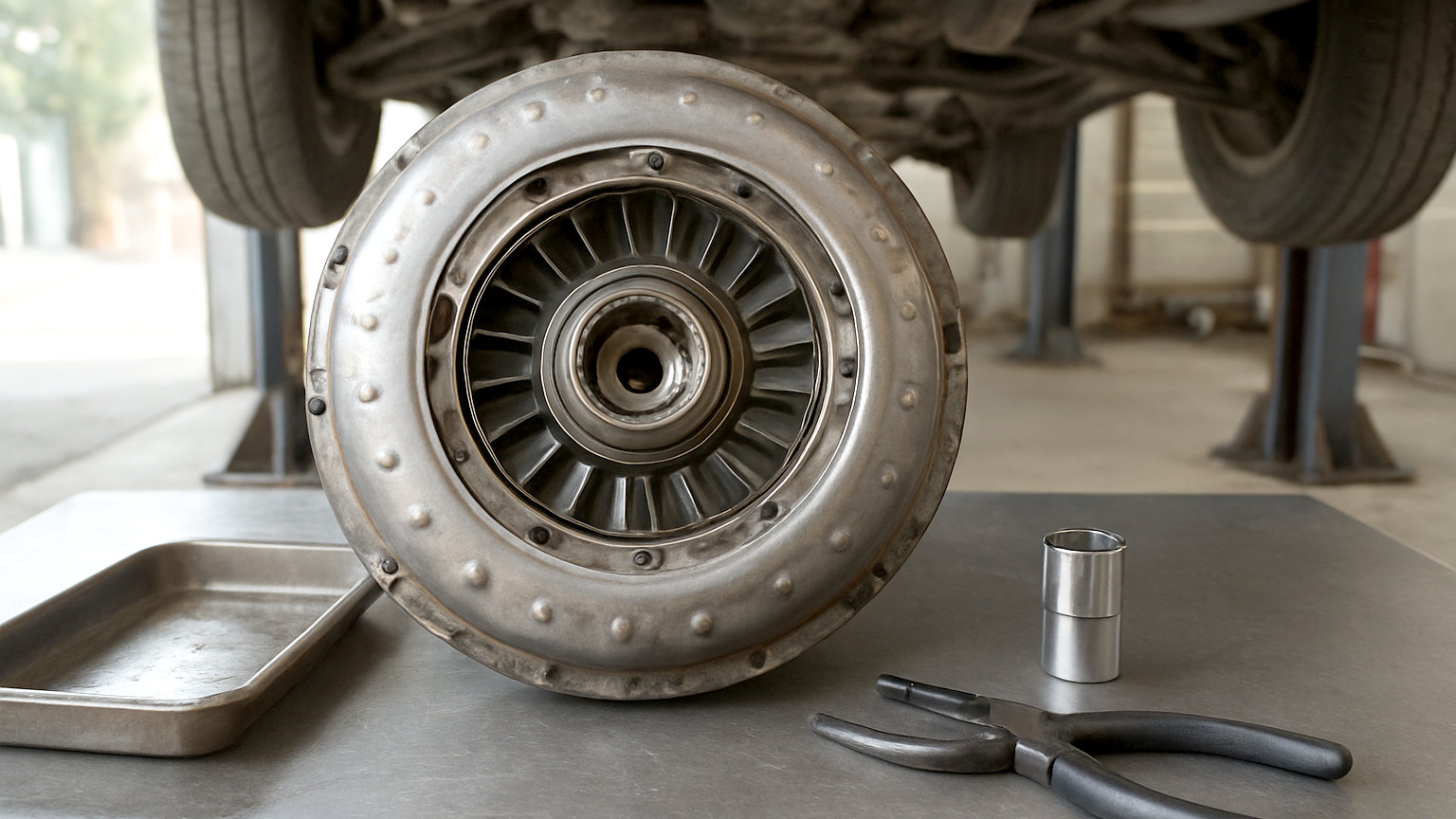
The torque converter is what allows an automatic car to sit stationary in gear with the engine running, and it does so without any clutch pedal or friction plate. It is a fluid coupling, transmitting drive through moving oil rather than through direct mechanical contact. Understanding that explains both its advantages and the particular ways it fails.
How does it work?
A pump driven by the engine flings fluid outwards, a turbine connected to the gearbox is pushed round by that fluid, and a stator between them redirects the returning flow to multiply torque at low speeds. At a standstill the fluid simply churns, so the engine can idle while the car sits still. As engine speed rises, more drive is transmitted, which is why an automatic creeps forward gently.
Why is there a lock-up clutch?
Because a fluid coupling always slips slightly, and that slip wastes fuel and generates heat. Once the car reaches cruising speed, a clutch inside the converter locks the pump and turbine together mechanically, giving a direct connection with no slip at all. That lock-up clutch is a friction component, and it is the part of a torque converter most likely to cause trouble.
What does converter shudder feel like?
A vibration at a steady moderate speed, usually light throttle, often described as driving over a rumble strip or a rough road surface that is not there. It happens as the lock-up clutch engages and slips rather than gripping cleanly. It is one of the most recognisable transmission symptoms, and it is frequently related to fluid condition rather than to the converter itself.
Why does fluid matter so much here?
Because the lock-up clutch depends on the friction characteristics of the fluid to engage smoothly. As fluid ages and overheats, those characteristics change and the clutch begins to judder rather than grip. On some vehicles a fluid change with the correct specification resolves shudder entirely, which is why it is always worth trying before considering a replacement converter.
What are the other failure modes?
The stator contains a one way clutch, and when it fails the converter either loses torque multiplication, producing poor acceleration from rest, or locks up and limits top speed. Bearing failure produces a whining or grinding that changes with engine speed while the car is in gear. In severe cases the converter breaks up internally and sends debris through the entire transmission.
What is a stall speed test?
A diagnostic where the brakes are held firmly and the throttle applied briefly with the car in gear, measuring the engine speed at which it stalls against the converter. A reading well above specification suggests slipping in the converter or the transmission clutches, and well below suggests engine trouble or a seized stator. It must be done briefly and carefully, since it generates enormous heat.
How is lock-up assessed with a diagnostic tool?
By comparing engine speed against turbine or input shaft speed in live data. When the lock-up clutch is engaged, the two should be effectively identical. A persistent difference at cruising speed indicates slip. This is a far more precise assessment than driving impressions, and it distinguishes converter slip from transmission clutch slip.
Can it be replaced on its own?
Yes, though the transmission has to come out to reach it, so the labour is much the same as a larger job. Given that, most specialists recommend replacing the converter whenever a transmission is rebuilt, and flushing the cooler lines thoroughly, since debris trapped in the cooler will contaminate the new unit. Fitting a rebuilt transmission behind an old converter is a common cause of repeat failure.
What should you do about shudder?
Have the fluid condition assessed and consider a change with the exact specified fluid, since that is inexpensive and frequently effective. Have the lock-up slip measured in live data to establish how severe it is. Do not ignore it indefinitely, because a slipping lock-up clutch sheds friction material into the fluid, which then circulates through the rest of the transmission.


