
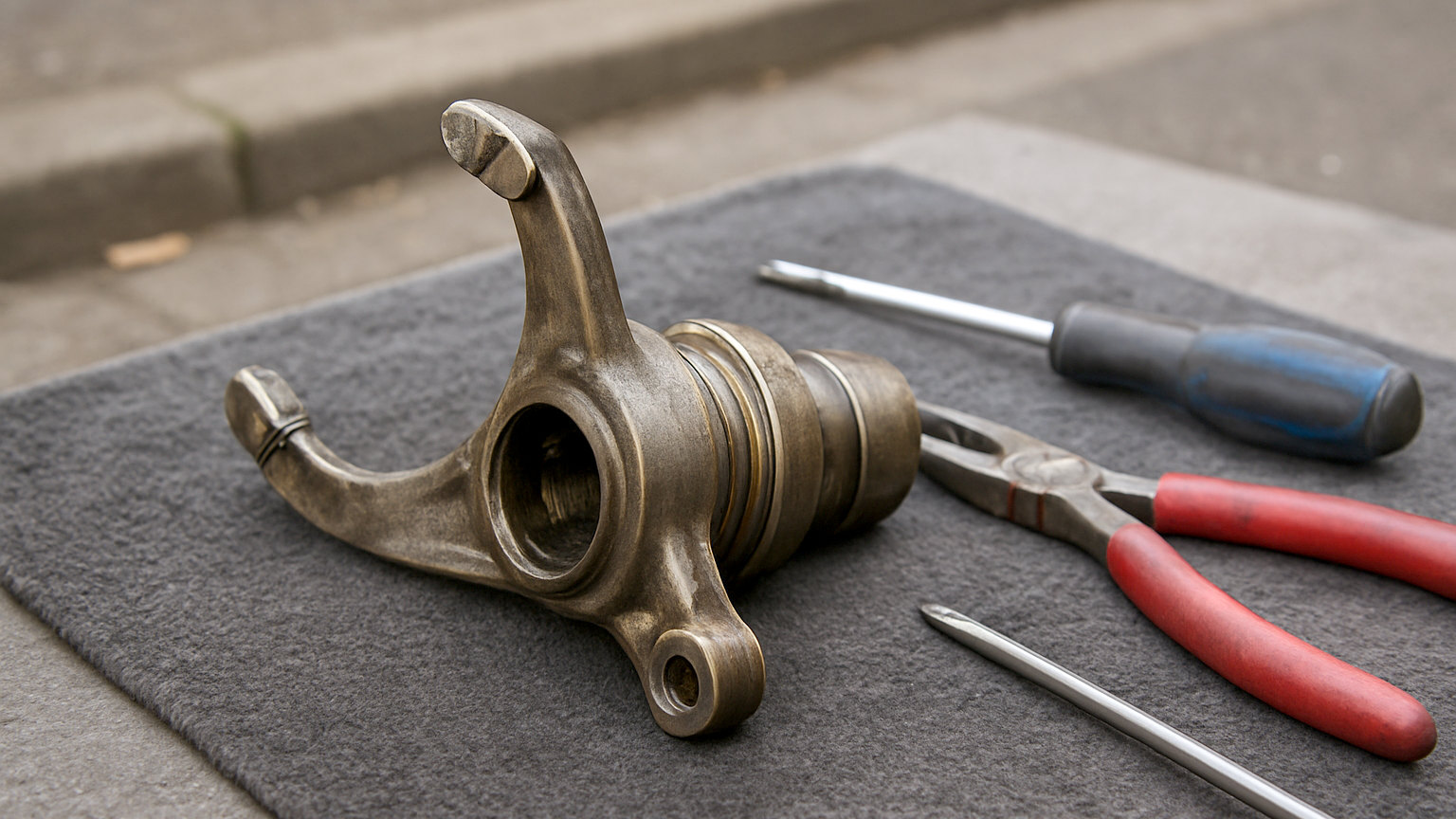
A gearbox that pushes itself out of gear, usually under acceleration or on the overrun, is doing something quite different from one that is difficult to get into gear. This is not a selection problem, it is a retention problem, and it almost always indicates mechanical wear inside the box. It is also one of the few transmission faults that is genuinely a safety concern.
What holds a gear engaged?
Inside the gearbox, a sliding collar engages with dog teeth on the side of the gear, locking it to the shaft. A selector fork moves that collar, and a spring loaded detent holds the fork in position. When everything is in good condition, the meshing teeth are slightly tapered so that torque actually pulls them together rather than pushing them apart. Wear reverses that relationship.
What wears out?
The dog teeth round off over hundreds of thousands of engagements, particularly if the car has been driven with a dragging clutch or shifted carelessly. Once the taper is worn away, torque pushes the collar out instead of holding it in. Selector forks wear where they contact the collar, allowing the fork to sit slightly out of position, and detent springs weaken so they no longer hold the fork firmly.
Which gears are usually affected?
Whichever has done the most work, so second and third on most cars, and fifth on vehicles that spend their lives on motorways. Reverse is another common one, since it is often unsynchronised and takes rough engagement. If it jumps out in one gear only, the wear is localised to that gear pair, which is helpful information for whoever quotes the repair.
When does it happen?
Under load or on the overrun rather than at steady throttle, because those are the moments when torque is trying to push the collar out. Many drivers notice it first when accelerating uphill or when lifting off suddenly. Some find themselves unconsciously holding the lever in gear, which is a clear sign the problem has been developing for some time.
Could it be something outside the gearbox?
Occasionally, and it is worth checking because it is far cheaper. Worn or collapsed engine and gearbox mounts allow the whole unit to move under load, which can pull on the selector linkage enough to drag a gear partly out. A stretched or misadjusted cable linkage does the same. If the mounts are visibly perished or the engine moves excessively when the throttle is blipped, start there.
Why is it a safety issue?
Because losing drive unexpectedly during an overtake or while pulling out of a junction removes your ability to accelerate at exactly the moment you need it. The engine also flares to high revs suddenly, which is unsettling. Holding the lever in gear occupies a hand that should be on the wheel. It is not a fault to live with for a year while deciding what to do.
Can it be repaired without a rebuild?
Rarely, unless the cause is external. Worn dog teeth and selector forks are inside the casing, so the gearbox has to come out and be dismantled either way. Once it is open, the sensible approach is to replace the worn components along with bearings and seals while access is available, since the labour is nearly all of the cost.
What are the options?
A rebuild by a transmission specialist, a good used gearbox, or an exchange reconditioned unit. On common vehicles a used box is often the cheapest route and carries some risk, since its history is unknown. An exchange unit costs more and usually comes with a warranty. A rebuild makes most sense on a car worth keeping or where a used box is hard to find.
What should you do meanwhile?
Avoid the affected gear where practical, drive gently on the throttle rather than accelerating hard, and do not hold the lever in gear as a permanent habit. Check the mounts and linkage first, since finding a perished mount turns an expensive prognosis into a cheap repair, and it happens often enough to be worth the ten minutes.


