
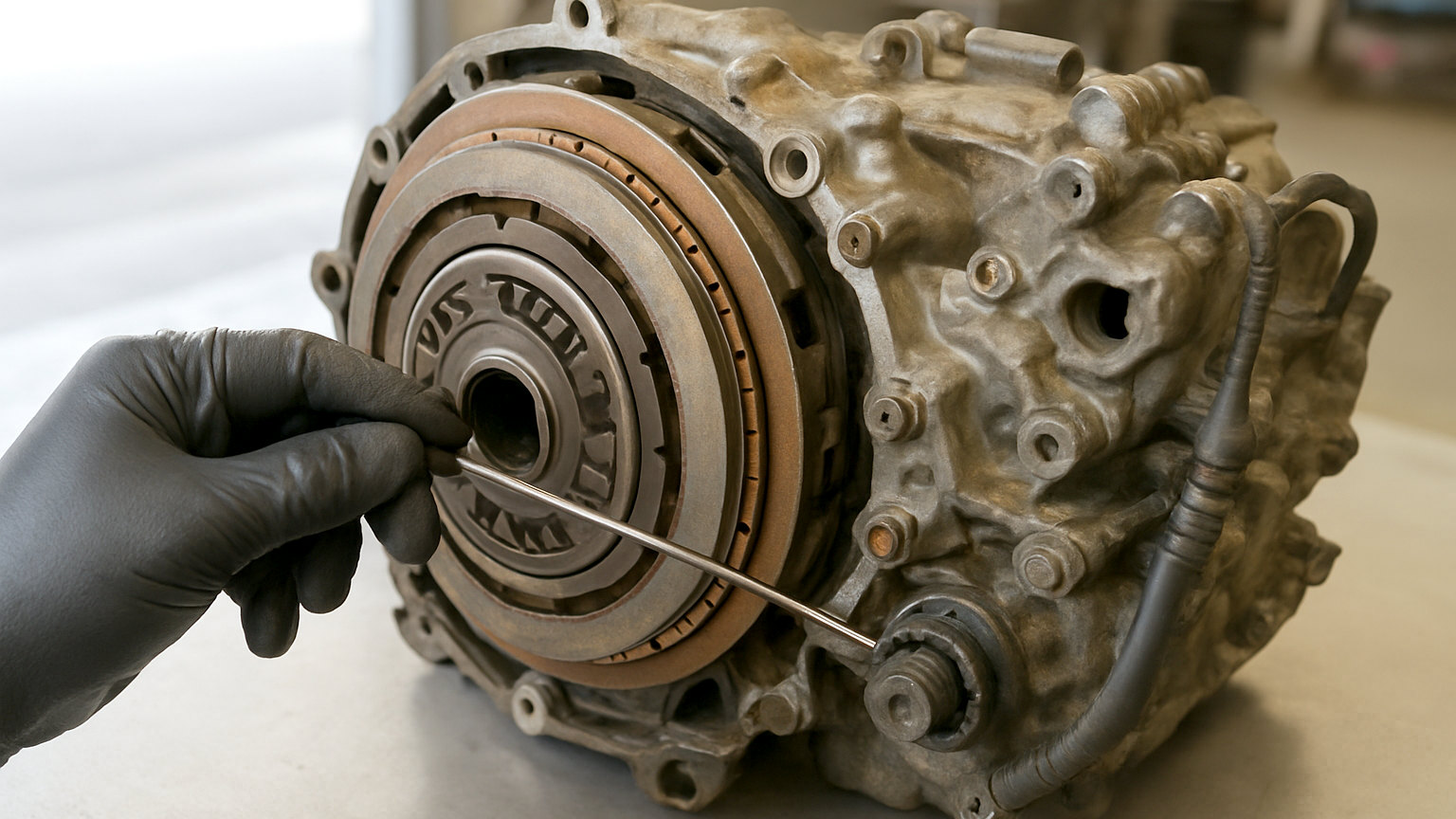
Dual clutch gearboxes, sold under names including DSG, PDK and Powershift, are mechanically closer to a manual gearbox than to a traditional automatic. Two clutches operate two sets of gears, with a computer and hydraulics doing the work a driver would otherwise do with a pedal. That architecture gives fast changes and good economy, and it also produces a distinctive set of faults.
How do they actually work?
One clutch handles the odd gears and the other the even ones. While driving in third, the box has already preselected fourth on the other shaft, so the change is simply a matter of releasing one clutch while applying the other. There is no torque converter and no fluid coupling, which is why they feel more direct and why low speed manoeuvring is less forgiving.
Why do they judder at low speed?
Because pulling away requires slipping a clutch, exactly as a manual does, and a computer has to judge it. When the clutch friction material wears or its engagement characteristics change, that slip becomes uneven and the car shudders. It is most obvious pulling away from rest, in slow traffic and on hill starts, which are the situations where the clutch spends the longest slipping.
What is the difference between wet and dry clutch versions?
Wet clutch units run their clutches in oil, which carries heat away and generally gives longer life, and they are usually fitted to higher torque applications. Dry clutch versions are lighter and more efficient but have far less thermal capacity, so they are more prone to overheating and wear in stop start traffic. Knowing which you have matters, because their failure patterns differ.
What is the mechatronic unit?
The combined electronic and hydraulic control module that operates the clutches and selects the gears. It contains solenoids, pressure sensors and the control electronics in one assembly. Faults in it produce erratic shifting, gears that will not engage, warning lights and limp mode, and it is a well known failure point on several transmissions. Replacement or repair is expensive but usually less than a full rebuild.
Does the oil need changing?
On wet clutch units, absolutely, and manufacturers usually specify an interval somewhere around forty thousand miles. The oil lubricates and cools the clutches and operates the hydraulics, and neglecting it is a reliable route to expensive trouble. Dry clutch units have separate gearbox oil that is often described as lifetime fill, though changing it on a high mileage car is a reasonable precaution.
Why does traffic wear them out?
Because crawling in queues means the clutch is repeatedly slipping at low speed, generating heat with little airflow and no torque converter to absorb it. A car used mainly for urban commuting will wear its clutches considerably faster than one doing motorway miles. Some owners find selecting neutral rather than holding the car on the brake in long queues reduces the load.
Can adaptations help?
Frequently. These transmissions learn their clutch engagement points and adjust continuously, and those adaptations drift as the clutch wears. A clutch adaptation reset carried out with a diagnostic tool, followed by a specific driving procedure to relearn, resolves a meaningful proportion of judder complaints without any parts. It is always worth trying before a clutch replacement is quoted.
What other symptoms are worth noting?
Hesitation or a delay before drive engages. A jerk when coming to a stop. Rattling at idle in gear. Warning messages about gearbox faults. Limp mode restricting the car to one or two gears. Any of these alongside judder suggests the mechatronic unit or the clutches rather than an adaptation issue, and they should be scanned promptly.
Are they worth avoiding?
They are excellent when maintained and expensive when neglected, which is a fair summary. If buying used, ask specifically about oil change history on a wet clutch unit and any mechatronic or clutch work already carried out. A full history on these transmissions is worth considerably more than on a conventional automatic, because the consequences of neglect are larger.


