
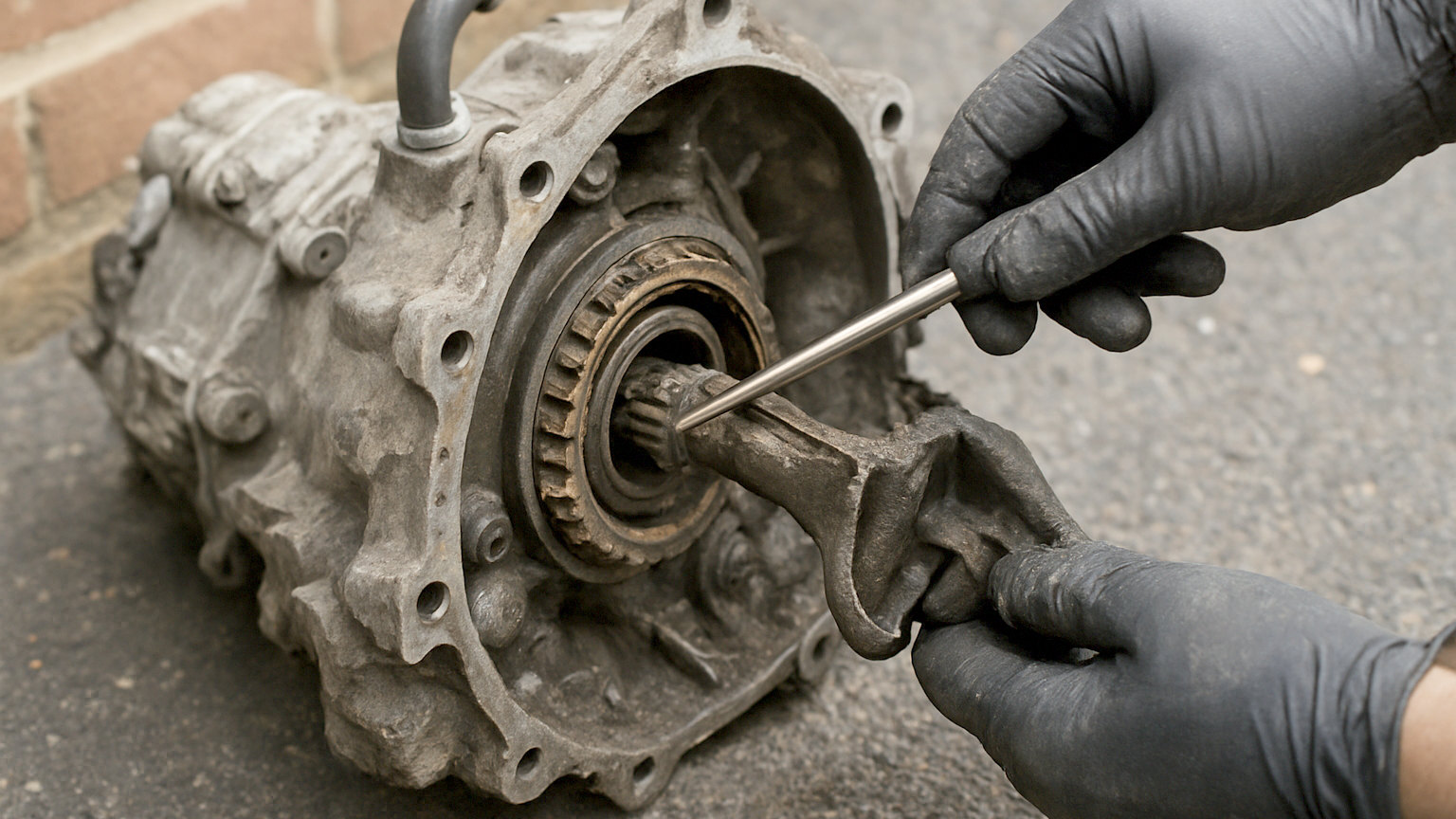
A crunch as second gear engages is one of the most common manual gearbox complaints, and second is almost always the first gear affected. That is not coincidence. It handles the largest speed difference of any change on most cars, particularly on downshifts, so its synchromesh does the hardest work and wears first. The important question is whether the synchro is worn or the clutch is dragging.
What does synchromesh actually do?
Before the gear teeth engage, a brass or composite ring is pushed against a cone on the gear, and friction between them brings the gear and the shaft to the same speed. Only once they match do the teeth slide together. When the ring wears, it can no longer match the speeds quickly enough, and the teeth meet while still turning at different rates, which is the crunch you hear.
How do you tell a synchro from a dragging clutch?
By how the fault responds to speed. A worn synchro allows a slow deliberate change and crunches on a quick one, so pausing briefly in neutral usually cures it. A dragging clutch produces crunching regardless of how slowly you move the lever, because the input shaft is still being driven. Try selecting gears with the engine switched off: easy engagement then points at the clutch.
Why are downshifts worse?
Because the engine and gearbox speeds are further apart. Changing down from third to second at speed asks the synchro to accelerate the gear substantially, which is a much larger task than the deceleration involved in an upshift. That is why a worn second gear synchro often crunches only on the way down while behaving perfectly on the way up.
Does the oil affect it?
Considerably, and it is the cheapest thing to try. Synchromesh performance depends on friction between the ring and the cone, and gearbox oil is formulated to give the right amount. Old, contaminated or incorrect specification oil changes that friction and produces crunching on a box whose synchros are not badly worn. Some gearboxes are notoriously sensitive to oil type, and a change to the correct fluid can transform them.
What is double declutching?
An older technique where the clutch is released in neutral and the engine blipped before selecting the lower gear, which brings the input shaft speed closer to where it needs to be and reduces the work the synchro has to do. On a car with a worn synchro it genuinely helps and can make a crunching gearbox usable. It is a workaround rather than a repair.
Does it get worse?
Yes, and forcing gears against a worn synchro accelerates it. Once the ring can no longer match speeds at all, the gear becomes difficult to obtain rather than merely noisy, and the dog teeth begin to wear too, which eventually leads to the gear jumping out under load. Catching it while it is still an occasional crunch gives you far more options.
Can one synchro be replaced?
Yes, but the gearbox has to come out and be dismantled to reach it, so the labour is almost the same as a full rebuild. Given that, most specialists replace the other synchros, bearings and seals at the same time, since they are inexpensive relative to the labour and are the same age. Replacing only the worst one usually means revisiting the job.
Is it worth repairing?
It depends on the car and the alternatives. A rebuild is thorough and expensive. A good used gearbox is often cheaper on a common vehicle and carries unknown history. An exchange reconditioned unit sits between the two with a warranty. On an older car, changing the oil to the correct specification and adapting your technique may be the pragmatic answer for some time.
What should you try first?
Check the clutch, including fluid level and pedal feel, and try selecting gears with the engine off. Then change the gearbox oil for the exact specified type. Those two steps cost relatively little, resolve a reasonable share of crunching complaints, and if they do not help you have eliminated the cheap causes before committing to anything larger.


