
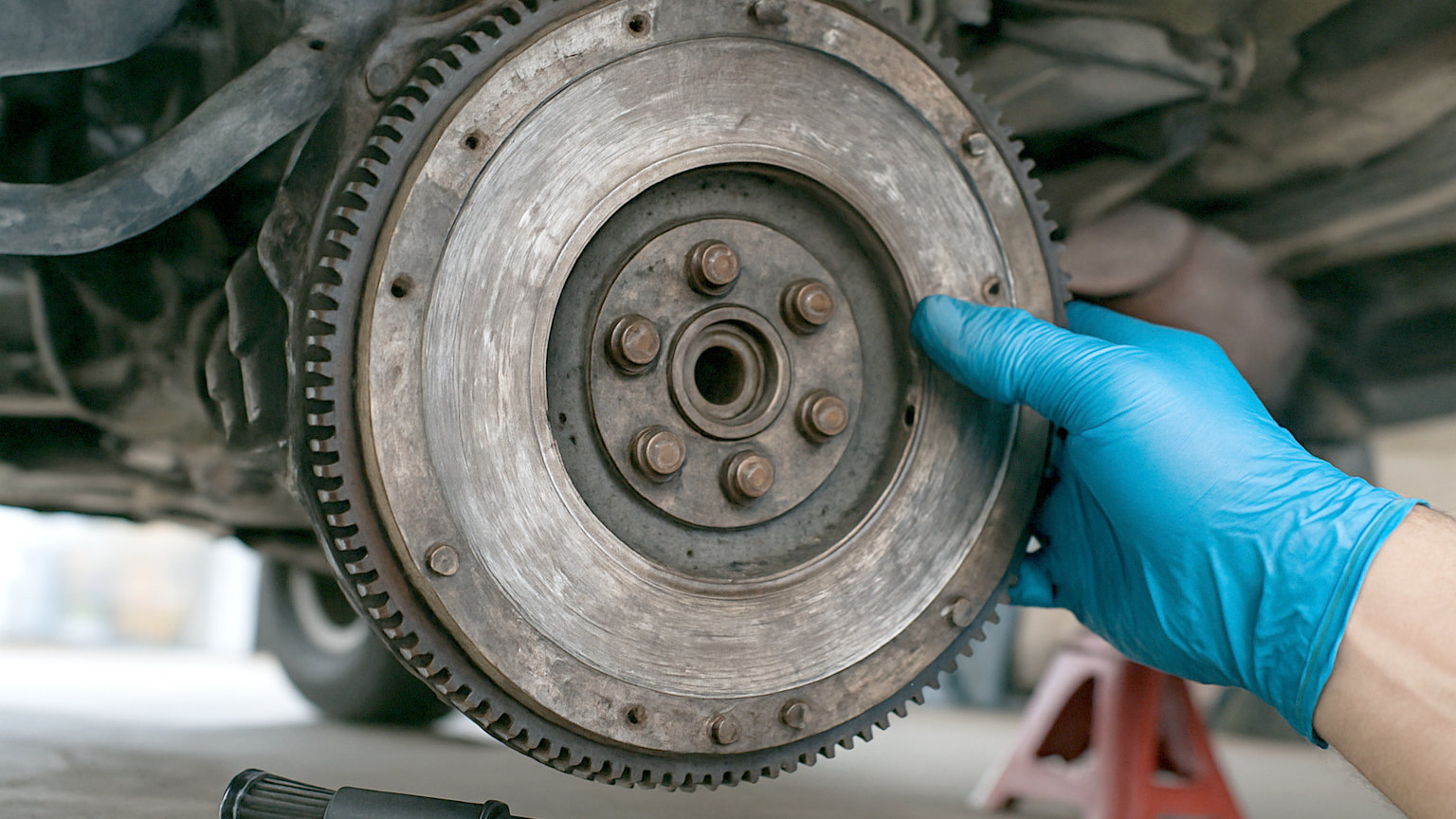
This question arrives at an awkward moment, usually with the gearbox already off and a workshop on the phone. The logic is straightforward once framed correctly: the labour to reach the flywheel has already been paid as part of the clutch job, so the only additional cost now is the part, whereas doing it later means paying the entire labour charge again.
What is the flywheel actually doing?
It provides rotating mass to smooth the engine power pulses, carries the ring gear the starter engages with, and provides the friction surface that the clutch plate clamps against. That last function is why its condition matters to a new clutch: a worn, scored or heat damaged surface gives the fresh friction material an imperfect partner to work against.
What happens to a solid flywheel?
It develops scoring from a worn clutch plate, and hot spots where a slipping clutch has locally overheated the metal, which appear as hard discoloured patches. Those hard areas grip differently from the surrounding surface and cause judder with a brand new clutch. A solid flywheel can usually be machined flat, which is inexpensive and restores an even surface, provided enough thickness remains.
When is machining not enough?
When hot spots have hardened the metal deeply enough that machining does not remove them, when cracks are visible, when the ring gear teeth are damaged, or when the flywheel is already at its minimum thickness. In those cases replacement is the only route. A good machinist will say honestly which applies rather than skimming something that will fail again.
Why can a dual mass flywheel not be machined?
Because the secondary mass thickness is part of the design, and removing material changes the clamping geometry and the balance of the assembly. More fundamentally, the wear that matters in a dual mass flywheel is internal, in the springs and damping, and no amount of work on the friction face addresses it. They are assessed for free play and replaced rather than repaired.
How is a dual mass flywheel assessed?
With the gearbox off, by measuring how far the secondary mass rotates against the primary before the springs take up, and comparing against the manufacturer tolerance. Lateral rocking movement and heat discoloration are also checked. Some designed free play is normal, so the measurement rather than the presence of movement is what determines the answer.
What is the practical recommendation?
If it measures within tolerance and the car has moderate mileage, keeping it is reasonable. If it is at or beyond tolerance, or the car has high mileage and the flywheel is original, replacing it is usually the better decision, because a flywheel failing eighteen months after a clutch job means paying the whole labour charge again for a component that was already accessible.
Does the clutch warranty depend on it?
Frequently, and it is worth asking. Many clutch manufacturers state that their warranty is void if fitted to a worn flywheel, since a poor friction surface will damage the new plate. Some suppliers require evidence that the flywheel was machined or replaced. That makes the decision partly commercial as well as mechanical.
Is a solid flywheel conversion worth considering?
On some vehicles yes and on others no, and the answer is specific to the engine. Conversion kits are cheaper and more durable, and they transfer the vibration the dual mass flywheel was absorbing into the gearbox, producing more noise and rattle and potentially more gearbox wear. Owner experience on your particular model is worth researching, since results vary considerably.
How should you handle the conversation?
Agree in advance what happens if the flywheel is found worn, including a price, so the decision is not being made under pressure with the car immobilised. Ask for the measurement rather than an opinion. A workshop that measures and shows you the figure is giving you the information to decide, which is what you are paying for.


