
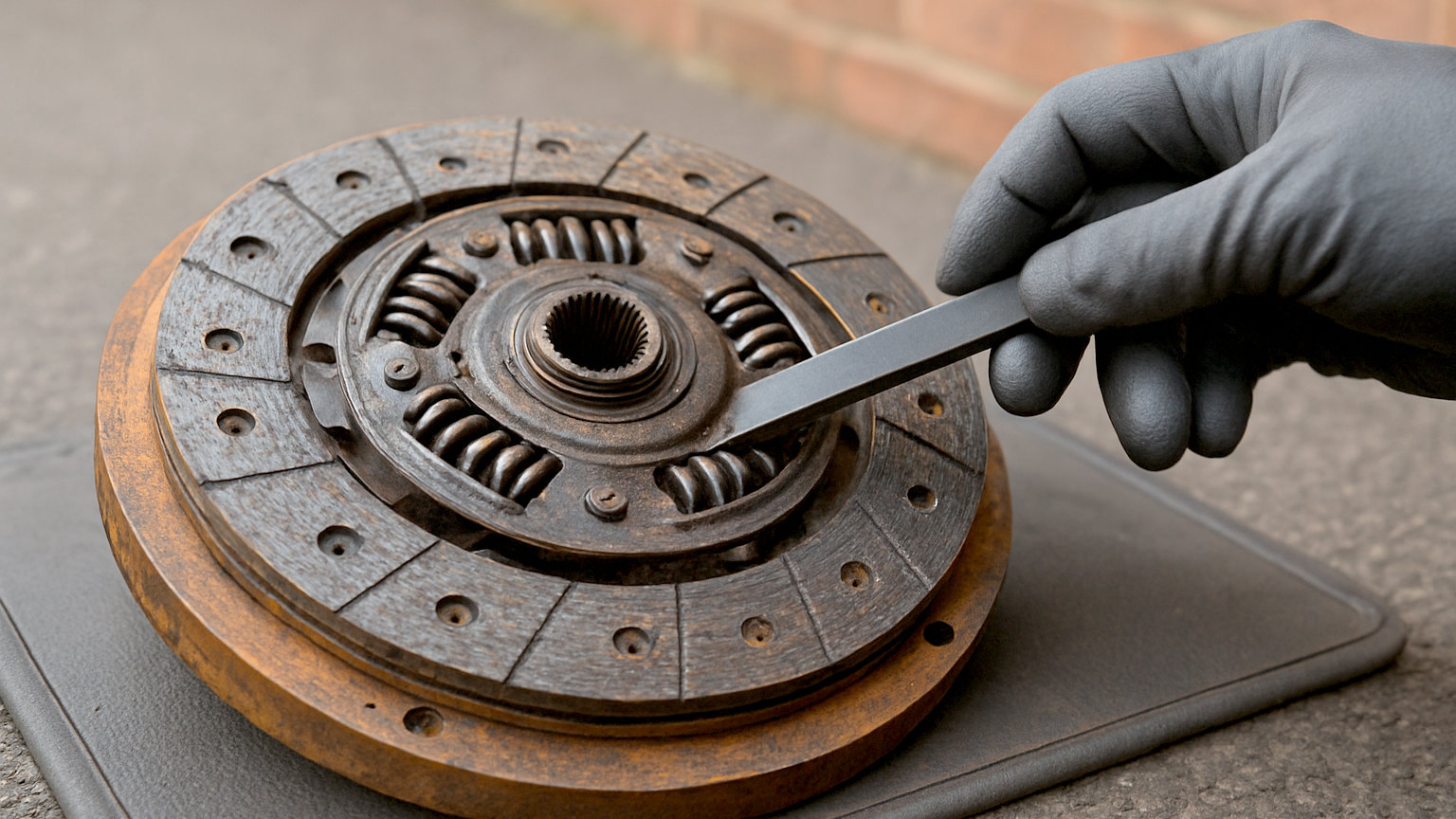
A clutch should last many years, so one that fails within twelve months has almost always been destroyed by something rather than being defective. Since the labour is the dominant cost, doing the job twice is an expensive way to learn that. There are five explanations that account for the great majority of early failures, and all of them are identifiable.
Was there an oil leak left unrepaired?
The most common cause by a distance. A leaking crankshaft rear seal or gearbox input shaft seal will contaminate a new friction plate within weeks, producing judder and then slipping. Both seals are inexpensive and both are accessible only when the gearbox is off, which is precisely why they should have been inspected and renewed during the original job.
Was the flywheel replaced or machined?
A new friction plate clamped against a scored or heat spotted flywheel face grips unevenly and judders from the first mile. A dual mass flywheel worn beyond tolerance produces the same, along with rattle at idle. Fitting a clutch to an unaddressed flywheel is a well known cause of comeback, and many clutch warranties are explicitly void where it has happened.
Could the fitting itself be at fault?
It happens. A friction plate fitted the wrong way round will not release properly and can foul the flywheel bolts. A plate not centred correctly with an alignment tool makes gearbox refitting difficult and can distort the hub. Pressure plate bolts tightened unevenly or out of sequence distort the cover. Excess grease on the splines flings onto the friction surface and contaminates it.
Was the release mechanism renewed?
A worn release bearing or a tired concentric slave cylinder left in place will fail long before the new clutch does, and replacing it means the whole job again. The same applies to a worn spigot bearing. These are inexpensive parts that share the same access, and leaving them out to reduce a quote is a false economy that surfaces within a year or two.
Could the hydraulics be causing it?
Yes. A master or slave cylinder that does not allow full return keeps slight pressure on the release bearing, which partially disengages the clutch continuously and causes slipping. A system that does not travel far enough prevents full release and grinds the gearbox. Either will destroy a clutch, and both are cheap to check compared with what they cost when ignored.
Was the part itself any good?
Quality varies, and clutch kits are an area where the cheapest options have a genuinely poor reputation for friction material life and pressure plate consistency. Given that the labour to fit one dwarfs the part cost on most vehicles, choosing a budget kit to save a modest sum is a poor trade. A reputable brand with a warranty covering labour is worth the difference.
Was it bedded in properly?
Less often the cause, but relevant. A new clutch needs a few hundred miles of moderate use for the friction surfaces to mate fully, and heavy towing or hard acceleration in that period can glaze the material. It is a modest factor compared with the others, and it is worth knowing when a car has gone straight from the workshop onto a heavy job.
What should you ask the original workshop?
Whether the flywheel was inspected and what it measured, whether the seals were checked for leakage, which release components were renewed, and what brand of kit was used. Those answers usually identify the cause immediately. If oil is found in the bellhousing on a clutch fitted a year ago, the conversation about who pays becomes a good deal more straightforward.
What should be done differently this time?
Renew both seals regardless, address the flywheel properly with a measurement rather than an opinion, replace the release bearing and slave cylinder, use a quality kit, and check the hydraulics for full travel and full return. That adds relatively little to the parts bill and it is the difference between a repair that lasts a decade and one that comes back.


