
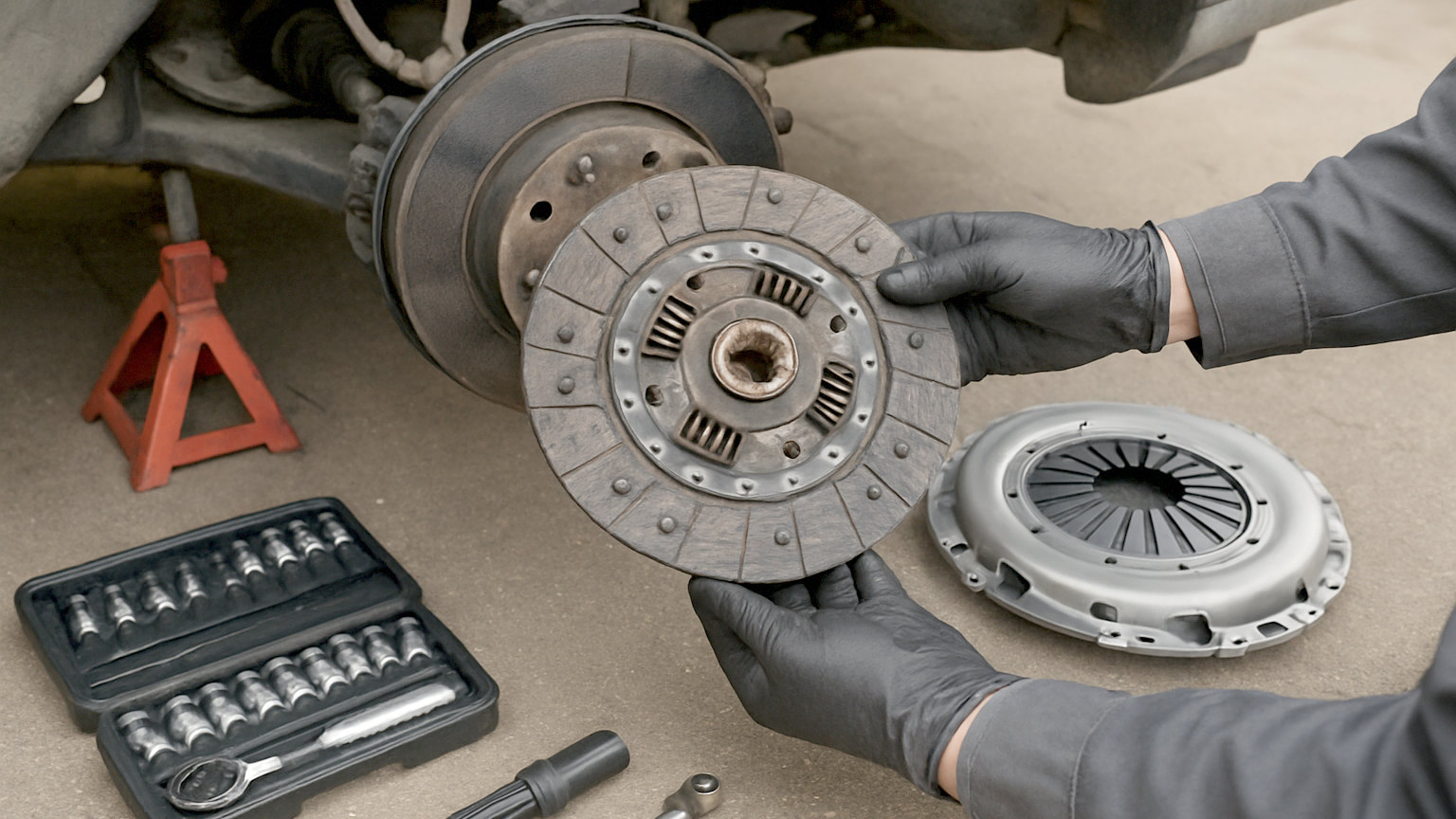
Clutch life varies more than almost any other component on a car, and the range is genuinely enormous. The same model can need a clutch at sixty thousand miles in one owner hands and last past two hundred thousand in another. That is because a clutch does not wear with distance travelled; it wears during the seconds it spends slipping, and how many of those there are depends entirely on how the car is driven.
When does a clutch actually wear?
Only while it is slipping, which means during the transition between fully disengaged and fully engaged. Once the plate is clamped, it turns with the flywheel and experiences no wear at all. So a car cruising for a hundred miles on a motorway wears its clutch during the handful of gear changes and nothing else, while a car crawling through town wears it continuously.
What mileage is typical?
As a broad guide, somewhere between seventy and a hundred and fifty thousand miles for average use, with urban driving at the lower end and motorway use at the upper. Some manufacturers offer no figure at all because the variation is so wide. Treating it as a wear item with no fixed interval, inspected when other work provides access, is a more useful approach than expecting a number.
Why is town driving so much harder?
Because every pull away from a junction involves slipping the clutch, and stop start traffic multiplies that many times over. A commute involving twenty sets of traffic lights each way accumulates thousands of engagements a month. Add hills, and each engagement lasts longer and generates more heat. This is why identical cars used for urban and motorway work have completely different clutch lives.
Does towing shorten it?
Considerably. Moving a heavy trailer from rest requires a much longer period of slip at higher engine loads, generating more heat each time. Repeated hill starts with a caravan are among the harshest things a clutch experiences. Cars used regularly for towing should be expected to need clutches sooner, and it is worth factoring that into running costs rather than treating it as bad luck.
What about resting a foot on the pedal?
It is genuinely damaging and extremely common. Even light pressure can partially load the release bearing against the pressure plate, which wears the bearing and can reduce clamping force enough to allow slight slipping under load. That slipping wears the friction material continuously while you drive. Keeping the left foot on the floor or a footrest is one of the simplest ways to extend clutch life.
Does holding the car on the clutch matter?
A great deal. Holding a car stationary on a hill using clutch slip rather than the brake means the plate is slipping continuously against a stationary output, generating substantial heat with no airflow to remove it. A few seconds is unavoidable during a hill start; thirty seconds at a junction is not. Using the handbrake instead costs nothing and saves real wear.
Do engine modifications affect it?
Directly. A remap producing significantly more torque than the clutch was designed to transmit will cause it to slip under load, often within a short period. Manufacturers size clutches with a modest margin, and a substantial power increase consumes it. Anyone remapping a car should expect the clutch to become the limiting factor, and budget accordingly.
How do you know when it is nearing the end?
The biting point rises towards the top of the pedal travel, and slipping appears first under maximum load such as steep hills or heavy acceleration in a high gear. There may be an occasional smell of burning after a demanding hill start. None of these means immediate failure, and all of them mean the clutch has entered the final part of its life.
Can you check the wear without removing anything?
Not directly, since the friction material is enclosed. The practical assessment is behavioural: the high gear slip test, the biting point position and whether the car struggles under load. Those three together give a reasonable picture, and a workshop can confirm it properly only once the gearbox is off.


