
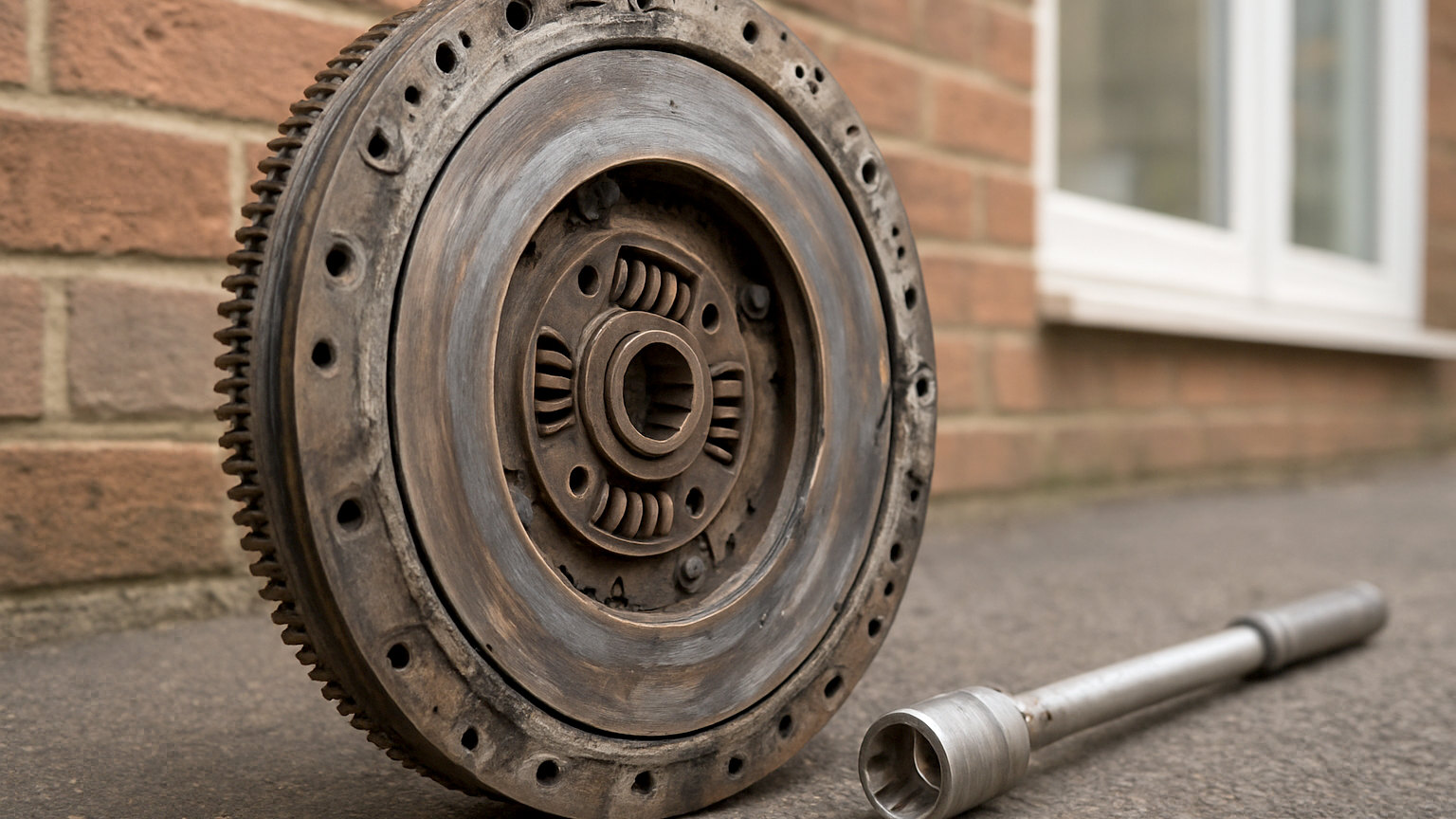
A dual mass flywheel is one of those components most owners have never heard of until they are quoted for one, at which point it roughly doubles the cost of a clutch replacement. It exists for a genuine engineering reason, it is not a manufacturer conspiracy, and understanding what it does explains both why it is fitted and why it wears out.
What problem does it solve?
Modern engines, particularly diesels, produce enormous torque with violent combustion pulses, and fewer cylinders make those pulses further apart. That rotational vibration passes into the gearbox, where it causes rattle, gear wear and noise. A dual mass flywheel splits the flywheel into two masses connected by springs and a damper, so the engine side can oscillate slightly while the gearbox side turns smoothly.
How is it constructed?
The primary mass bolts to the crankshaft and carries the starter ring gear. The secondary mass carries the clutch friction surface. Between them sit arc springs in a grease filled channel, plus a friction damping element. The two halves can rotate relative to each other by a limited angle, absorbing torsional shock in both directions. It is a sophisticated component doing a difficult job.
Why do they wear out?
Because the springs and damping surfaces work constantly and eventually lose their damping. The grease degrades with heat, the springs weaken and the internal stops wear, allowing more free play than intended. Once the damping fails, the two masses knock against each other rather than moving smoothly, which produces the characteristic noise and judder.
What are the symptoms?
A rattle or chatter at idle in neutral that stops when the clutch pedal is pressed. A rumble as the engine starts and stops, passing through its resonant speed. Judder when pulling away. Vibration through the floor at low revs. In advanced cases a knocking that can be felt as well as heard. The idle rattle test is the most reliable single indicator.
How is it tested?
Properly, only with the gearbox removed, where the free play between the two masses can be measured against a specification and the secondary mass checked for lateral movement and heat discoloration. Some wear is designed in, so a small amount of rotational play is normal. That is why a definitive assessment usually happens during a clutch job rather than before it.
Should it be replaced with the clutch?
This is the central question and the honest answer depends on its condition and the mileage. Since the labour to reach it is identical to the clutch job already being paid for, replacing a marginal flywheel now costs only the part, while replacing it later costs the entire job again. On a high mileage car with any measurable wear, most specialists recommend it.
Can a dual mass flywheel be reconditioned?
Some specialists rebuild them, replacing springs, grease and bearings, and a properly reconditioned unit from a reputable rebuilder can be good value. Quality varies, so the reputation of the rebuilder matters more than the price. Skimming a dual mass flywheel like a conventional one is not appropriate, since the secondary mass thickness is critical to its operation.
What about a solid flywheel conversion?
Conversion kits replace the dual mass unit with a solid flywheel and a sprung clutch plate, and they are cheaper and more durable. The trade off is that the vibration the dual mass flywheel was absorbing now passes into the gearbox, producing more noise, more rattle and, over time, more gearbox wear. On some vehicles they work well and on others they are unpleasant. It is worth researching your specific engine.
How long should one last?
Typically the life of a clutch or two, so somewhere between eighty and a hundred and fifty thousand miles depending on use. Stop start traffic, towing, labouring the engine at low revs in high gears, and remapped engines producing more torque than the component was designed for all shorten it considerably. Driving in a gear that keeps the engine above its lugging range genuinely helps.


