
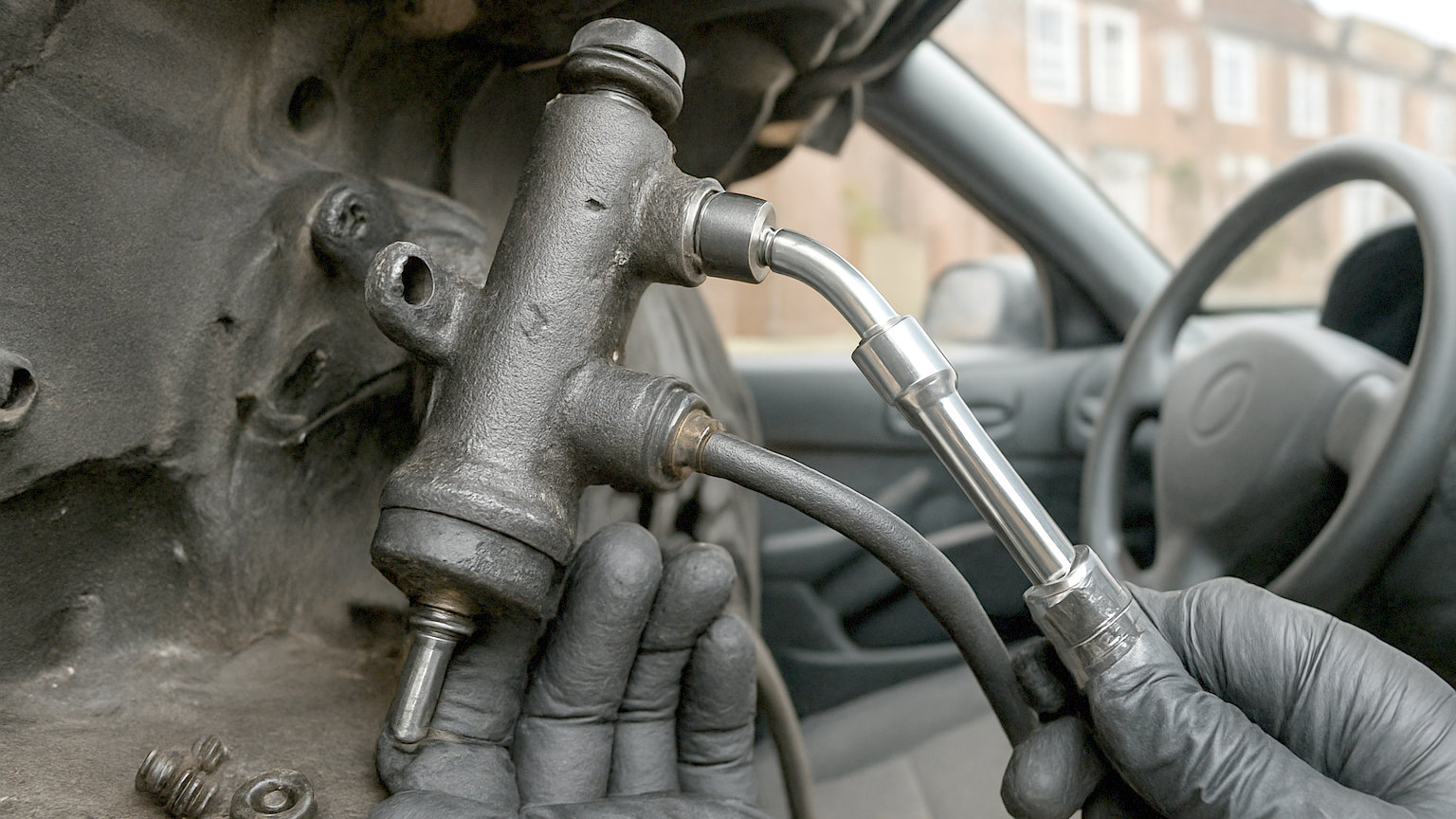
A clutch pedal that has gone soft, spongy or sinks to the floor without resistance is describing a hydraulic problem rather than a worn clutch. That is genuinely good news, because hydraulic components cost a fraction of a clutch replacement and are usually far quicker to fit. The distinction is clear enough to make from the driving seat before anyone lifts the car.
How does the hydraulic system work?
Pressing the pedal moves a piston in the master cylinder, which pushes fluid through a pipe to a slave cylinder at the gearbox. That slave cylinder moves the release mechanism, which lifts the pressure plate away from the friction disc. Because fluid cannot be compressed, the movement transfers directly, giving a firm consistent pedal. Anything that lets fluid escape or air enter destroys that firmness.
What does a sinking pedal indicate?
A pedal that goes slowly to the floor while you hold pressure on it means fluid is escaping past a seal internally, almost always in the master cylinder. It leaks past the piston rather than out of the system, so the fluid level may look normal and there is nothing visible on the ground. It is a very characteristic symptom and it points at one component.
What does a spongy pedal indicate?
Air in the system. Unlike fluid, air compresses, so pressing the pedal squashes the air before it moves the slave cylinder, giving a soft indistinct feel and often a clutch that will not fully release. Air enters through a leak, after a repair, or when the fluid level has been allowed to fall low enough for the reservoir to draw air in.
Where should you look first?
The fluid reservoir. On most cars the clutch shares the brake fluid reservoir, and a level that has dropped means fluid has gone somewhere. Then look at the pedal box inside the car for dampness around the master cylinder, and underneath at the gearbox for fluid around the slave cylinder or its pipe. Many slave cylinders are internal to the bellhousing, which makes leaks harder to see.
What is a concentric slave cylinder?
A slave cylinder mounted inside the bellhousing, surrounding the gearbox input shaft and acting directly on the release bearing. It is compact and effective, and it has one significant drawback: replacing it means removing the gearbox, exactly as a clutch replacement does. That is why these are almost always replaced at the same time as the clutch, and why a failure at any other time is expensive.
Can you pump the pedal to get home?
Sometimes. Pumping the pedal several times can build enough pressure momentarily to select a gear, and it is a legitimate way of moving a car a short distance. It is not a repair and it will get progressively less effective. Starting the engine in gear to move a car with no clutch is possible in an emergency and is hard on the starter and the transmission.
Does the fluid itself matter?
More than most people realise. Clutch systems usually use brake fluid, which absorbs moisture over time, and old contaminated fluid corrodes cylinder bores from the inside. That corrosion damages the seals, which is why master and slave cylinders often fail on cars where the brake fluid has never been changed. Replacing the fluid at the recommended interval protects both systems.
Will bleeding it fix the problem?
If air entered through a repair or a temporarily low reservoir, yes, and it may be the whole answer. If air is entering because a seal has failed, bleeding will restore the pedal for a short time before it goes soft again. A system that needs bleeding repeatedly has a leak, and finding it matters more than continuing to bleed it.
How urgent is it?
Reasonably. A clutch that will not fully release makes gear selection difficult and grinds the synchromesh, so continued driving damages the gearbox rather than just being awkward. There is also the practical risk of losing clutch operation entirely somewhere inconvenient. Given that the parts are usually inexpensive compared with the clutch itself, it is worth dealing with promptly.


