
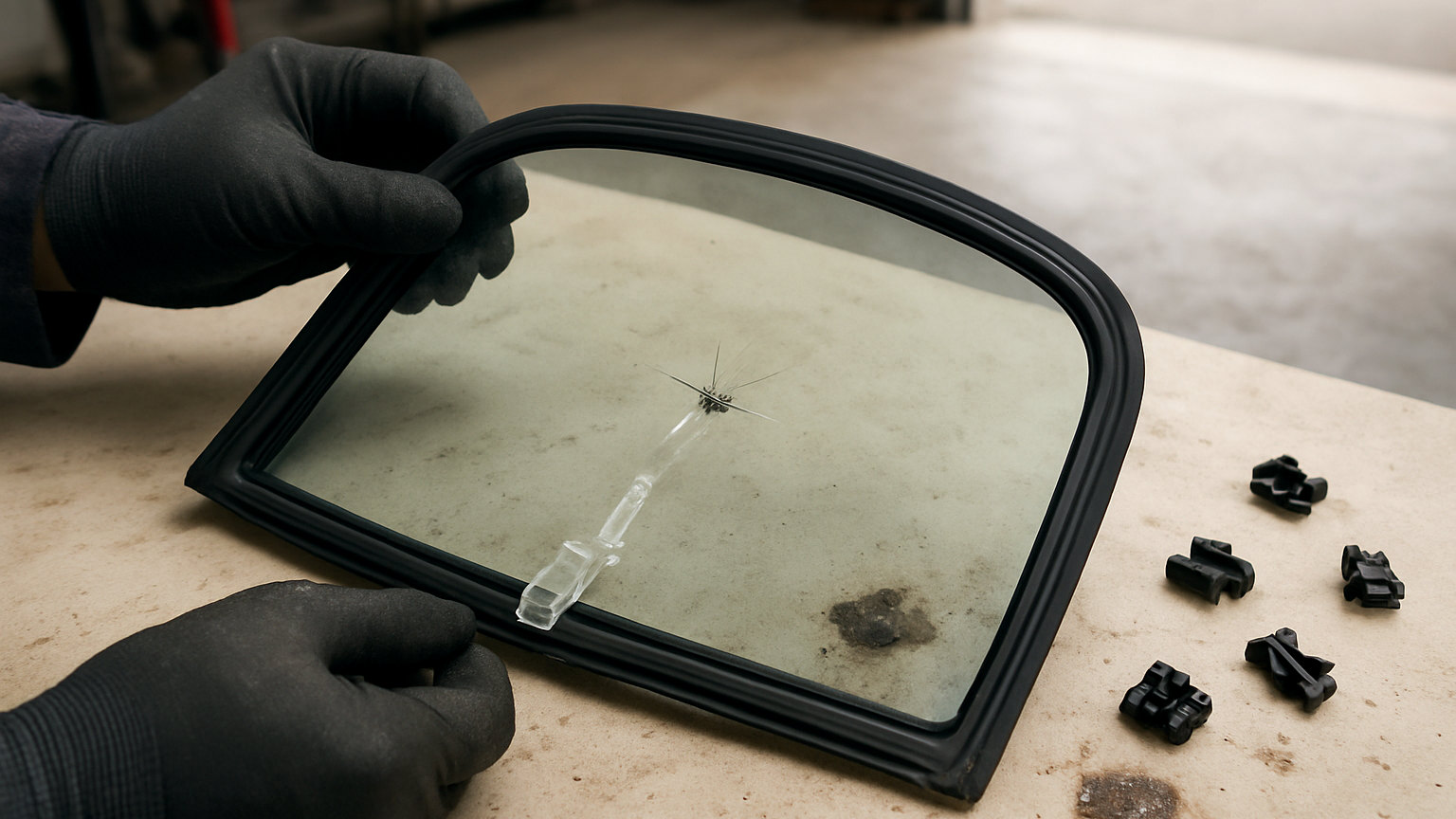
A stone chip in a windscreen is one of the few faults where acting quickly genuinely changes the outcome. A small chip caught early can usually be repaired for a modest sum, often free through insurance, while the same chip left for a few weeks can spread into a crack that requires a complete replacement screen and a considerably larger bill.
What determines whether it can be repaired?
Size, position and how long it has been there. Broadly, chips smaller than a twenty pence piece are usually repairable, and cracks longer than a few inches usually are not. Damage directly in the driver primary view is treated more strictly, since a repair leaves some visual distortion. And contamination that has worked into the damage over weeks reduces the quality of any repair.
Why does position matter?
Because a repair is never invisible, so damage in the area swept by the wipers directly in front of the driver is held to a tighter standard. Chips near the edge of the screen are also problematic, since that is where the glass is most stressed and where a crack is most likely to run. The technician will assess both before agreeing to repair.
How does the repair work?
Air is drawn out of the damage under vacuum, then a clear resin is injected under pressure to fill the void, and ultraviolet light cures it. The resin has a similar refractive index to glass, so the chip becomes far less visible and, more importantly, the structure is restored so it can no longer spread. The whole process takes half an hour.
Will it look perfect afterwards?
No, and any firm promising invisibility is overselling. A good repair typically removes most of the visual impact, leaving a faint mark visible if you look for it. The purpose is structural rather than cosmetic: it stops the damage spreading and it saves a screen replacement. Judging it on appearance alone misses the point of doing it.
Is it free on insurance?
Very often. Most comprehensive policies cover windscreen repair with no excess and without affecting the no claims discount, precisely because insurers would far rather pay for a repair than a replacement. Checking the policy takes a moment and the saving is worthwhile. A replacement usually does carry an excess, which is another reason to act while a repair is still possible.
What should you do immediately?
Cover the chip with a small piece of clear tape to keep dirt and moisture out until it can be repaired, which genuinely improves the result. Avoid extremes of temperature, meaning no hot water on a frozen screen and no blasting the demister at maximum onto cold glass, since thermal stress is what turns chips into cracks.
Does it fail an MOT?
It can. Damage larger than specified limits within the area swept by the wipers is a failure, with a smaller limit applying directly in the driver line of sight. A chip elsewhere on the screen is generally acceptable. Since the limits are modest, a chip that seems trivial can still fail, which is another argument for repairing it promptly.
How quickly do chips spread?
Unpredictably. A chip can sit unchanged for a year or run into a crack overnight, and cold weather, potholes and thermal shock all encourage it. Once it has become a crack the repair option is gone. Booking a repair within days rather than weeks is the practical response, and mobile technicians will usually come to you.
What if it is already a crack?
Then repair is generally not an option and replacement is the route, which usually carries an insurance excess. It is worth checking whether the car needs camera calibration afterwards, since most vehicles with driver assistance systems do and it should be included in the quote rather than appearing as an addition later.
Original equipment glass is worth asking about too, since the camera bracket position and the optical quality both matter more on a car with driver assistance systems.


