
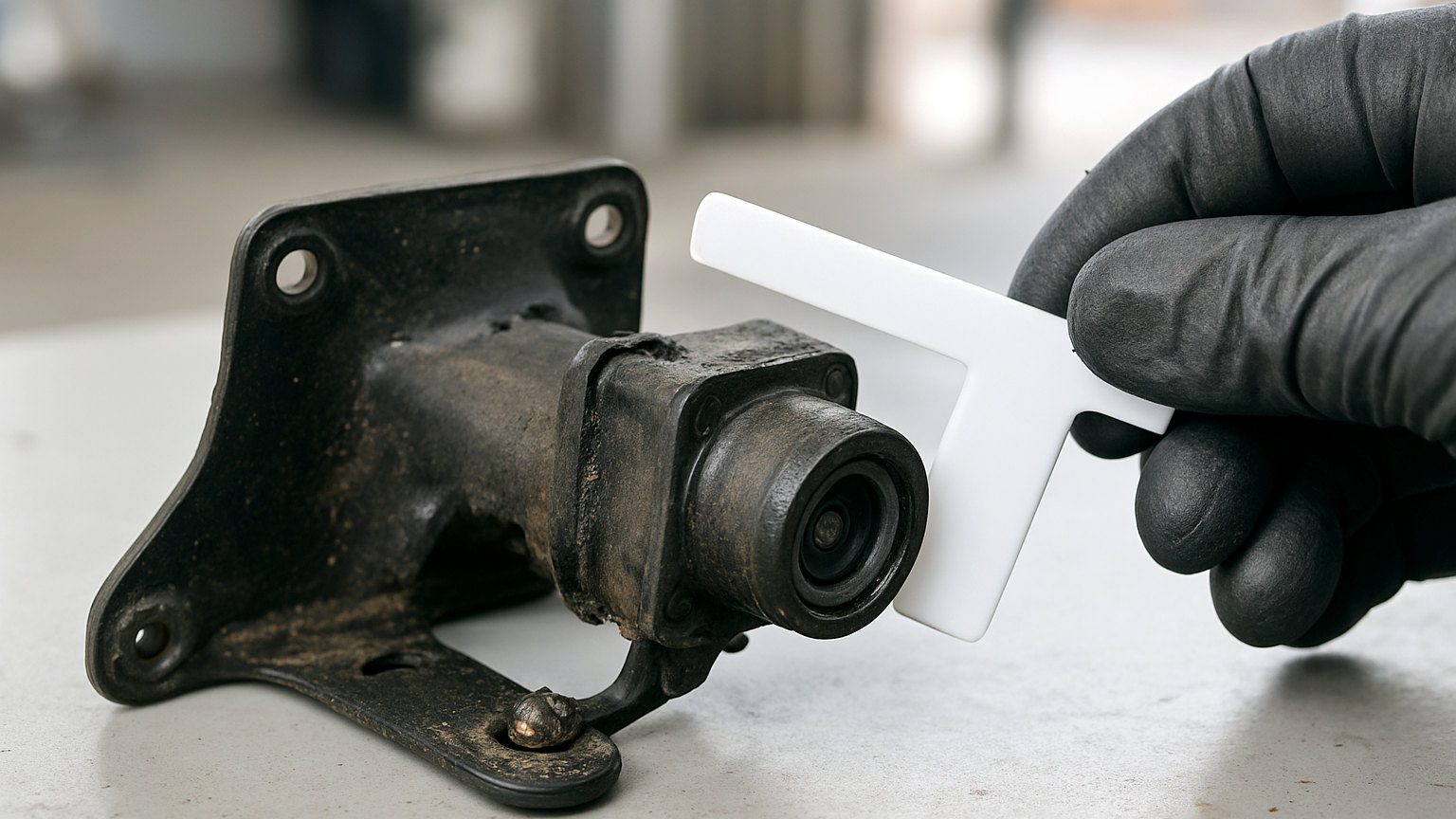
Windscreen replacement used to be a simple exchange of glass. On any car with driver assistance systems it is now a two part job, because a forward facing camera is mounted to the screen behind the rear view mirror, and moving that camera by even a fraction of a degree changes where the car believes it is looking.
What does the camera do?
It provides the vision for lane departure warning, lane keeping assist, traffic sign recognition, automatic high beam and, most importantly, autonomous emergency braking. On many cars it works alongside a radar sensor in the grille. Since it is judging distances and lane positions from the image it sees, its aim has to be extremely precise.
Why does replacing the screen affect it?
Because the camera bracket is bonded to the glass, so a new screen means the camera is mounted in a fractionally different position. Manufacturing tolerances in the glass thickness and the bracket position are enough to shift the aim. A small angular error at the camera becomes a large positional error at a hundred metres, which is where the systems are looking.
What is static calibration?
Carried out in a workshop with the car positioned precisely relative to a printed target board at a specified distance and height, on level ground with correct tyre pressures and a known load. The system is then instructed to recalibrate against the target. It requires space, controlled lighting and the correct target for the specific vehicle.
What is dynamic calibration?
Carried out on the road, with a diagnostic tool connected, driving at a specified speed on a road with clear lane markings for a set period. The system calibrates itself against what it sees. It requires suitable roads and reasonable weather, which is why a dynamic calibration can be delayed by fog or heavy rain.
Which does a car need?
It depends on the manufacturer, and some require both. The vehicle specific procedure determines it rather than the fitter preference. A firm equipped for one and not the other may be unable to complete the job on your car, which is worth establishing when booking rather than discovering when the car is already in pieces.
Can it be skipped?
It should not be. An uncalibrated camera may leave warning lights illuminated, which is the visible consequence. The more serious possibility is a system that appears to work while judging distances incorrectly, so automatic emergency braking intervenes at the wrong moment or fails to intervene at all. That is a safety system operating on false information.
Does it add much to the cost?
Meaningfully, since it requires equipment, space and time. It is a substantial part of why windscreen replacement on a modern car costs considerably more than it did on an older one. Insurance policies generally cover it as part of the replacement, and it is worth confirming that rather than assuming.
What else can require it?
Anything that changes the geometry the sensors reference. Wheel alignment on many cars, since the camera and radar are referenced to the thrust line. Suspension work that alters ride height. Bumper removal or repair where a radar is mounted. And accident repairs generally. A workshop that raises calibration on those jobs is being thorough rather than opportunistic.
How do you know it has been done?
Ask for the calibration certificate or the diagnostic printout, which any properly equipped firm will provide as a matter of course. The absence of warning lights is not proof, since a camera can be aimed incorrectly while reporting no fault. Keeping that paperwork also matters if the car is involved in an incident later.
It is also worth checking the systems behave normally on the first drive afterwards, particularly lane keeping and any adaptive cruise control, and returning promptly if anything feels different from before. A system that intervenes at odd moments is reporting an aim that is not quite right.


