
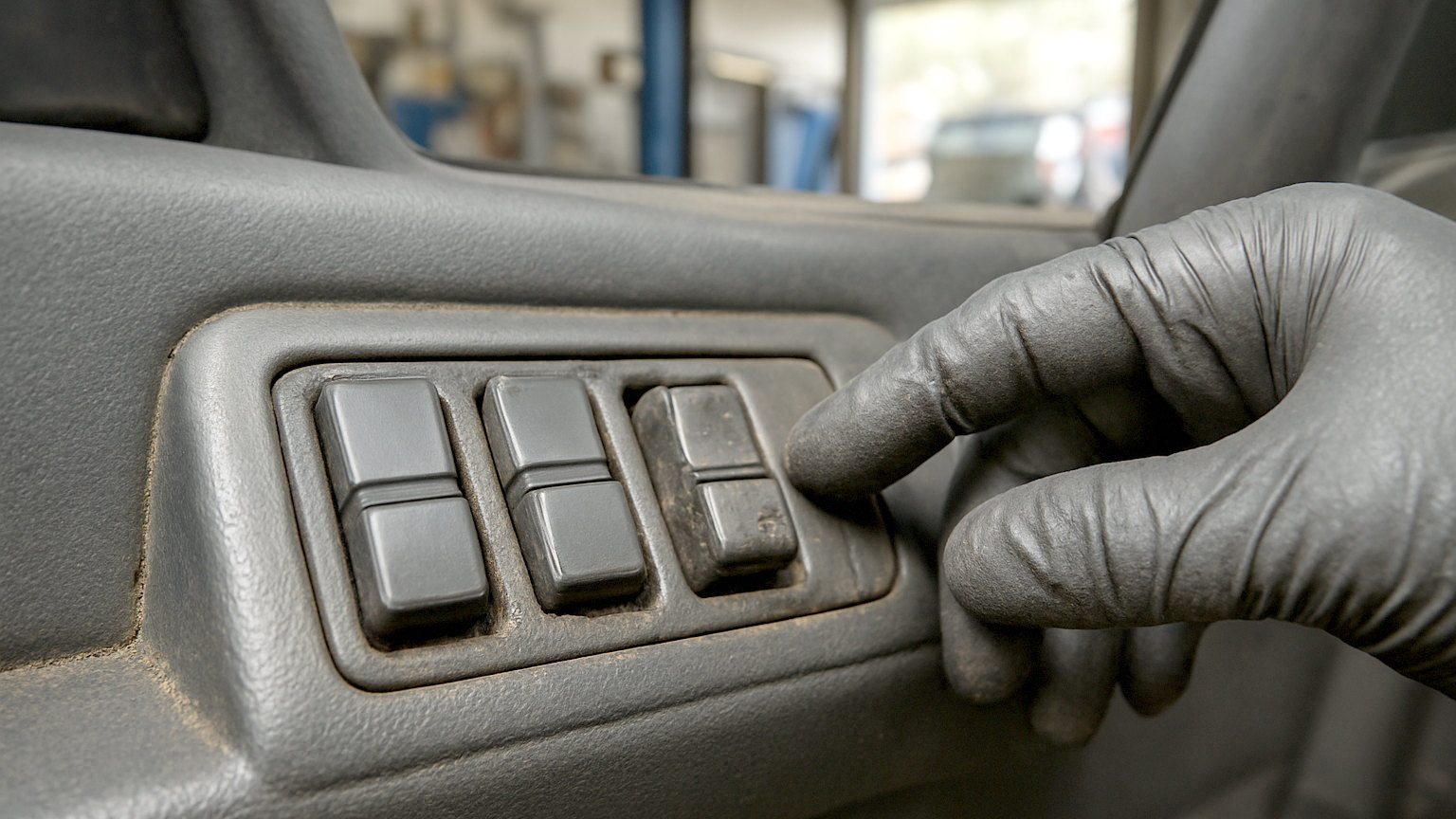
Windows that operate perfectly from the driver door master panel but not from their own switches are displaying a fault pattern that immediately narrows the possibilities. The motor works, the regulator works and the power supply is fine, since the master switch proves all three. What has failed is somewhere between the individual switch and the motor, or the master switch is deliberately preventing it.
Have you checked the lock button?
Always the first question, and it resolves this more often than any repair. Every car with rear windows has a lock button on the driver panel that disables the rear switches, intended to stop children operating them. It is easily pressed by accident, and the symptom is exactly this. Pressing it again restores normal operation immediately.
Why do individual switches fail?
Because on many designs they carry the full motor current, and repeated arcing burns the contacts over years. They also sit in a door where drinks get spilled and where humidity is high. The master switch is used just as often but tends to be a better quality assembly, which is why the individual switches usually go first.
Can they be cleaned?
Sometimes. Many switches can be prised apart carefully and the contacts cleaned with a suitable electrical contact cleaner and a fine abrasive. It is fiddly and it frequently works, particularly where the failure is corrosion rather than burning. Given how inexpensive most switches are, it is worth a try before ordering a replacement rather than instead of it.
Could the wiring be the problem?
Frequently, and it is one of the more overlooked causes. The wiring loom passes from the body into the door through a flexible rubber conduit, and it flexes every time the door opens. Over tens of thousands of cycles the individual wires fatigue and break inside the insulation, so nothing is visible from outside. It affects the front doors most, since they are used most.
How do you find a broken door wire?
By peeling back the rubber conduit between the door and the pillar and flexing the loom while operating the switch. An intermittent fault that comes and goes as the door is opened and closed is a strong indicator. The break is usually within a few inches of where the loom enters the conduit, and repairing it means soldering in a short replacement section.
What if several functions have stopped?
That points firmly at the door loom rather than at any individual component. If the window, the mirror, the speaker and the door lock have all stopped on the same door, a broken wire or a failed connector in the conduit is far more likely than four separate failures. It is a useful pattern because it saves investigating each function separately.
Could a module be involved?
On many modern cars, yes. Door modules control the windows, mirrors and locks and communicate with the rest of the car over a data network. A failed module produces multiple symptoms on one door, similar to a broken loom, and it usually stores fault codes. Water entering a door is a common cause, since modules are not designed to be submerged.
What order should you check things?
The lock button first, since it costs nothing. Then swap a suspect switch with one from another door, which confirms it in minutes. Then check whether other functions on that door still work, which distinguishes a switch from a loom. Only then does it become worth removing door cards or reading fault codes.
Is a broken loom expensive?
Not usually, since the repair is a matter of finding the broken wires and soldering in replacement lengths with proper heatshrink insulation. The labour is in locating them rather than in the materials. What is expensive is replacing a complete loom, which is rarely necessary and worth questioning if it is proposed.
A good repair uses proper soldered joints with heatshrink rather than crimped connectors, since the wires will continue flexing every time the door opens.


