
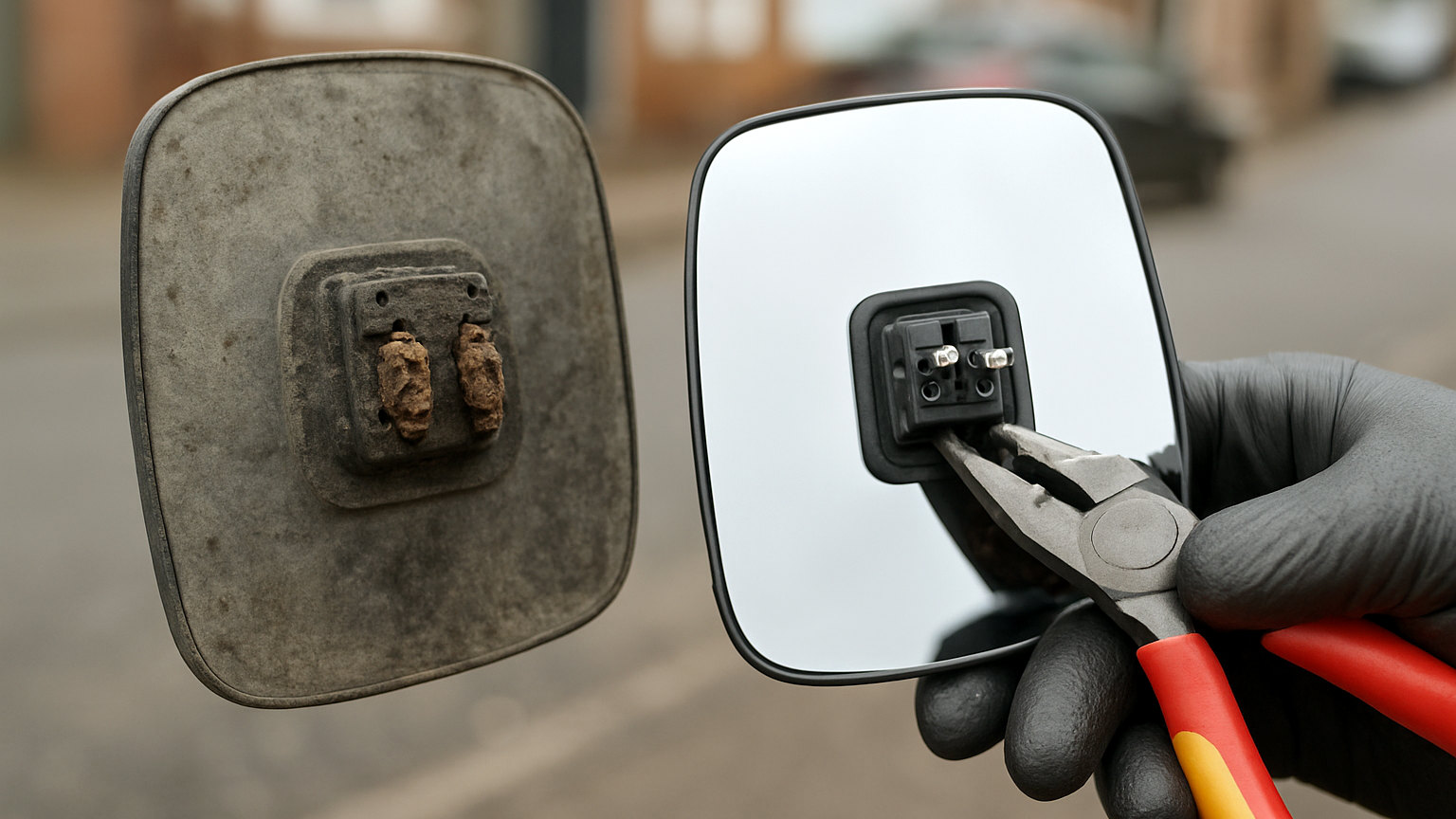
A heated door mirror works through a small heating element bonded to the back of the glass, warming it enough to clear condensation and thin ice. On most cars it shares a circuit with the heated rear window, which is the single most useful thing to know when one stops working, since it immediately tells you where to look first.
Does the rear screen still work?
The first question to ask. If both mirrors and the rear window have all stopped, the fault is in the shared supply: the fuse, the relay, the switch or a timer module. If the rear screen clears normally and only a mirror is cold, the fault is specific to that mirror or its wiring, which is a quite different investigation.
How does the element fail?
The heating film is bonded to the back of the glass, and it can crack or separate with age and thermal cycling. Water finding its way behind the glass corrodes the connections. And the two spade terminals that supply it can work loose or corrode, particularly on a mirror whose glass has been removed and refitted at some point.
Can it be tested?
Straightforwardly. With the heated screen switched on, carefully prise the mirror glass off its backing and check for voltage at the two connectors. Voltage present with a cold element means the element has failed. No voltage means the fault is upstream in the wiring, the switch or the shared circuit, which points the investigation in a completely different direction.
How is the glass removed?
By tilting it fully in one direction to expose the opposite edge, then applying gentle even pressure to release the clips. Cold glass is more brittle, so doing it in a warm garage is wise, and a plastic trim tool spreads the load better than a screwdriver. The heated connectors must be disconnected before the glass comes fully away.
Is the glass replaceable on its own?
Usually, and it is far cheaper than a complete mirror. Heated glass with the element already bonded is widely available for most models, including aftermarket versions. Making sure it is the correct curvature and, where relevant, that it includes any blind spot indicator, matters more than the price difference between suppliers.
Is there a timer?
On many cars, yes. The heated screen and mirror circuit switches off automatically after ten to twenty minutes to avoid draining the battery and overheating the elements. That is normal behaviour rather than a fault. A timer module that has failed can leave the circuit permanently off, which produces exactly the symptom of nothing working at all.
Why does the fuse matter so much?
Because the heated rear window draws substantial current and the mirrors share that circuit, so the fuse is a meaningful one and it does blow. Checking it takes a minute and it is always worth doing before anything is dismantled. A fuse that blows repeatedly indicates a short somewhere rather than a component simply having failed.
Is it worth fixing?
In a British winter, genuinely. A frozen or misted door mirror removes a significant part of your view at exactly the time of year when visibility matters most, and the repair is usually inexpensive if it is the glass or a connector. It also tends to fail alongside the rear screen, so fixing one often restores both.
Does it need to be on all the time?
No, and leaving it on wastes energy since the elements draw meaningful current. Most cars switch the circuit off automatically after ten to twenty minutes, which is enough to clear a screen and mirrors from cold. Using it when needed rather than habitually is the sensible approach, particularly on a car with a marginal battery.
Some cars also link the mirror heaters to the rear screen switch without any separate control, so there may be no way to run one without the other.


