
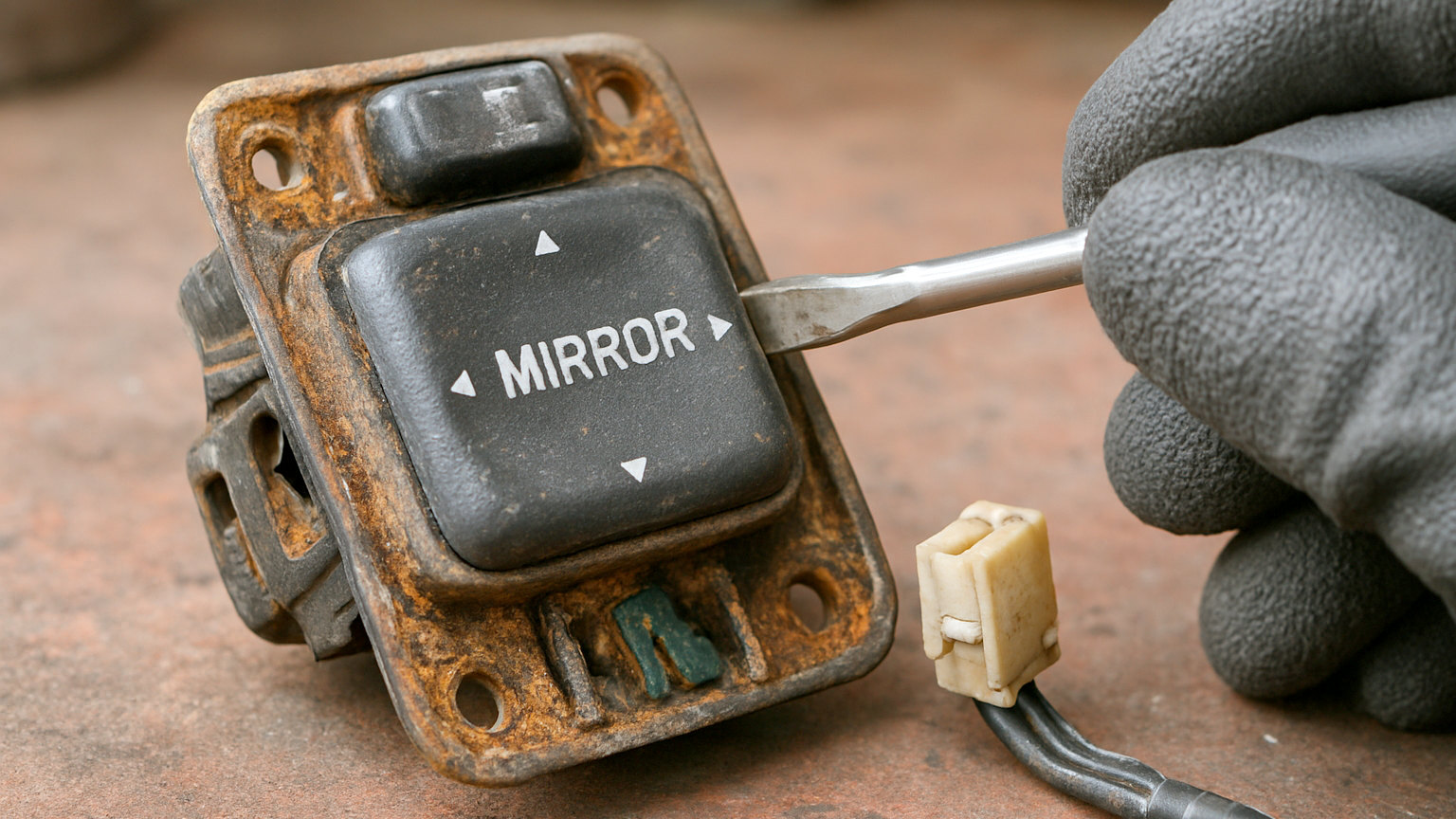
An electric mirror contains a pair of small motors, one for each axis, driving the glass on a ball mounting. A selector switch chooses which mirror is being adjusted and a joystick or four way control decides the direction. It is a simple arrangement, and when it stops working the fault is usually in the switch or the wiring rather than in the motors themselves.
Does one mirror work and not the other?
That is the most useful observation available. If one adjusts normally, the joystick and the supply are fine, so the fault lies in the selector switch position for the dead side, the wiring to that door, or the mirror itself. If neither works, attention moves to the switch assembly, its fuse and its power supply.
Why do selector switches fail?
Because they are used less than window switches and therefore accumulate corrosion on contacts that are rarely wiped clean by use. On many cars the mirror control is combined with the window switches in a single unit, so a spilled drink takes out both. Cleaning the contacts sometimes restores it, and replacement is usually inexpensive.
What if it moves in one axis only?
Then one of the two motors or its circuit has failed, since each axis has its own. That narrows it to the mirror assembly rather than the switch, because a switch failure would normally affect both directions. Mirror motors are small and not usually available separately, so the glass and motor assembly is generally replaced as a unit.
Could it be the door loom?
Very possibly, and it is the cause most often missed. The wiring passes through a flexible conduit between the door and the body, flexing every time the door opens, and individual wires fatigue and break inside the insulation. If the mirror, the window and the speaker on the same door have all stopped, a broken loom is far more likely than three separate faults.
What about folding mirrors?
They have a third motor for the folding action, and it is the one most likely to fail. Folding mirrors are frequently knocked in car parks, and forcing a powered mirror by hand strips the plastic gears inside. The symptom is a whirring or clicking with no movement, and the fix is usually a replacement mechanism or a repair kit of gears.
Can a mirror be adjusted by hand?
The glass usually can, gently, by pressing on its edges to tilt it on the ball mounting. It is worth doing carefully rather than forcing it, since the motors resist movement and the glass is bonded to a plastic backing that cracks. On a car with a failed motor it is a legitimate way of setting the mirror and leaving it.
Is the glass replaceable separately?
Frequently, and it is inexpensive. Most mirror glass clips onto a backing plate and can be prised off with careful pressure, though it is easy to crack. Heated versions have two spade connectors to transfer. Replacing the glass alone is far cheaper than a complete mirror assembly, which is worth knowing if the damage is only to the glass.
Does it matter for the MOT?
The mirror must be present, secure and provide an adequate view, but there is no requirement for the electric adjustment to work. A mirror set correctly by hand and left alone will pass without comment. What fails is a mirror that is broken, missing, insecure or so damaged that the view is inadequate.
What should you check first?
Whether the other mirror works, since that immediately separates a switch fault from a mirror fault. Then whether other functions on the same door still operate, which points at the loom. Then the fuse. Those three observations take two minutes and they narrow the cause before anything is removed.
If both mirrors have stopped and the windows still work, the selector switch is the strongest suspect, since the two share a power supply on most cars.


