
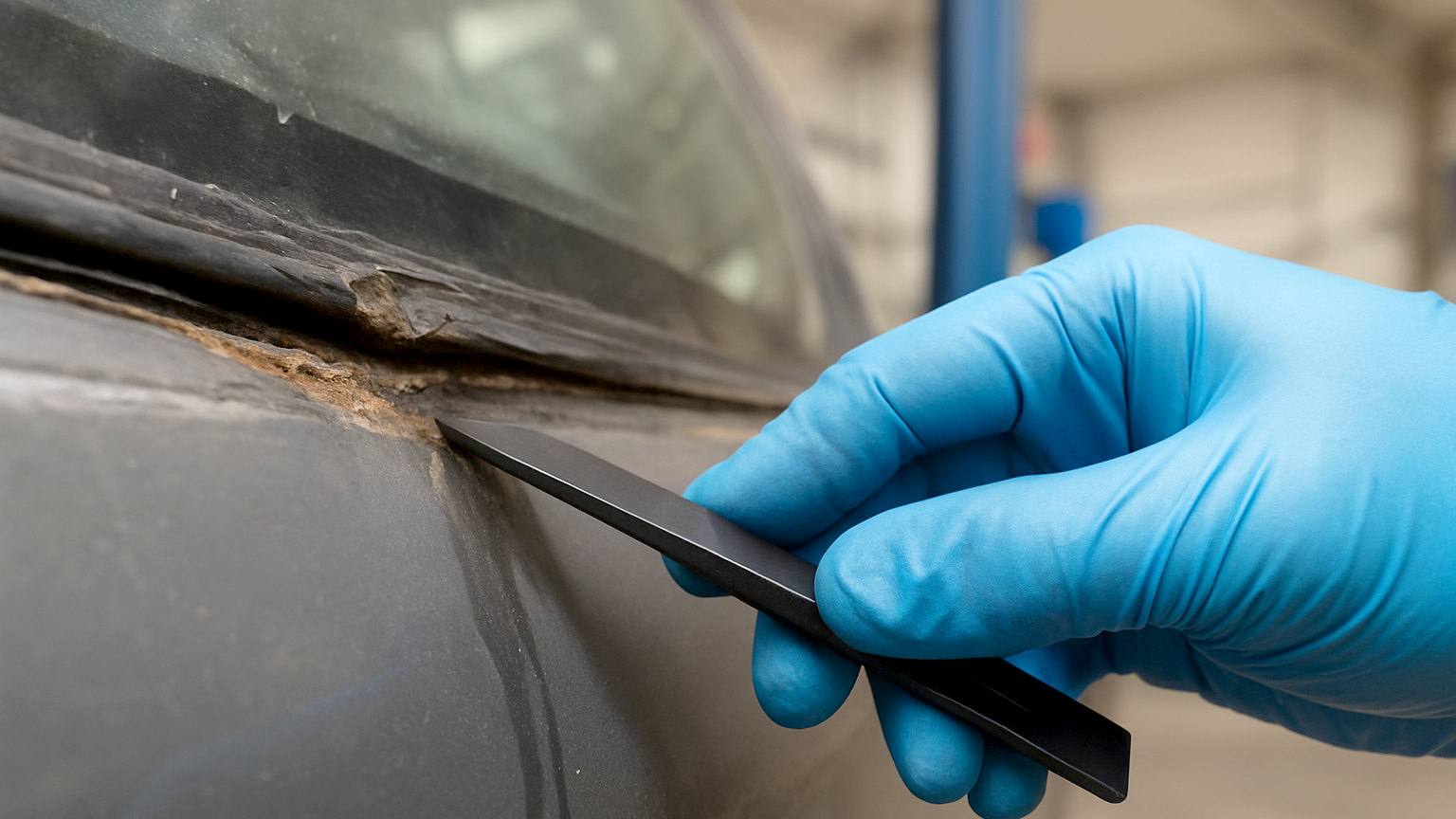
Windscreen leaks are less common than blocked drains and considerably more awkward to put right. On any car built in the last few decades the screen is bonded directly to the body with adhesive rather than held by a rubber gasket, and that bond is structural as well as watertight. When it leaks, the water usually appears at the top of a pillar and runs down into the footwell.
How are modern screens fitted?
With a bead of polyurethane adhesive applied to a primed flange on the body and to a primed border on the glass. Once cured it is extremely strong, contributing meaningfully to the rigidity of the shell and supporting the roof in a rollover. It is not a seal that can be adjusted or tightened; it either bonds properly or it does not.
Why do bonded screens leak?
Most often because they have been replaced and the preparation was inadequate. If the old adhesive was not trimmed to the correct height, if the primer was omitted, or if the flange had corrosion that was not treated, the new bond will have gaps. A screen that started leaking within a year of replacement is almost certainly reporting the fitting.
What about corrosion?
It is the other common cause and the more serious one. Rust starting under the bonding, frequently where the flange was scratched during a previous replacement, lifts the adhesive and creates a path for water. Simply resealing over it achieves nothing, since the corrosion continues underneath. Proper repair means removing the screen, treating the metal and rebonding.
Do older cars differ?
Considerably. Cars with a rubber gasket holding the screen in place can genuinely have a failed seal, since the rubber hardens and shrinks with age. Those are sometimes improved with a suitable sealant worked into the gasket, which is a legitimate repair on a classic. On a bonded screen the same approach does not work.
How do you test for it?
With a helper inside using a torch while water is run gently along the base of the screen and then up each side, one area at a time. Removing the A pillar trim first makes a real difference, since water entering at the top of the screen runs down inside that pillar and is invisible with the trim in place.
Where does the water appear?
Usually in a footwell, having run down inside a pillar, and frequently along a wiring loom. That is why the wet patch is so misleading: a leak at the top corner of the screen can produce a soaked carpet a metre away with nothing wet in between. Following the loom is often the best guide to the entry point.
Can it be repaired without removing the screen?
Occasionally, where the gap is at an accessible edge and there is no corrosion, a specialist can inject adhesive into it. It is worth asking about since it costs far less than a replacement. Where corrosion is present or the bond has failed over a length, the screen has to come out, which usually means a new screen since removal often breaks it.
Is it worth claiming?
Where a screen was replaced recently and has begun to leak, the fitter should put it right without charge, and it is worth raising promptly and firmly. Reputable firms guarantee their bonding. Where the leak follows corrosion on an older car, that is a repair rather than a warranty matter and it should be treated as such.
Either way, establishing when the screen was last replaced is the first useful question, since it frequently answers the whole matter.
What does that involve?
A new screen, the flange treated and primed, fresh adhesive and a curing period before the car can be driven. On a vehicle with driver assistance systems it also means camera recalibration afterwards. It is a substantial job, which is why eliminating drains and seals first is worth the effort before concluding the screen is at fault.


