
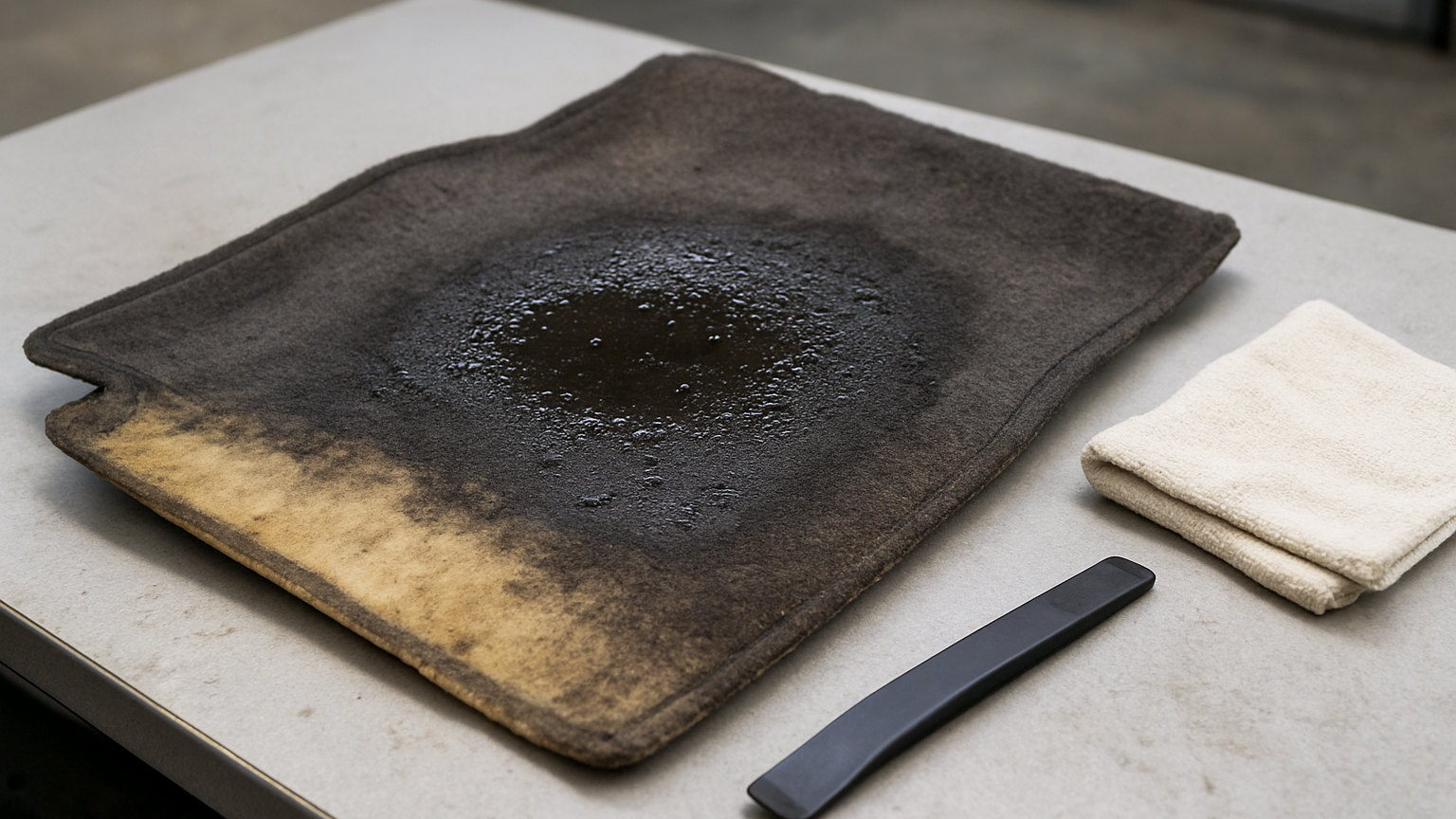
The passenger footwell is the single most common place to find water in a car, and that is no coincidence. Three separate systems drain through or near that area, and any of them can put water on the carpet. Establishing which fluid you are dealing with is therefore the first step, and it takes a clean white tissue and a moment.
How do you identify the fluid?
Press a white tissue firmly into the wettest area and look at it. Coolant is coloured, feels slightly slippery and smells distinctly sweet. Air conditioning condensation is completely clear and odourless. Rainwater is also clear but frequently carries dirt with it, so it marks the tissue grey or brown. Those three descriptions cover nearly every case.
What if it is coloured and sweet?
Then it is coolant and the heater matrix is leaking. It usually comes with an oily film on the inside of the windscreen that smears when wiped, persistent misting and a coolant level that keeps falling. It is the most expensive of the three possibilities, since the matrix sits behind the dashboard, and it should not be left because coolant is toxic.
What if it is clear and appears in warm weather?
That points at the air conditioning drain. The evaporator produces a considerable quantity of condensation, which normally exits through a tube beneath the car. When that tube blocks with debris, the water backs up in the housing and overflows into the footwell. The clue is that it appears when the air conditioning is used rather than after rain.
Can the drain be cleared?
Usually, and it is a cheap job. The tube emerges through the bulkhead beneath the car, and gently probing it with soft trimmer line or blowing it through with low pressure air clears the blockage. Care matters, since forcing something sharp up the tube can damage the housing. Once cleared, the water usually pours out immediately.
What if it appears after rain?
Then the scuttle area is the prime suspect. The channel beneath the windscreen collects rainwater and drains it away through tubes at each end, and it also houses the cabin filter and the fresh air intake. Leaves and debris block those drains, the channel fills, and water overflows into the filter housing and down into the footwell.
How do you check the scuttle?
Open the bonnet and look at the area at the base of the windscreen, lifting any plastic covers or removing the wiper arms if necessary. Leaves, pine needles and moss accumulate there over years, particularly on a car parked under trees. Clearing it out and flushing water through to confirm the drains flow freely is straightforward and worth doing annually.
Could it be the door?
Possibly, and it produces damp at the outer edge of the footwell rather than in the middle. Water is meant to run down inside the door and out through drain holes at the bottom. When those block, the door fills and water spills over the inner sill. Clearing them with a piece of wire takes minutes and prevents corrosion as well.
What order should you check?
Identify the fluid first, since that immediately eliminates two of the three. Then check the drain associated with whichever it turns out to be. Only if the fluid is clear and unexplained by either drain is it worth moving on to seals and grommets, which are considerably more time consuming to test.
How urgent is it?
More than it appears, since modules and connectors are frequently mounted low in that footwell and water reaching them produces electrical faults that cost far more than the leak itself. A damp carpet also produces persistent misting, which is a visibility problem in winter. It is worth dealing with promptly rather than waiting for drier weather.
Lifting the carpet to let air beneath it in the meantime slows the damage, even if the repair has to wait a week or two.


