
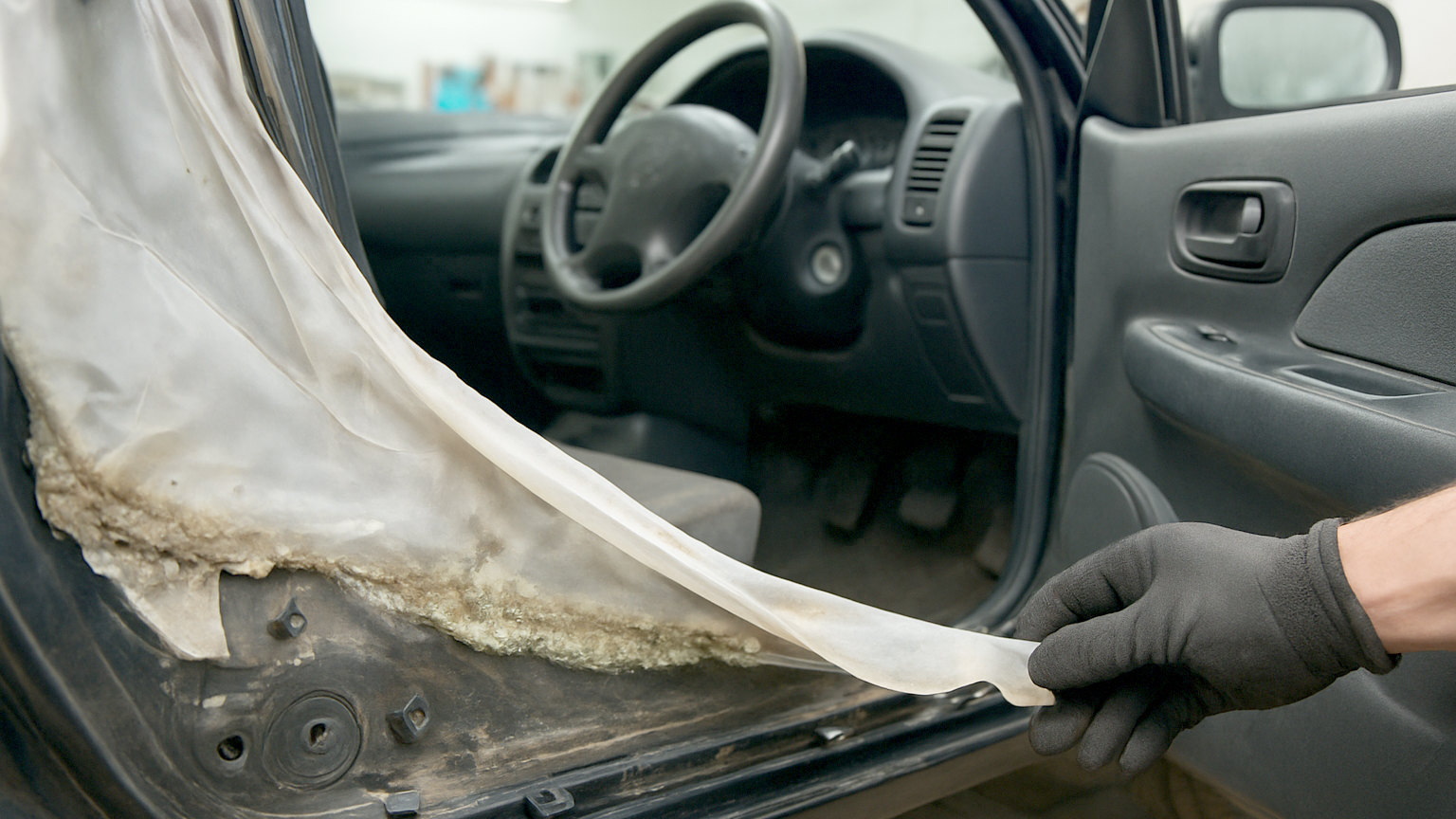
A leak that produces a soaked carpet after a motorway journey and nothing at all during an hour of hose testing on the driveway is genuinely frustrating. It is also entirely explicable, because a moving car behaves quite differently from a stationary one. Three things change, and any of them can open a path that simply is not there when the car is parked.
What does body flex do?
Every bump and camber change twists the shell slightly, and that movement opens and closes seams and gaps that sit still when the car is parked. A seam sealer that has cracked, or a bonded screen with a marginal edge, may be watertight at rest and admit water as the body works. It is why some leaks appear only on rough roads.
How does cabin pressure matter?
A moving car develops pressure differences across its body, and the ventilation system pushes air in while extractor vents let it out. If those extractor vents are blocked, the cabin becomes slightly pressurised, which can force water back through a drain rather than letting it out. Conversely, low pressure at certain points can draw water in through a gap.
Where are the extractor vents?
Usually behind the rear bumper or in the rear quarter panels, covered by flap valves that let air out and not in. They block with debris and their flaps stick, and the consequence is a car that feels stuffy, whose doors are hard to close, and which can push water back through drains. Checking them is quick and rarely done.
Does speed drive water upwards?
Considerably. At motorway speed, spray from the road is driven up the sides and underside of the car with real force, reaching places that gravity alone never would. A grommet in the floor or a seal on the underside of a door can be perfectly adequate against falling rain and quite unable to resist water being pushed upwards at seventy.
How do you test for it?
By driving the car in the wet with a helper looking for the water arriving, which is more practical than it sounds on a quiet road. Alternatively, drive through a car wash with somebody inside, or spray water while a helper pushes and rocks the body to simulate flex. Talcum powder along suspect seams shows where water has passed.
Which leaks behave this way?
Windscreen and rear screen bonding, since the glass is structural and flexes with the shell. Seam sealer along the roof and floor joints. Door seals that only fail under aerodynamic pressure. Floor grommets, which are attacked by spray from below. And blocked extractor vents, which turn a working drain into a route inwards.
Does the direction of rain matter?
Frequently, and it is a useful clue. A leak that only appears when driving into heavy rain, or with wind from one side, is describing a gap on that face of the car. Noting the conditions each time it happens builds a pattern, and that pattern is often more useful than any single test session.
What should you record?
Speed, road type, wind direction, how heavy the rain was and where the water appeared. Those details turn an intermittent leak into something a workshop can reproduce. It is also worth mentioning any recent bodywork, windscreen replacement or accident repair, since those are the most common origins of a leak that only shows itself on the move.
Is it harder to fix?
Usually, since finding it is most of the work and a dynamic leak resists the ordinary hose test. Once located, the repair itself is often no more involved than any other. That is why describing the conditions accurately is worth so much: it is the difference between an hour of testing and an afternoon of guessing.
Keeping a short note each time it happens builds that description without any effort, and it is far more reliable than recalling it weeks later.


