
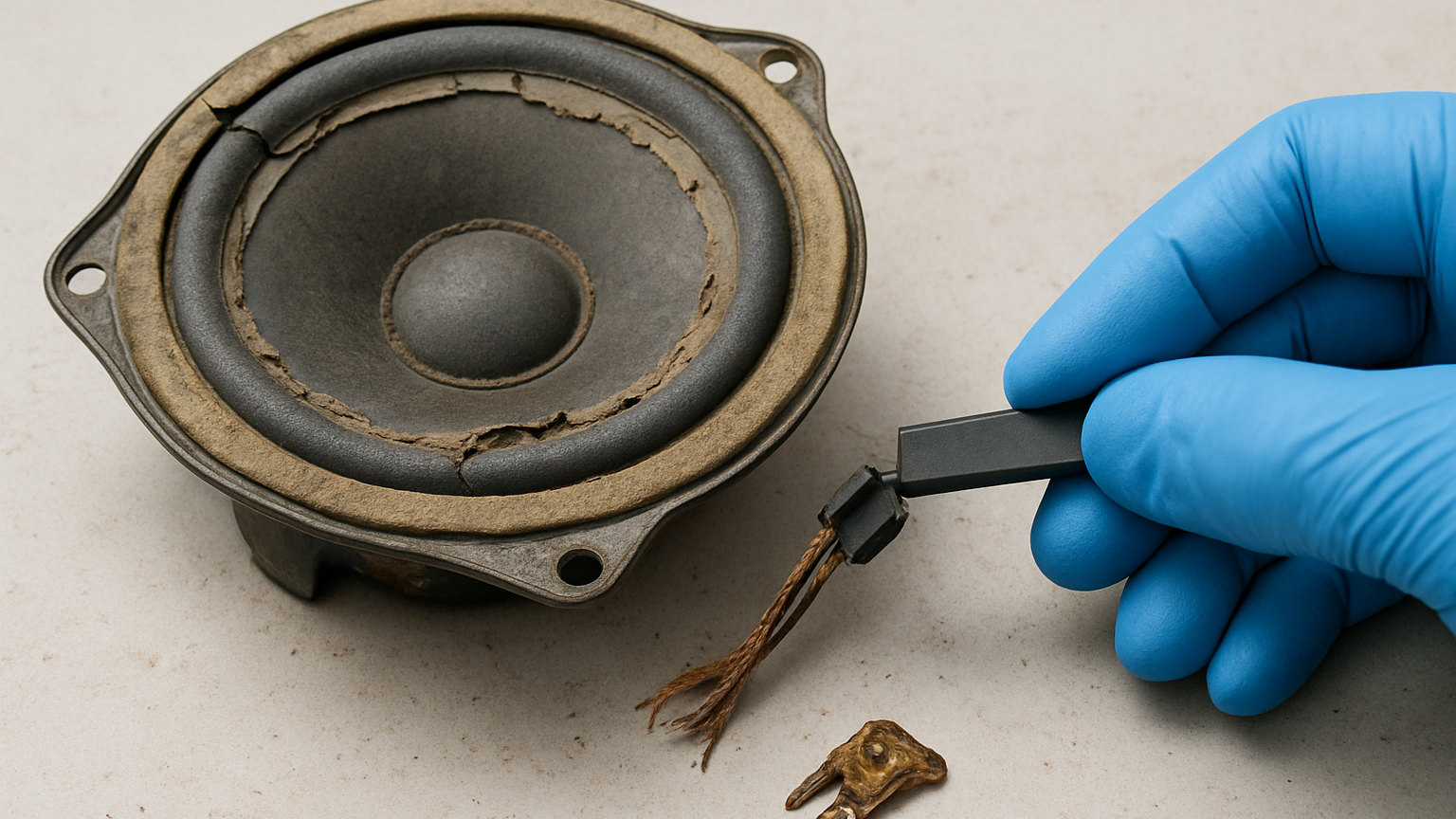
Car speakers work in conditions no domestic speaker would tolerate: mounted in a door that is damp by design, subjected to constant vibration, and exposed to temperature swings from below freezing to well above thirty degrees. That environment explains most of the ways they fail, and the symptoms usually point clearly at which failure you have.
What does crackling indicate?
Usually a damaged cone or a perished surround, the flexible ring joining the cone to the frame. Foam surrounds deteriorate over years and eventually crumble, so the cone no longer moves squarely and the sound distorts. It is a physical failure and it worsens progressively rather than coming and going.
Why does one speaker cut out?
Frequently the door wiring loom. The wires pass through a flexible conduit between the door and the body and flex every time the door opens, and individual conductors eventually fatigue and break inside the insulation. A speaker that cuts out as the door is opened or closed, or on rough roads, is describing exactly that.
What if several functions have stopped?
Then the loom is almost certainly at fault rather than the speaker. If the window, the mirror, the lock and the speaker on the same door have all failed, one broken loom explains all four. It is a far more likely explanation than four separate components failing at once, and it points the repair somewhere specific.
Can water damage them?
Certainly. Speakers are mounted low in the door where water collects if the drain holes block, and the cone and surround absorb moisture. A speaker that has been sitting in water will sound dull and eventually fail. Keeping the door drains clear protects the speakers as well as the regulator and the lock mechanism.
What does distortion at volume mean?
Either the speaker is being driven beyond its capability, which is common with aftermarket amplification, or the voice coil is damaged. A speaker that sounds fine quietly and distorts as volume rises is usually reporting a coil that has been overheated at some point. That damage is permanent and replacement is the answer.
Could it be the amplifier?
On cars with a separate amplifier, frequently. It is often mounted under a seat or in the boot, which puts it exactly where water goes if there is a leak. Symptoms include several speakers failing at once, sound cutting out when hot, or a system that works briefly and then goes quiet. Fault codes sometimes identify it.
Are aftermarket speakers a good idea?
Frequently, since replacements often outperform the originals for modest money, and adapter plates make fitting straightforward on most cars. What matters is matching the impedance and power handling to the system, and on vehicles with an amplifier or active crossovers, checking compatibility before buying rather than afterwards.
How difficult is replacement?
Moderate. The door card comes off, the old speaker unscrews and the new one connects, usually with an adapter. The awkward part is removing the door card without breaking clips, and refitting the weather membrane properly afterwards since it keeps water out of the cabin. It is a realistic afternoon job on most cars.
What should you check first?
Whether the fault follows the speaker or the source, by using the balance and fade controls to move the audio around the car. A crackle that stays in one corner is that speaker or its wiring; one that follows the sound wherever it is sent points at the head unit or the source. That single test takes a minute and it separates the two possibilities cleanly.
It is also worth trying a different source, since a crackle present on the radio and absent on a phone connection points at reception rather than at the speakers, and that saves removing a door card unnecessarily.
Speakers are also one of the few interior components where an upgrade genuinely improves the car every day, so a failure is sometimes worth treating as an opportunity.


