
A reversing camera that has stopped working is more than an inconvenience on a car whose rear visibility is poor, and on many vehicles it is now the primary means of seeing what is behind. The failures follow a small number of patterns, and the position of the camera at the back of the car explains most of them.
What does a black screen indicate?
Either the camera is not producing an image or the signal is not reaching the screen. If the display switches to the camera view but shows black, the system knows reverse is selected and the camera is the problem. If nothing happens at all when reverse is engaged, the signal telling the system to switch has not arrived.
Why does water get in?
Because the camera sits in the tailgate or the bumper, exposed to road spray, pressure washers and salt. The seal around the lens hardens with age, and moisture works inside. The classic symptom is condensation visible inside the lens on a cold morning, followed eventually by a milky image and then no image at all.
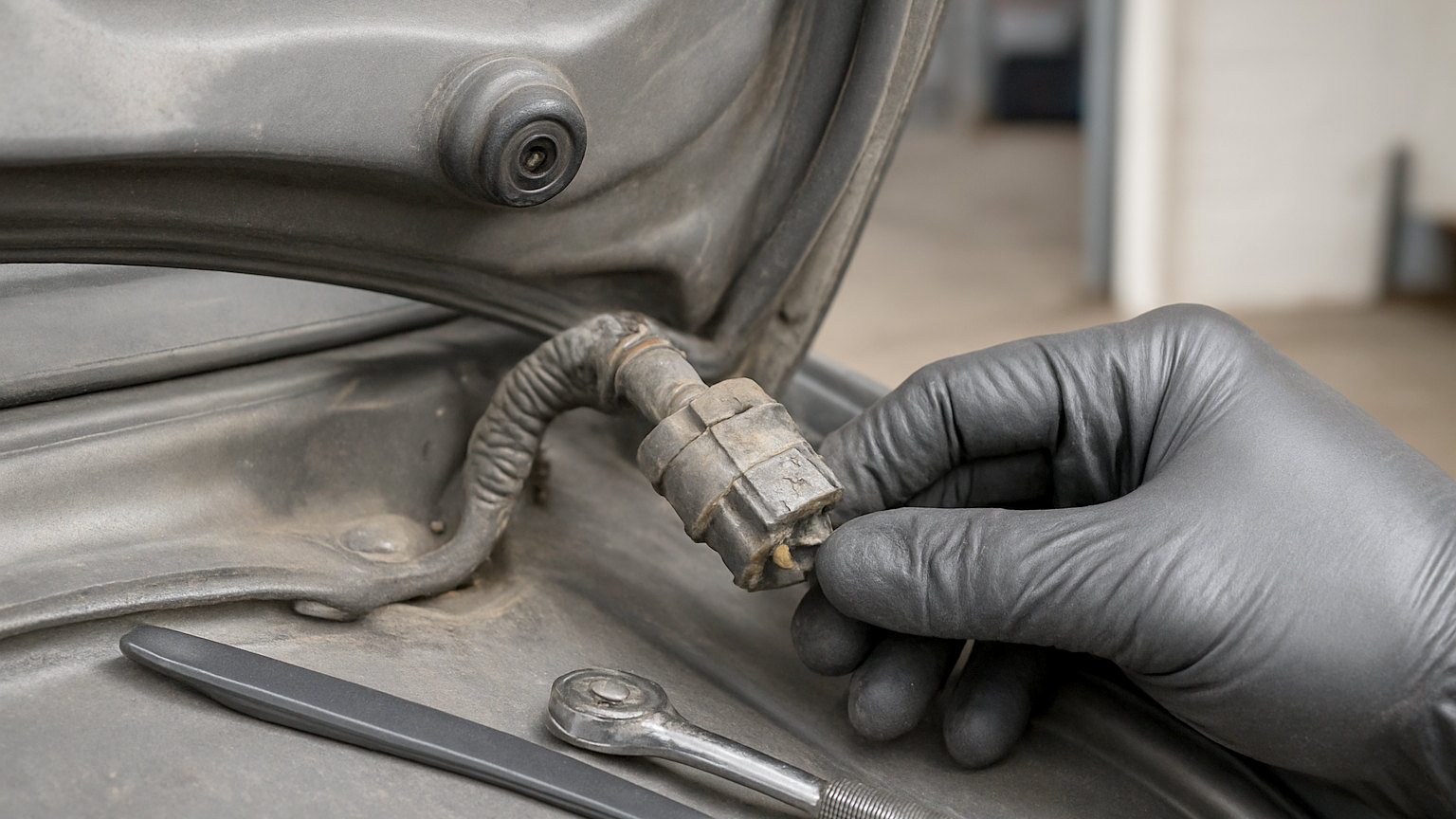
Is the tailgate loom involved?
Frequently, and it is the cause people miss. The wiring passes through a flexible conduit between the body and the tailgate, bending through a large arc every time the boot is opened. Individual wires fatigue and break inside the insulation. If the rear wiper, a number plate light and the camera have all stopped, one broken loom explains all three.
How do you check that?
Peel back the rubber conduit between the tailgate and the body and flex the loom gently while somebody watches the screen with reverse selected. An image that flickers or appears as the wires are moved confirms a break. The damage is usually within a few inches of where the loom enters the conduit, and it is repairable by soldering in a new section.
Could it be the reverse signal?
Yes. Most systems trigger from the reversing light circuit, so a failed reverse light switch means the camera never activates. The useful test is whether the reversing lights themselves come on. If they do not, the switch or its wiring is the fault and the camera may be perfectly healthy.
Can the lens be cleaned?
Externally, certainly, and it is worth doing regularly since road film builds up quickly on a rear camera and produces a hazy image people assume is a fault. Internal condensation cannot be cleaned without opening the unit, and on most cameras that means replacement since they are sealed assemblies rather than serviceable ones.
Are aftermarket replacements viable?
For many vehicles, yes, and at a fraction of the dealer price. What matters is matching the signal type and the connector, and confirming the guidelines and any parking sensor overlay will still work. On cars where the camera integrates with a parking system or driver assistance, a genuine part is frequently the safer choice.
Does it matter for the MOT?
A reversing camera is not a test item, so a failed one will not cause a problem. What matters practically is that on many modern cars rearward visibility is genuinely poor without it, so reversing safely becomes considerably harder. That is a good reason to repair it rather than treating it as a lost convenience.
Can guidelines be recalibrated?
On many systems the guidelines are fixed overlays, and on others they steer with the wheels and are generated by the module. Where they appear misaligned after a camera replacement or a bumper repair, a calibration procedure usually exists and needs a diagnostic tool. Guidelines that point somewhere other than where the car actually goes are worse than none at all, so it is worth having them checked after any work at the rear.
On cars where the camera also feeds a driver assistance system, a replacement may need coding to the vehicle rather than simply plugging in, which is worth confirming before ordering an aftermarket part.


