
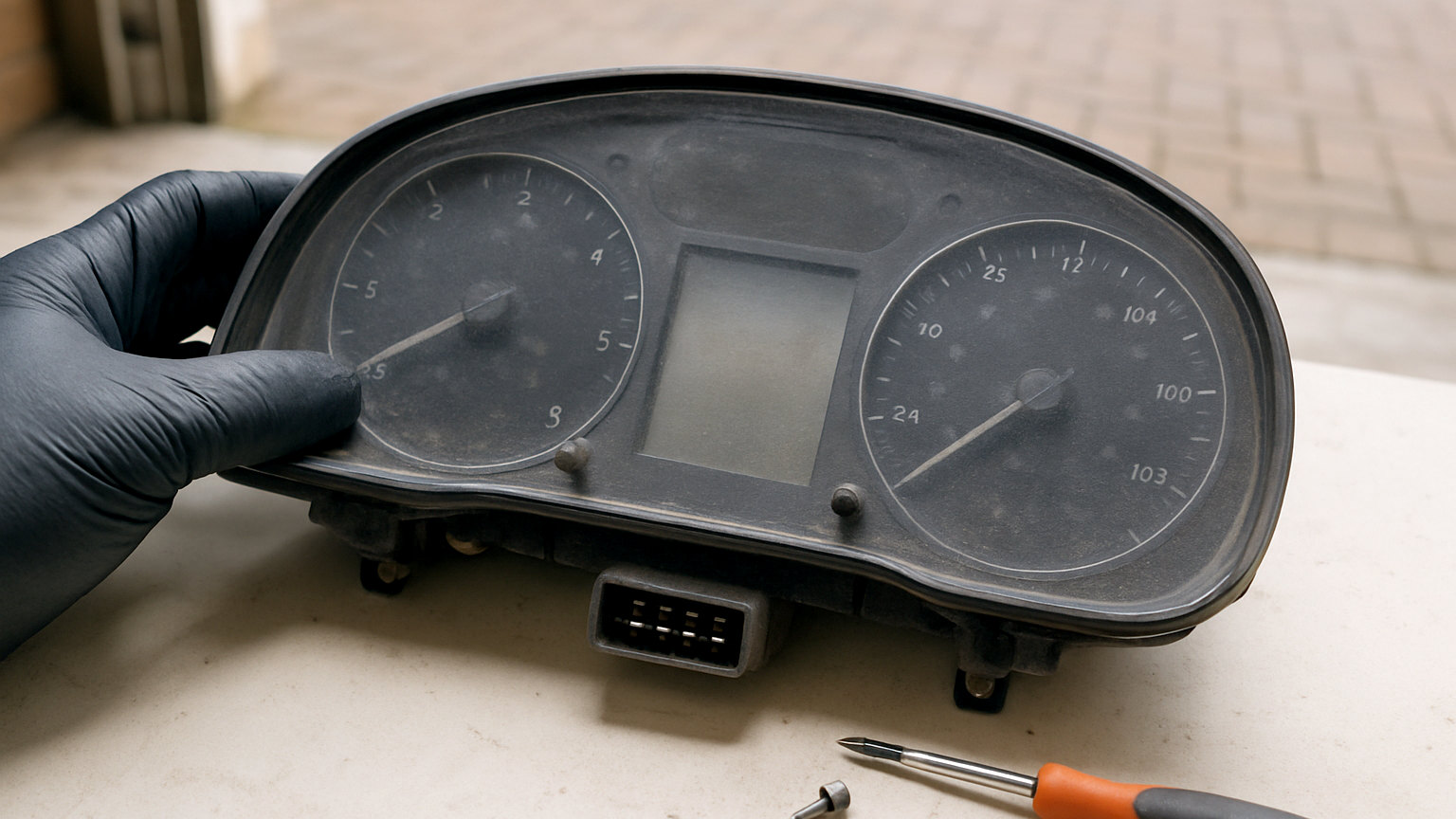
A dashboard display that flickers, dims or fades in and out is unsettling because the instrument cluster is where you look for everything else that might be wrong. The useful distinction is whether the flickering follows engine speed, which points at the charging system, or whether it is independent of it, which points at the cluster or its dimmer circuit.
Does it change with engine speed?
The most informative test. Watch the display while revving the engine gently with the car stationary. Brightness that rises and falls with the revs is following the charging voltage, and that points at the alternator or a poor connection rather than at the display. Flickering that is entirely unrelated to engine speed points inside the cluster.
What does the alternator have to do with it?
A failing regulator produces unstable voltage, and every light on the car responds to it. If the headlights and the interior lights also pulse, the charging system is the obvious suspect. It is worth checking properly, since an unstable supply damages electronic modules over time and is a considerably more serious fault than a dim display.
Could it be the dimmer?
Frequently. The instrument brightness is controlled by a rheostat or a digital dimmer, usually adjustable by a wheel or a menu setting, and those wear. A cluster that suddenly appears very dim at night is often reporting a dimmer that has been turned down or a control that has failed, and it is worth checking the setting before anything else.
Why does it dim when lights are switched on?
Because most cars automatically reduce instrument brightness when the exterior lights are on, so the display does not dazzle at night. That is designed behaviour. If the reduction is too great, the dimmer setting is the answer. It catches people out on cars where the lights come on automatically in daylight during poor weather.
What about a failing backlight?
Older clusters used bulbs which simply fail, producing dark patches. Modern ones use light emitting diodes, which degrade more gradually and unevenly, so the display fades or develops a coloured cast. On some vehicles the backlight is a known weak point and specialist repairers replace it for far less than a new cluster costs.
Can solder joints be the cause?
Genuinely, and it is a well documented failure on several models. Vibration and heat cycling crack the solder around the connector pins on the cluster circuit board, producing intermittent behaviour that changes when you press the dashboard or go over a bump. Resoldering is a straightforward specialist repair and it is far cheaper than replacement.
Does a cluster need coding?
Usually, if replaced. The cluster holds the mileage and is paired to the immobiliser on many cars, so a replacement has to be programmed to the vehicle. That is why repairing an existing cluster is frequently preferable to fitting a used one, and why the mileage on a replacement instrument pack is a legitimate concern when buying a car.
What should you check first?
The dimmer setting, since it is free and it is a common answer. Then whether the flickering follows engine speed, which separates a charging fault from a cluster fault. Then have the battery and alternator tested. Only when those are clear is it worth approaching a cluster specialist, and arriving with that information makes the diagnosis quicker.
Is it an MOT concern?
Indirectly. Warning lamps must be visible and working, so a cluster whose backlight has failed to the point where the lamps cannot be seen is a problem, and a display that is too dim to read the speedometer at night is clearly unsatisfactory. A slightly uneven backlight is cosmetic. The practical test is whether you can read everything you need to at night.
A cluster that has become noticeably dimmer over a couple of years is worth addressing before the winter, since that is when the shortfall is most obvious.


