
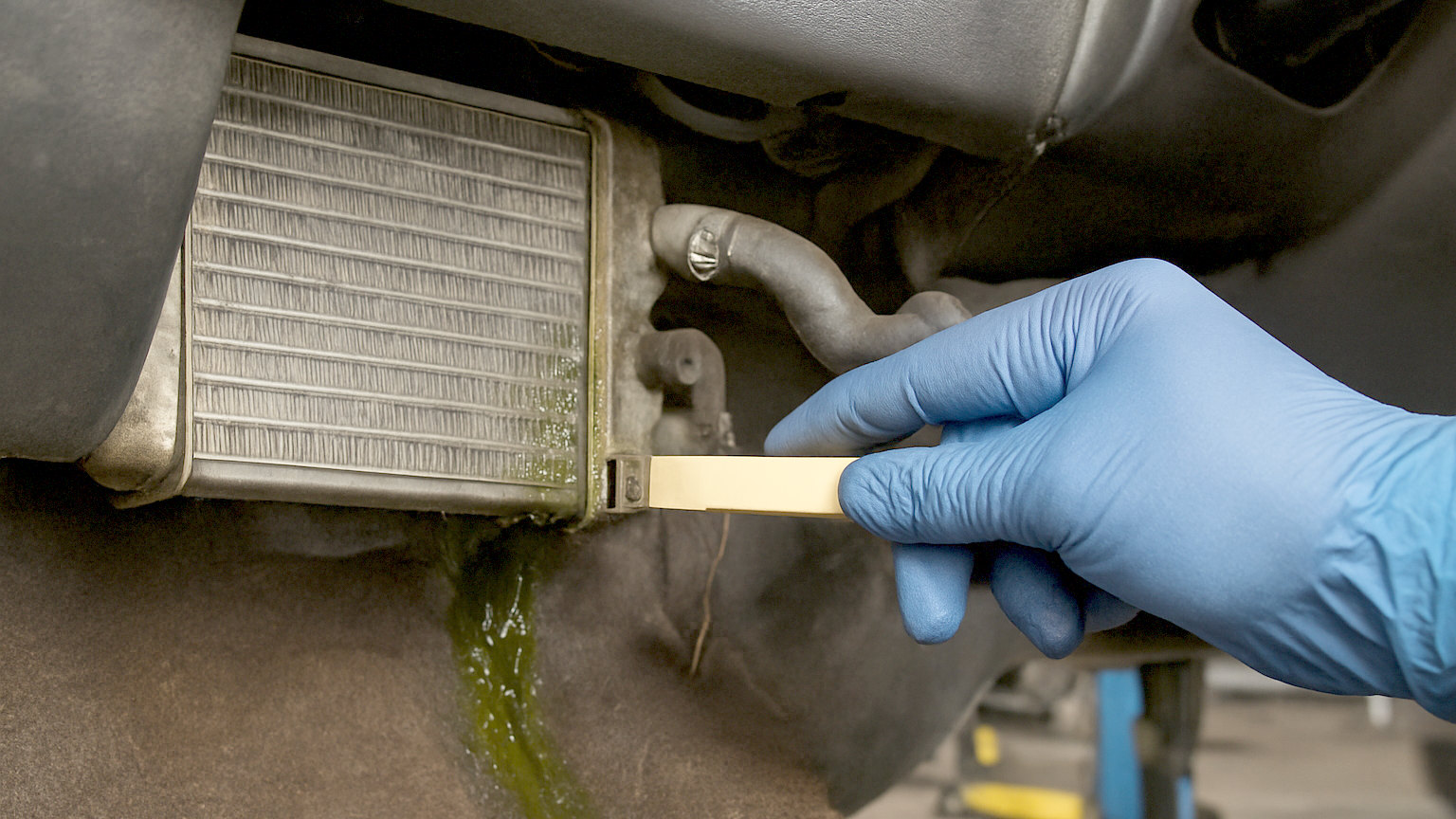
The heater matrix is essentially a small radiator hidden behind the dashboard, plumbed into the engine cooling system. Hot coolant flows through it and the blower pushes cabin air across its fins, which is where every bit of warmth inside the car comes from. Its position makes it awkward to reach, and that single fact governs almost everything about what a failure costs.
How does it fail?
In two ways. It blocks, when corrosion products or sludge restrict its narrow passages so coolant cannot flow through properly, which produces poor or no heat. Or it leaks, when corrosion perforates the tubes or a joint fails, which allows hot coolant to escape inside the car. The second is the more serious and the more expensive.
What are the signs of a leak?
A damp or soaking passenger footwell, often first noticed as a wet carpet with no rain to explain it. A sweet smell inside the car, which is the distinctive scent of ethylene glycol. An oily film on the inside of the windscreen that smears when wiped. Persistent misting that will not clear. And a coolant level that keeps falling with no leak visible under the bonnet.
How do you tell it from a water leak?
By the fluid itself. Coolant is coloured, feels slightly slippery and smells sweet, while rainwater is clear and odourless. Dabbing the carpet with a white tissue usually shows the colour. A leak that appears regardless of the weather, and worsens as the engine warms, points at the matrix rather than at a blocked drain or a failed seal.
What causes the corrosion?
Neglected coolant, overwhelmingly. Antifreeze contains corrosion inhibitors that deplete over time, and once they are exhausted the coolant becomes mildly acidic and attacks the thin metal of the matrix from inside. Mixing incompatible coolant types accelerates it. Topping up with plain water dilutes the inhibitors further. It is one of the clearest cases where a cheap fluid change prevents an expensive repair.
Can a blocked matrix be flushed?
Sometimes, and it is worth trying before committing to replacement. The hoses are disconnected and clean water is flushed through in both directions, occasionally with a proprietary cleaner. It works where the restriction is sludge rather than corrosion damage, and it costs a fraction of a replacement. It will not help a matrix that is leaking.
Why is replacement so expensive?
Because on most cars the dashboard has to come out, and on many the steering column, airbags, wiring and centre console with it. The part itself is often modest and the labour can run to a full day or more. That combination surprises owners, and it is why the quote for a small radiator can approach the cost of a clutch.
Are bypass repairs sensible?
As a temporary measure only. Joining the two heater hoses together bypasses the matrix, stops the leak and removes all cabin heat, which is workable in summer and unacceptable in winter with no demisting. It is a way of keeping a car usable while arranging the proper repair, and it should not be treated as a solution.
Is coolant on the carpet a health concern?
It is worth taking seriously. Ethylene glycol is toxic if ingested, which matters with children or pets in the car, and the vapour in an enclosed cabin is unpleasant. The carpet and underlay should be cleaned or replaced rather than simply dried, since coolant soaks in and the smell persists indefinitely otherwise.
How do you avoid it happening?
Change the coolant at the interval the manufacturer specifies, using the correct type rather than whatever is on the shelf, and top up with premixed coolant rather than plain water. That single habit does more to protect the matrix, the radiator and the water pump than anything else, and it costs a fraction of what any of them cost to replace.
If a matrix has already failed, ask what condition the coolant was in when it came out, since that often explains why and tells you what to do differently afterwards.


