
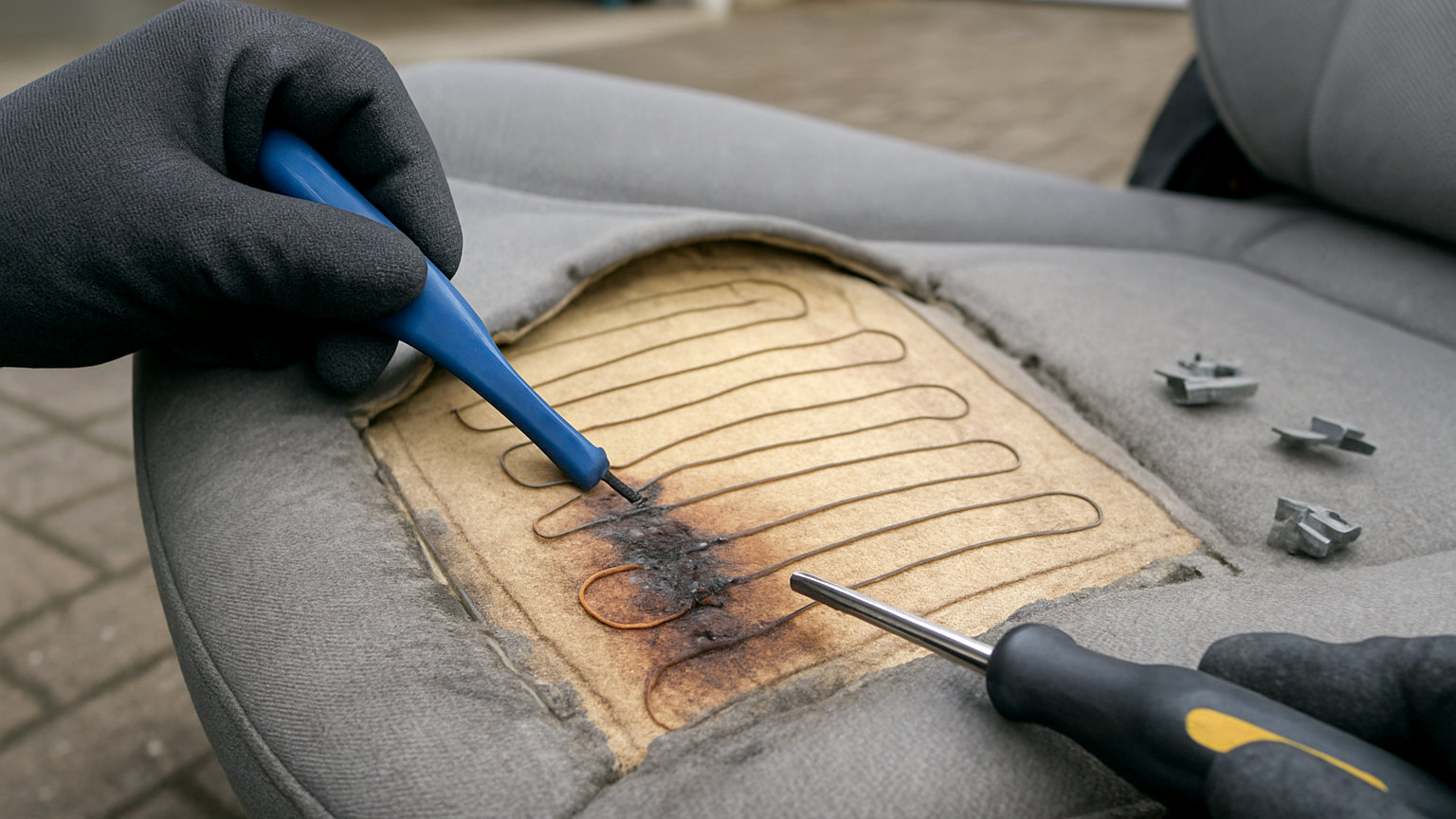
Heated seats work through a thin element of resistive wire or conductive fabric sewn into the seat base and backrest, warmed by current and regulated by a thermostat or sensor. The element sits directly beneath a surface that flexes and compresses every time someone sits down or slides across, which explains almost everything about how and why they fail.
Why does the driver seat fail first?
Because it is used far more than any other, and because getting in and out involves sliding across the outer bolster, which flexes the element repeatedly at the same point. The base almost always fails before the backrest for the same reason. A car where the driver seat heater has died while the passenger one still works is following the expected pattern.
What are the common failures?
A broken element, usually a single fracture in the wire that opens the circuit. A failed thermostat or temperature sensor, which either prevents the element switching on or lets it overheat. A chafed wiring loom where it passes under the seat and flexes as the seat slides. And the switch or its module, particularly on cars where the control is part of a touchscreen.
What should you check first?
The fuse, since heated seats draw meaningful current and share a circuit on many cars. If both seats have stopped working simultaneously, a fuse or a relay is far more likely than two elements failing at once. If only one has stopped, the fault is specific to that seat and the fuse is probably fine.
Is the wiring under the seat a common cause?
Very. The loom runs under the seat and has to flex through the full range of seat travel, and over years it chafes against the frame or is pinched by items pushed under the seat. It is worth inspecting before anything is dismantled, since a broken wire in the loom is far easier to repair than an element inside the upholstery.
Can the element be repaired?
Yes, and repair kits exist. The seat cover has to be removed, the break located, usually with a multimeter, and the wire joined or a replacement element fitted. It is fiddly rather than difficult, and the awkward part is removing and refitting the cover without damaging it or the side airbag that many seats contain.
Is the airbag a concern?
It genuinely is. Most modern front seats contain a side airbag in the outer bolster, so any work involving removing a seat or its cover requires the battery disconnected and time allowed for the system to discharge. Disturbing airbag wiring can also trigger a fault light. It is a real reason to think carefully before dismantling a seat at home.
Why does it sometimes work intermittently?
Because a partially broken element or a chafed wire can make contact when the seat is loaded in a particular way and lose it in another. Heat that works when you first sit down and fades, or that comes and goes on rough roads, is describing an intermittent connection rather than a failed component. Those are harder to find and usually in the wiring rather than the element.
Is a seat heater a fire risk?
Properly functioning ones are not, since the thermostat limits the temperature. A failed thermostat combined with a damaged element is a different matter, and there have been manufacturer recalls on this. Any seat that becomes uncomfortably hot, smells of burning, or produces a scorch mark should be switched off and inspected rather than used.
Is it worth repairing?
That depends on the car and how much you use it. On a vehicle being kept, a seat heater is a genuine comfort in a British winter and the element or wiring repair is usually modest once access is achieved. On an older car where the seat would have to come out and the cover off, many owners reasonably decide to live without it.


