
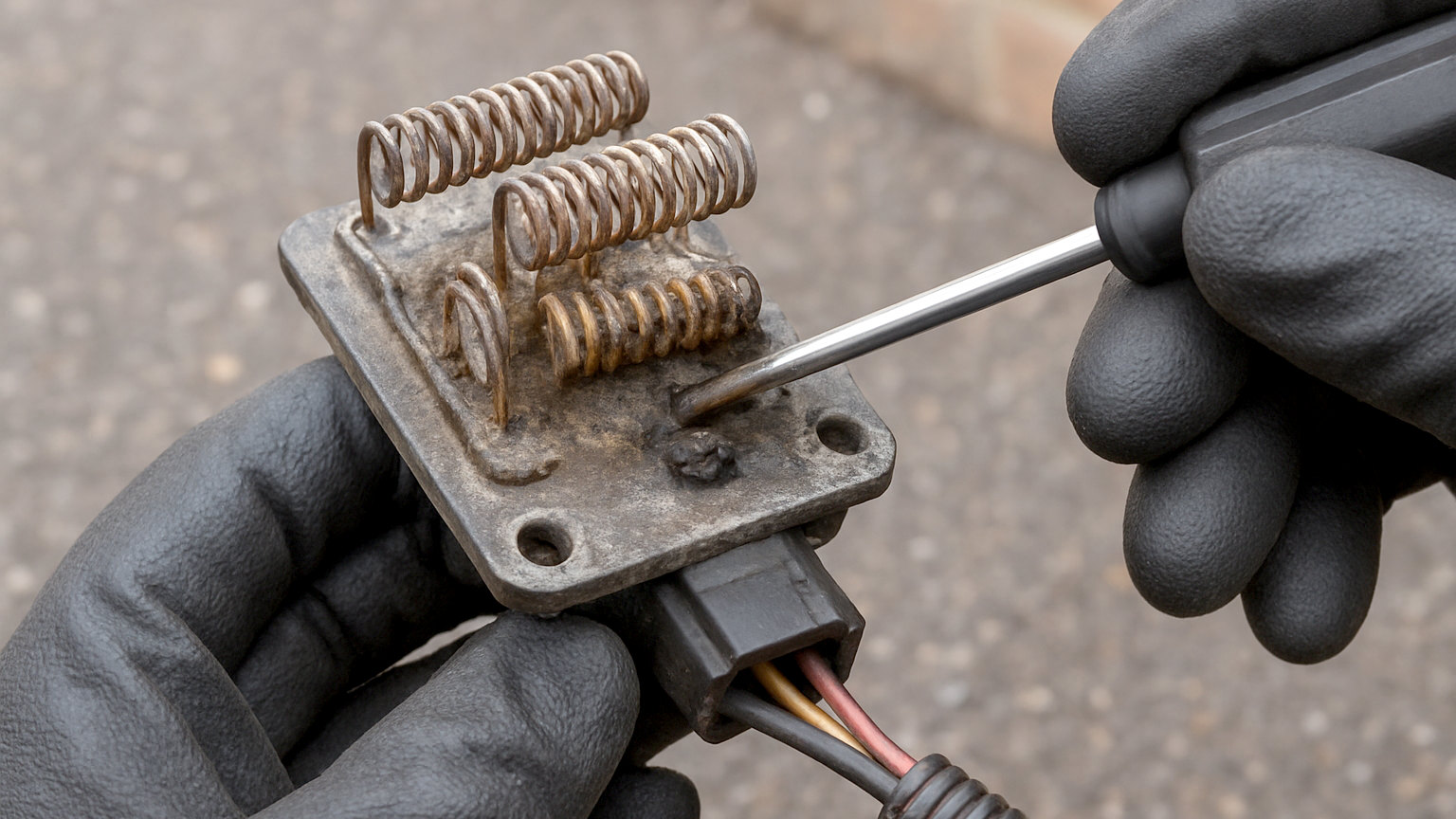
A heater blower that works perfectly on its highest setting and does nothing at all on the lower ones is displaying one of the most recognisable faults in any car. It is caused by a failed resistor pack, the component that reduces the voltage reaching the fan motor to produce the slower speeds, and it is usually an inexpensive part.
How does fan speed control work?
On a conventional system, a resistor pack sits in the airflow with several resistors of different values. Selecting a lower speed routes current through one of them, dropping the voltage and slowing the fan. The highest setting bypasses the resistors entirely and feeds the motor full battery voltage, which is exactly why that speed continues working when the others have failed.
Why do resistors fail?
Because they work by converting electrical energy into heat, so they get hot by design and are cooled by the airflow passing over them. A blocked cabin filter reduces that airflow and lets them overheat. A blower motor whose bearings are worn draws more current than it should, which also overheats them. Both causes are worth addressing rather than simply fitting a new pack.
Where is the resistor pack?
Usually in the heater housing near the blower motor, positioned in the airflow so it stays cool. On many cars it is accessible from the passenger footwell with the glovebox removed or lowered, held by a couple of screws. That makes it a realistic job for a competent home mechanic, though access varies considerably between models.
What if no speeds work at all?
Then the fault is more likely the fan motor itself, its fuse, its relay, or the wiring and connector. Checking the fuse takes a minute and is always worth doing first. A motor that has seized will often blow the fuse repeatedly, which is a useful clue that the motor rather than the circuit is at fault.
What if some speeds work and others do not?
That is still the resistor pack, since it contains several resistors and they do not all fail at once. Losing the lowest speed first is common, because that resistor drops the most voltage and therefore runs the hottest. It is a progressive failure, and the remaining speeds usually disappear over the following months.
Do modern cars work differently?
Many climate control systems use an electronic control module rather than a simple resistor pack, giving infinitely variable fan speed rather than fixed settings. Those fail too, though less predictably, and they cost considerably more. The symptom is often erratic behaviour rather than the neat pattern of a resistor failure.
Is the blower motor a common failure?
Reasonably. Worn bearings produce a whirring, squealing or rumbling that changes with fan speed, and debris such as leaves drawn in through the intake can catch in the fan and cause a rattling. A motor drawing excessive current will destroy a new resistor pack, so a noisy fan should be investigated at the same time.
What should you do alongside the repair?
Replace the cabin filter, since a blocked one restricts the airflow that keeps the resistor cool and is a leading cause of the failure. Check the blower motor spins freely and quietly. And clear any leaves or debris from the scuttle intake area under the windscreen, which is where most of it enters.
Is it worth doing yourself?
On many cars, yes. The part is usually inexpensive and access is frequently behind or below the glovebox, held by a couple of screws. The main difficulty is working upside down in a footwell rather than anything technical. Checking a forum for your specific model will usually tell you within minutes whether it is a twenty minute job or a dashboard out one.
Disconnecting the battery first is worth doing, since the circuit carries meaningful current and the connector sits in an awkward position to work on.


