
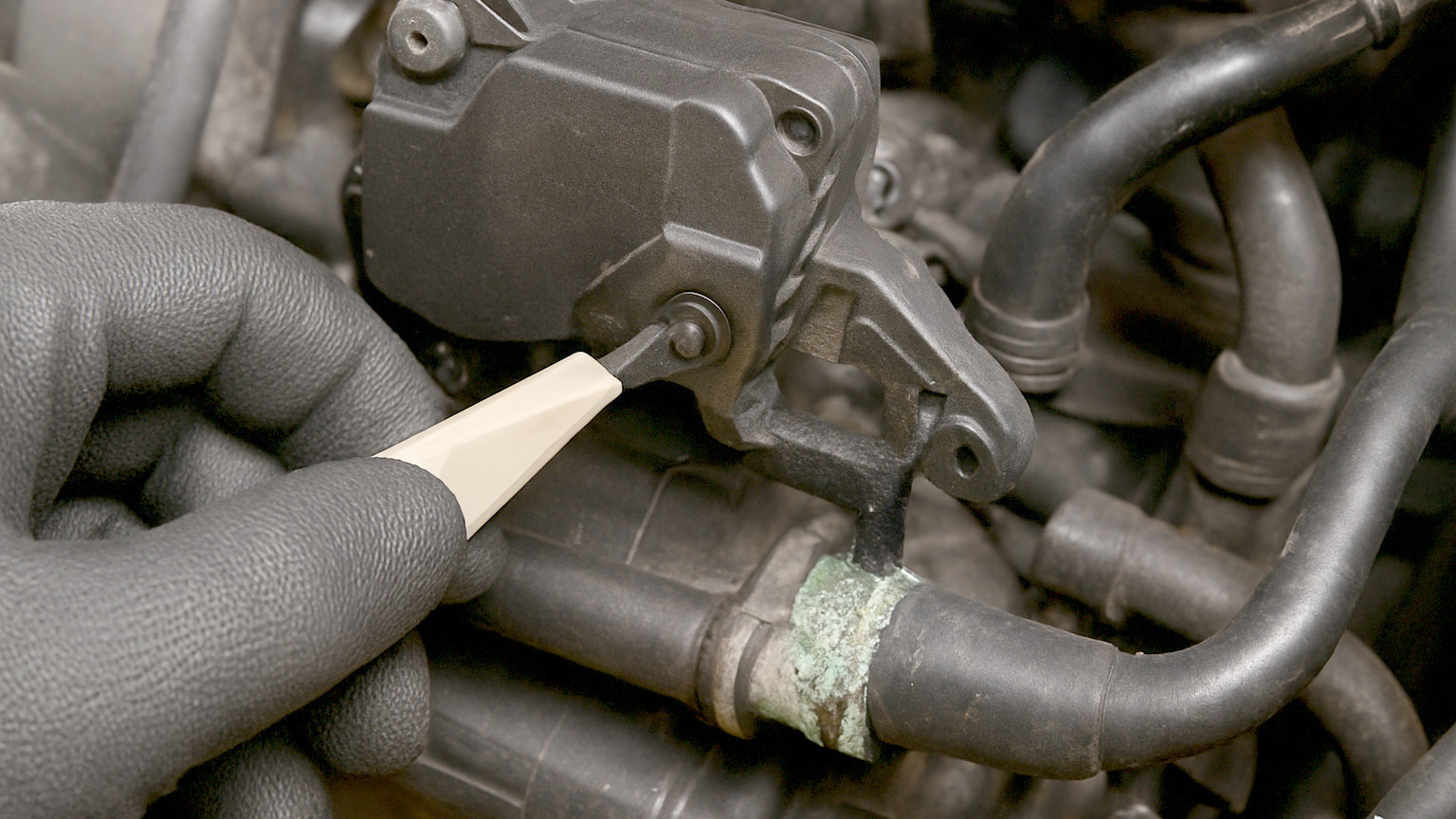
Where the air comes out is controlled by a set of flaps inside the heater housing, moved either by small electric motors, by cables, or on older cars by vacuum. When one of those mechanisms fails, the system defaults to a fixed position, and the position it chooses is rarely the one you want. It is a mechanical or electrical fault rather than anything to do with the coolant.
Why does it default to the windscreen?
On vacuum operated systems, because the flaps are held in other positions by vacuum and spring back to the screen setting when it is lost. That is a deliberate safety choice, since if something has to fail, defaulting to demisting the windscreen is the least dangerous outcome. It is why losing vacuum produces a car stuck on screen with nothing at the feet.
What causes vacuum loss?
A perished or disconnected vacuum hose, a failed check valve, or a leaking actuator diaphragm. The hoses are thin and brittle after years of heat cycling and frequently split where they connect. A useful clue is whether the fault worsens under acceleration, since engine vacuum drops when the throttle is open, and a marginal system will lose the flap position at exactly that moment.
What does clicking behind the dashboard mean?
Almost always a flap actuator motor whose gears have stripped, so it turns without moving the flap and clicks repeatedly as it tries to reach its target position. It is a distinctive rapid ticking that starts when the controls are adjusted or when the ignition is switched on. The actuator is usually an inexpensive part, and access determines the labour.
Can a flap itself break?
Yes. The flaps are plastic and their pivots or the linkages between them can snap, particularly on older cars. A broken flap will not move whatever the actuator does, and it sometimes falls into a position that partially blocks the airflow. Diagnosis usually requires access to the heater box, which is the awkward part.
How does it interact with temperature?
A separate blend flap controls how much air passes over the heater matrix and therefore the temperature. If that fails, the air comes from the right vents at the wrong temperature, sometimes hot on one side and cold on the other where dual zone control is fitted. Distinguishing a direction fault from a temperature fault narrows the diagnosis considerably.
Can it be reset?
Sometimes. Many climate control systems run a calibration routine that moves every flap through its full travel to learn the end stops, and a fault can occasionally be cleared by running it. Some cars do it automatically after a battery disconnection. It is worth asking about, since it costs nothing and occasionally resolves what appeared to be a failed actuator.
Is it worth fixing?
If the car is stuck on screen, yes, since you have no footwell heat in winter and no face level air in summer. If it is stuck somewhere workable, the cost of access may outweigh the inconvenience on an older car. What is not acceptable is being stuck without any airflow to the windscreen, since demisting is a safety function rather than a comfort one.
How is it diagnosed?
On a climate control car, by reading the fault codes from the heating module, which usually name the specific actuator. On simpler systems, by listening for clicking, checking the vacuum hoses for splits, and observing whether any flap movement can be heard when the controls are changed. Silence when adjusting the controls points at a failed motor or a lost supply.
Can debris cause it?
Occasionally, and it is worth eliminating since it costs nothing. Leaves and small objects drawn in through the scuttle intake can jam a flap, and coins or pens dropped into a vent can do the same. Clearing the scuttle area under the windscreen is worth doing anyway, since blocked drains there cause several other problems.


