
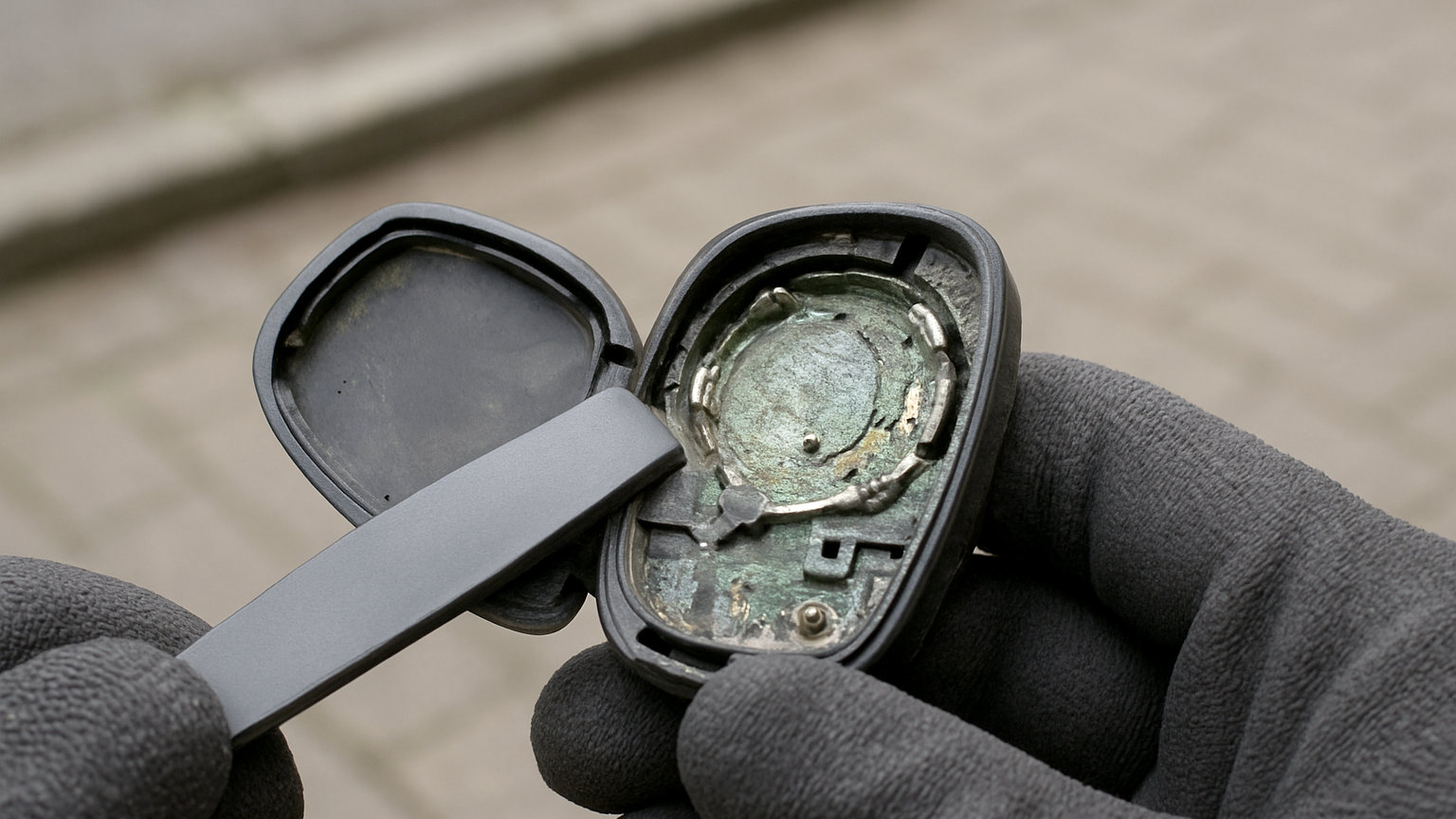
Keyless entry, sometimes called keyless go or smart entry, allows the car to unlock as you approach and start without the fob leaving your pocket. It works through a continuous low power radio conversation between the car and the fob, and that constant communication explains both its convenience and the particular ways in which it fails.
How does the car find the fob?
Antennas around the vehicle transmit a low frequency signal, and when the fob is close enough to hear it, it replies with an encrypted code on a different frequency. The car can also tell roughly where the fob is, which is how it knows whether the key is inside the cabin or outside, and which door you are approaching.
Why do the batteries fail so often?
Because the fob is listening constantly rather than only when a button is pressed, so it uses far more power than a conventional remote. Annual replacement is reasonable on many keyless fobs. Some go into a sleep mode when stationary for a period to save power, which is why a fob left in a drawer lasts considerably longer.
What happens when the fob battery dies?
Every keyless car has a backup. The fob contains a passive transponder that needs no power, and holding the fob against a specific point, often the start button or a marked area on the steering column, allows the car to read it inductively. There is also a mechanical key blade inside the fob and a lock barrel hidden somewhere on the driver door.
Where is the hidden lock?
Usually behind a cover on the driver door handle, released by prising a small trim panel or by pulling the handle and inserting the key blade into a slot. It is worth locating it in daylight rather than discovering it in a dark car park. Note that opening the door this way will normally trigger the alarm until the car is started.
What causes interference?
Radio transmitters, some security systems, mobile phone masts and certain electronic devices can swamp the frequencies involved. Carrying the fob next to a mobile phone occasionally causes problems. The characteristic clue is a system that fails in one particular location and works everywhere else, which points at the environment rather than the car.
Can the handle sensors fail?
Frequently, since they sit inside the door handle exposed to water. The symptom is a car that will not unlock when the handle is touched while the fob buttons still work perfectly. On most cars the sensor is part of the handle assembly, so replacement means a new handle rather than a separate component.
Why does it sometimes not detect the fob inside?
Because the interior antennas have a defined coverage area, and a fob in a deep pocket, a metal container or the boot may be outside it. The car then warns that no key is detected. Moving the fob to the centre console and trying again usually resolves it, and it is worth knowing before assuming a fault.
What should you carry?
A spare coin cell, since a fob battery is the most common failure and the replacement takes a few minutes. Knowing the emergency start procedure and the location of the hidden lock is worth more than any tool. Both are in the handbook and neither is intuitive, which is why reading them in advance matters.
Can the system be switched off?
On many cars, through the settings menu or a button sequence on the fob, which reverts to conventional button operation. Some owners do this for security reasons rather than because of a fault, and it also extends fob battery life considerably since the fob is no longer listening constantly.
The trade off is losing the convenience entirely, which is why many owners prefer a signal blocking pouch and leave the system enabled rather than reverting to button operation and giving up the feature they paid for.


