
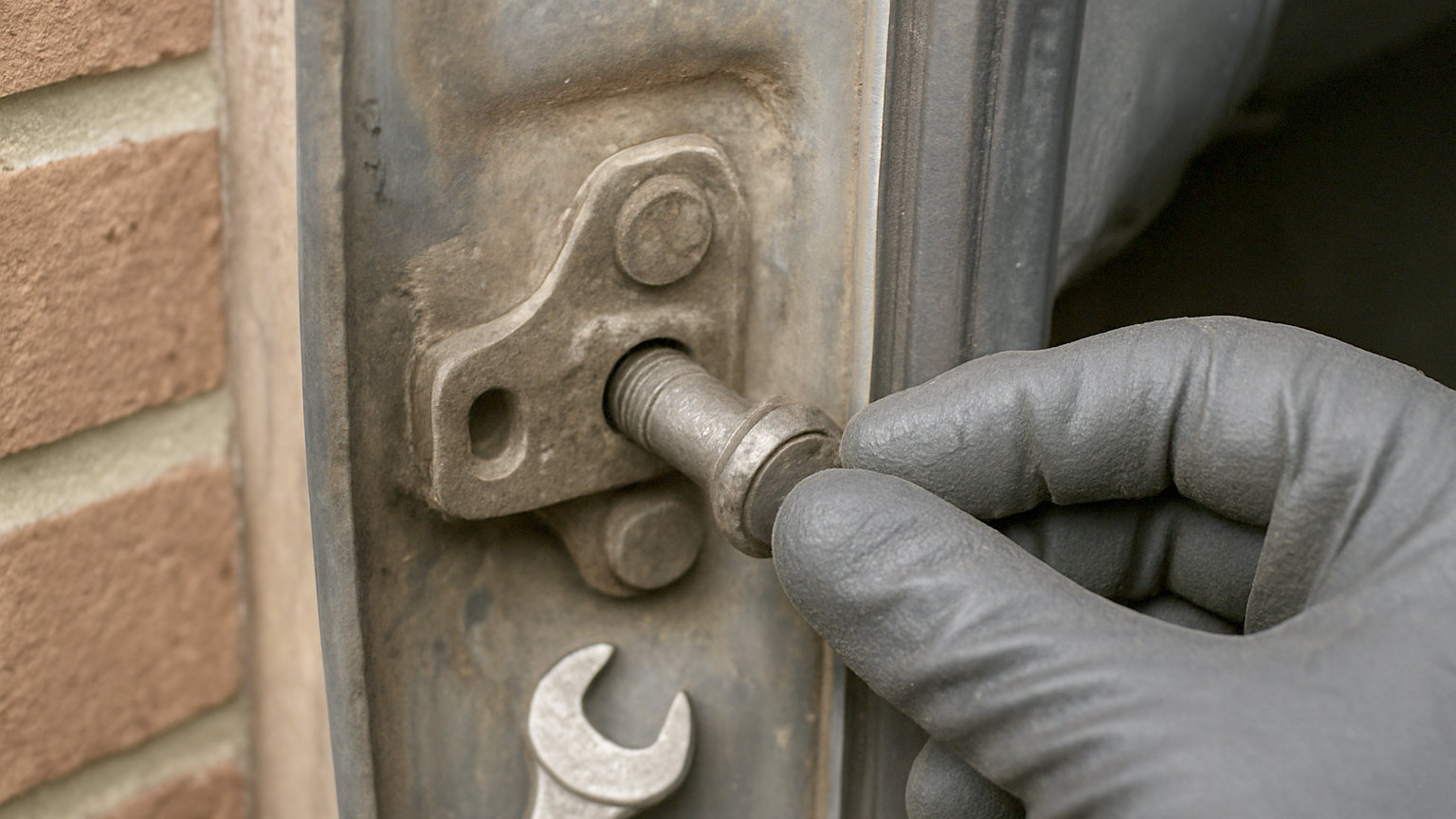
A door that has to be lifted slightly to close, or that visibly sits lower than its aperture, has dropped on its hinges. It is a common fault on older cars and on any vehicle with heavy doors, and while the symptom appears at the latch end, the cause is almost always at the hinge end. Understanding that distinction prevents the wrong repair.
Why do hinges wear?
Because a door is heavy and it hangs on two small pins with bushes, taking the full load every time it is opened. Those pins and bushes wear, and the door drops by a few millimetres, which is enough to misalign the latch with the striker. Front doors on two door cars suffer most, since the doors are longer and heavier.
How do you check for wear?
Open the door fully and lift gently at the outer edge while watching the hinges. Any movement indicates worn pins or bushes. The amount of lift at the latch end is amplified compared with the movement at the hinge, so even slight wear produces a noticeable drop. Comparing against the opposite side of the car makes it clearer.
Why not just adjust the striker?
Because it treats the symptom while the cause continues. Moving the striker down to meet a dropped door restores easy closing temporarily, and the hinge continues to wear, so the adjustment has to be repeated. It also means the door is no longer sitting correctly in its aperture, which affects the seal and produces wind noise and leaks.
Can hinge pins be replaced?
Frequently, and it is far cheaper than replacing hinges. Repair kits containing new pins and bushes are available for most common vehicles, and the job involves supporting the door, driving out the old pins and fitting the new. It is fiddly and it usually requires a second pair of hands, and it genuinely restores the original alignment.
What is a check strap?
The mechanism that holds the door at intermediate positions and stops it swinging fully open. When it wears or breaks, the door swings freely and can hit the wing, and it may bang shut in wind. A broken check strap also allows the door to be pushed beyond its normal travel, which accelerates hinge wear.
Does the seal contribute?
Sometimes. A door that suddenly needs slamming may have a seal that has swollen or been displaced rather than a hinge problem, and a seal that has come out of its channel prevents the door closing properly. Running a hand around the seal to check it is seated correctly is worth doing before assuming the worst.
What are the consequences of ignoring it?
Wind noise and water leaks, since the door no longer compresses the seal evenly. Increased wear on the latch and striker, since they are meeting at the wrong angle. And eventually a door that will not latch at all, which is an MOT failure and a safety concern. It also looks poor, which matters when selling.
Is it an MOT item?
Doors must open, close and latch securely, so a door that will not stay shut fails. A door that closes with effort but latches properly generally passes. Given that it worsens progressively and the repair is not expensive if caught early, it is worth dealing with before it reaches the point of failing.
Can it be adjusted at all?
The hinges on some cars are bolted rather than welded, which allows the door position to be adjusted properly rather than compensating at the striker. It is skilled work, since moving a door affects the gaps on all four sides, and it should be done by someone who will mark the original positions before loosening anything.
Body shops do this routinely after accident repair, and it is worth seeking out somebody with that experience rather than treating it as a general mechanical job, since the panel gaps are what give the result away.


