
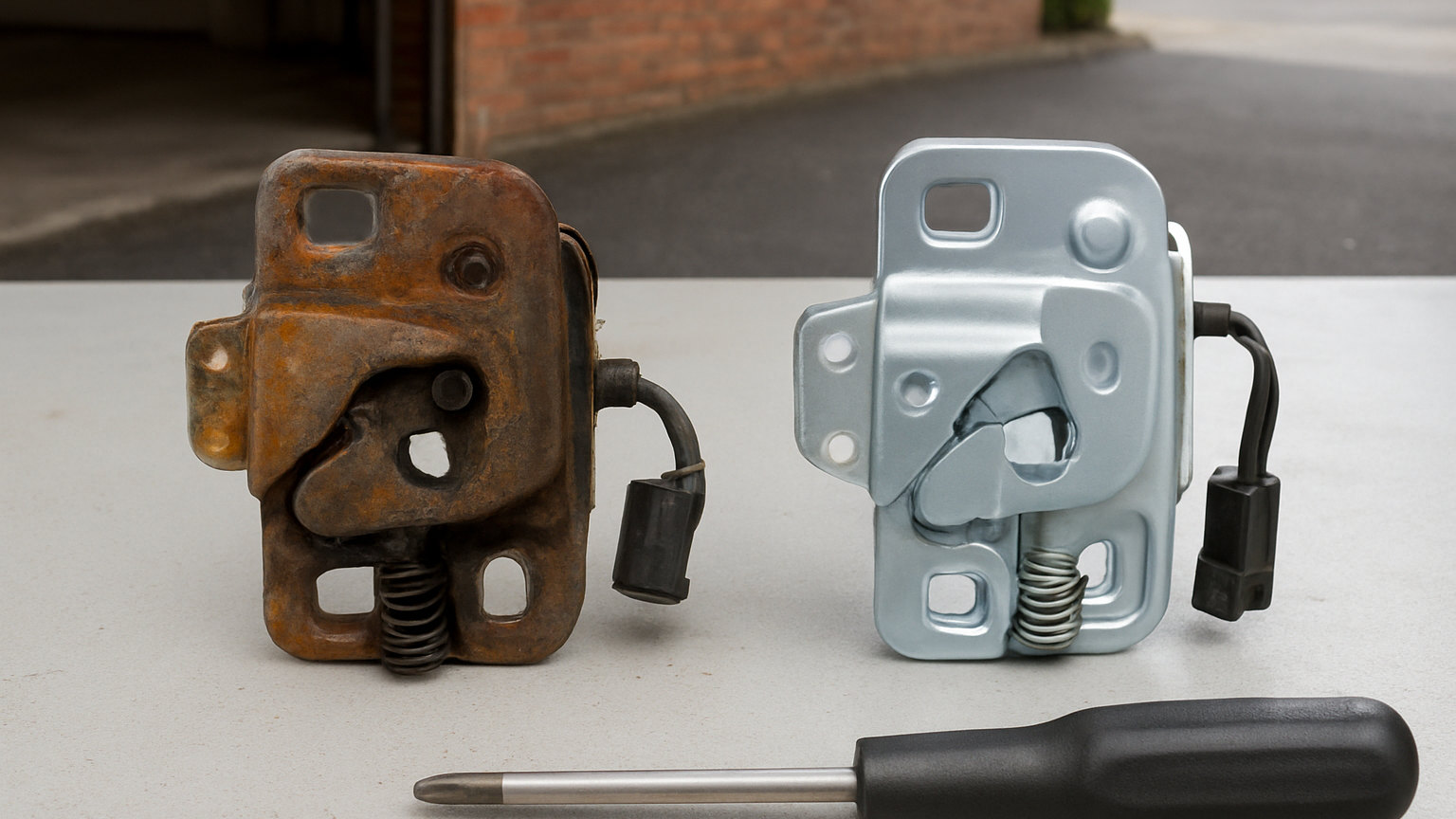
The door latch is the mechanism in the edge of the door that grips the striker on the body pillar and holds the door closed. On a modern car it does considerably more than that, since it usually contains the central locking actuator, the child lock, the deadlock mechanism and the switch that tells the car the door is shut. That integration explains why one failure produces several symptoms.
How does it work?
A rotating claw catches the striker as the door closes, and a spring loaded pawl holds that claw in place. Pulling either handle moves the pawl and releases the claw. Most latches have two stages, so a door that is not fully closed catches on the first notch rather than swinging open, which is the reason a partially shut door still feels attached.
Why do they fail?
Wear and corrosion, principally. The latch lives in a damp position at the edge of the door where water runs down, and the original grease dries out over years. Plastic components inside crack with age. The actuator gears strip. And the microswitch that reports whether the door is open corrodes, which produces its own set of symptoms.
What does a door ajar warning mean?
Usually that the latch switch is reporting the door as open when it is closed. The consequence is an interior light that stays on, a warning on the dashboard, an alarm that will not set and on some cars a battery that goes flat overnight. The door itself is perfectly secure; the switch reporting its state has failed.
Can it be lubricated?
Often, and it is worth trying first since it costs almost nothing. A suitable lubricant sprayed into the latch mechanism, working it several times to distribute it, frees a sticking latch and can resolve both stiff closing and an intermittent switch. Use a product designed for locks rather than a general purpose oil, which attracts dirt and eventually makes things worse.
What if the door will not close?
Check whether the latch claw is in the open position, since a latch that has closed while the door is open cannot receive the striker. Operating the handle or gently moving the claw with a screwdriver usually resets it. If the door then closes normally, the latch was simply out of position rather than broken.
Does the striker need adjusting?
Sometimes, and it is a legitimate adjustment. The striker bolts to the pillar through slotted holes, allowing it to be moved slightly in and out or up and down. A door that needs slamming, sits proud, or drops as it closes can frequently be improved by adjusting the striker rather than replacing anything. It should be marked before moving so the original position can be found again.
Is the latch replaceable separately?
Generally yes, and it comes as a complete assembly including the actuator and switch. That means one part cures several symptoms, which is convenient, and it also means paying for the actuator even when only the switch has failed. The door card must come off and the linkages disconnected, which is fiddly rather than difficult.
Is it an MOT item?
Doors must open and close securely and latch properly, so a door that will not stay shut is a failure. A faulty ajar switch is not itself tested, though it may keep an interior light on. Given that a door opening while driving is a serious matter, a latch that is intermittent is worth dealing with promptly.
What are the warning signs?
A door that needs an extra push to catch. A latch that occasionally fails to release on the first pull. An interior light that stays on after the doors are shut. And a car that will not set its alarm because it believes a door is open. Each of those is the latch telling you it is deteriorating rather than failing outright.


