
Central locking failures divide neatly into two categories, and establishing which you have takes seconds. If every door has stopped responding, the fault is in something shared: the fob, a fuse, a relay or a module. If one door is misbehaving while the others work perfectly, the fault is in that door alone. Almost everything that follows depends on that distinction.
Does the key still work in the lock?
Worth trying, since most cars retain a physical key barrel in the driver door even where it is hidden behind a cover. If turning the key locks and unlocks the car normally while the fob does nothing, the mechanism and the actuators are fine and the problem is in the remote system. That single test eliminates half the possibilities.
What should you check first?
The fob battery, which accounts for a remarkable proportion of complete central locking failures and costs very little to replace. Then the fuse, which takes a minute. Then whether a second fob works, since a working spare confirms the car is fine and the fault is in the first fob rather than anything on the vehicle.
What does a clicking noise mean?
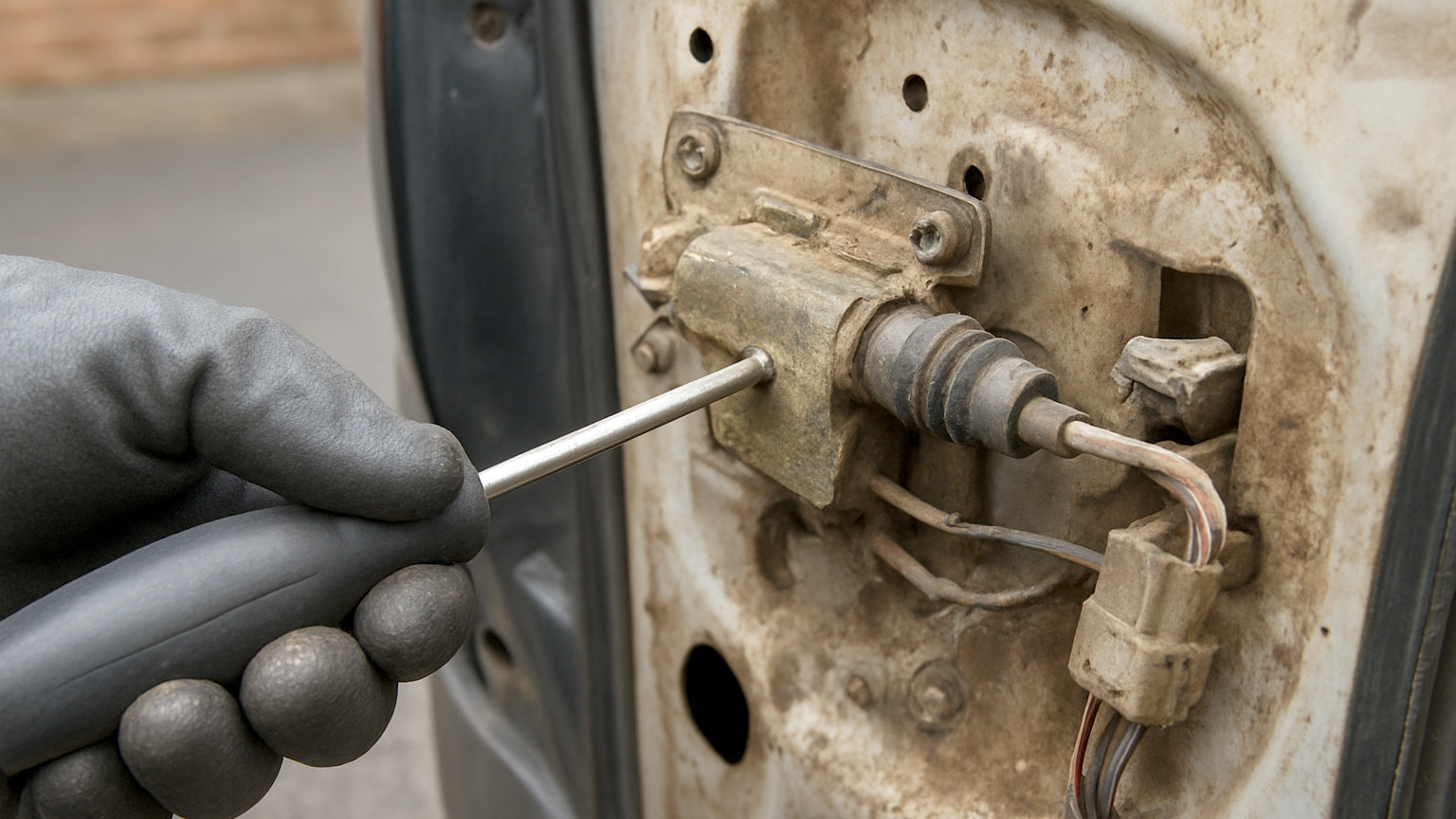
That the actuator is receiving power and trying to work, but the mechanism is not moving. Inside each door is a small motor driving a plastic gear train, and those gears strip with age. The motor spins, the gears slip, and the lock stays where it is. It is the most common mechanical failure in a central locking system.
Could it be the door wiring?
Frequently, particularly on the driver door where the loom flexes every time the door opens. Wires fatigue and break inside the insulation with nothing visible from outside. If the lock, the window and the mirror on the same door have all stopped, a broken loom is far more likely than three separate component failures.
Is there a module involved?
On most modern cars, yes. A body control module or individual door modules manage locking, and they communicate over a data network. A failed module produces multiple symptoms on one door or across the car, and it usually stores fault codes. Water reaching a module through a damaged weather membrane is a common cause on older vehicles.
What if it works intermittently?
Intermittent operation points more strongly at wiring or a marginal connection than at a failed component, since a stripped gear does not repair itself. A lock that works when the door is closed and not when it is open, or the other way round, is describing a loom that flexes. Cold and damp making it worse supports the same conclusion.
Can the fob need reprogramming?
Sometimes, particularly after a battery has gone completely flat in the car or in the fob. Many vehicles have a resynchronisation procedure involving the ignition and the fob buttons, which is in the handbook. It costs nothing to try and it occasionally restores a fob that appears to have failed entirely.
How urgent is it?
More than it appears. A car that cannot be locked reliably is a security and an insurance concern, and a car that locks and will not unlock is worse. If only one door is affected the car is still secure, and if the whole system has failed it is worth resolving quickly rather than relying on the key for weeks.
What should you tell a garage?
Whether every door is affected or only one, whether the key works mechanically, whether a second fob behaves the same way, and whether any other function on the affected door has stopped. Those four answers narrow the diagnosis considerably before the car is even lifted, and they are exactly what a technician would otherwise spend the first half hour establishing for themselves.
Mentioning any recent work on the car is worth doing too, since a door card removed for a speaker or a window repair is a common way for a connector to be left unseated.


