
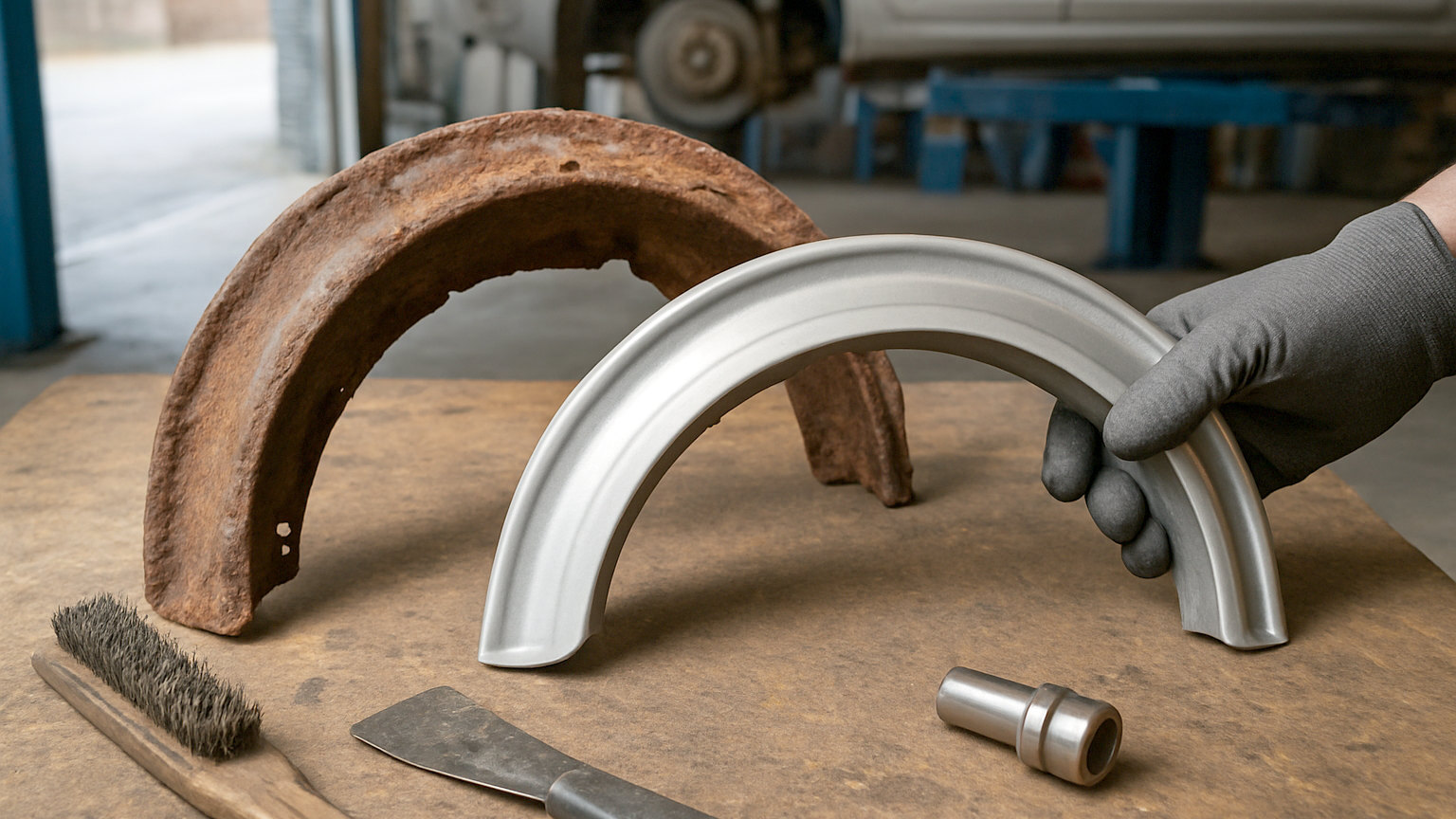
Wheel arches corrode before almost anything else on a car, and the reasons are entirely mechanical. Each arch sits directly in the path of everything the tyre throws upwards, which in a British winter means water carrying grit and dissolved salt, delivered at speed and continuously. It is the harshest environment on the whole vehicle.
Why is the lip so vulnerable?
Because it is a fold where the outer panel turns inwards and meets the inner arch, creating a capillary gap that draws water in and holds it. Mud packs into that fold and stays damp for weeks. The paint on the folded edge is also thinner than on a flat panel, since it is difficult to apply evenly around a tight radius.
Do arch liners help?
Generally yes, since they take the blasting instead of the paintwork. They also create a cavity, and where mud packs between the liner and the metal it holds moisture permanently against the panel. A liner that has come loose at one edge is worse than none at all, since it funnels debris in and prevents it escaping.
Why are rear arches worse?
Because the rear wheels run through everything the fronts have already loosened, and because the rear arch on most cars is a double skinned structure with a seam that traps water. Rear arches also see less airflow and dry more slowly. On most vehicles the rear arches corrode noticeably before the fronts.
What starts it?
Stone chips along the lip, which are unavoidable, and which breach the paint and expose steel. Corrosion then works along the seam in both directions beneath the paint. By the time bubbling appears the affected area is usually several times larger than what is visible, which is why arch repairs so often expand once the panel is stripped.
Can it be caught early?
Certainly, and that is the whole opportunity. Cleaning inside the arches thoroughly, particularly at the back where mud accumulates, and touching in any chips on the lip before winter prevents most of it. Running a finger along the underside of the lip finds roughness long before anything is visible from outside.
How is an arch repaired properly?
By cutting out the corroded metal and welding in a new section, then treating and sealing both faces including the inside of the seam. Repair panels are available for most common vehicles. It is skilled work and it costs accordingly, and anything less thorough returns within a couple of years, usually larger than before.
Are arch trims a solution?
Not on their own. Plastic trims cover the damage without addressing it, and they frequently trap moisture behind them, so corrosion continues out of sight. Where a trim is fitted from the factory it is designed with drainage in mind. Adding one to hide a rusty arch accelerates the problem while making it invisible.
What is the annual routine?
Clean inside the arches properly, including behind the liners where access allows, check the lips for chips and roughness, touch in anything down to primer or metal, and make sure the liner fixings are secure. Doing that each autumn is genuinely effective, and it costs an hour and a paint pen against a welding repair later.
Does it affect the MOT?
Arch corrosion is usually cosmetic in test terms unless it falls within a prescribed area near a suspension mounting, or unless it has produced a sharp edge presenting a risk of injury. A rotten arch lip with jagged edges can fail on that basis alone, which surprises owners who assume bodywork appearance is never tested.
Where an arch has reached that stage, the corrosion has usually spread well into the seam behind it and the repair is a welding job rather than a cosmetic one.
That is the practical reason for dealing with arch chips early: the difference between a paint pen in autumn and a repair panel two winters later is measured in hundreds of pounds rather than in appearance alone.


