
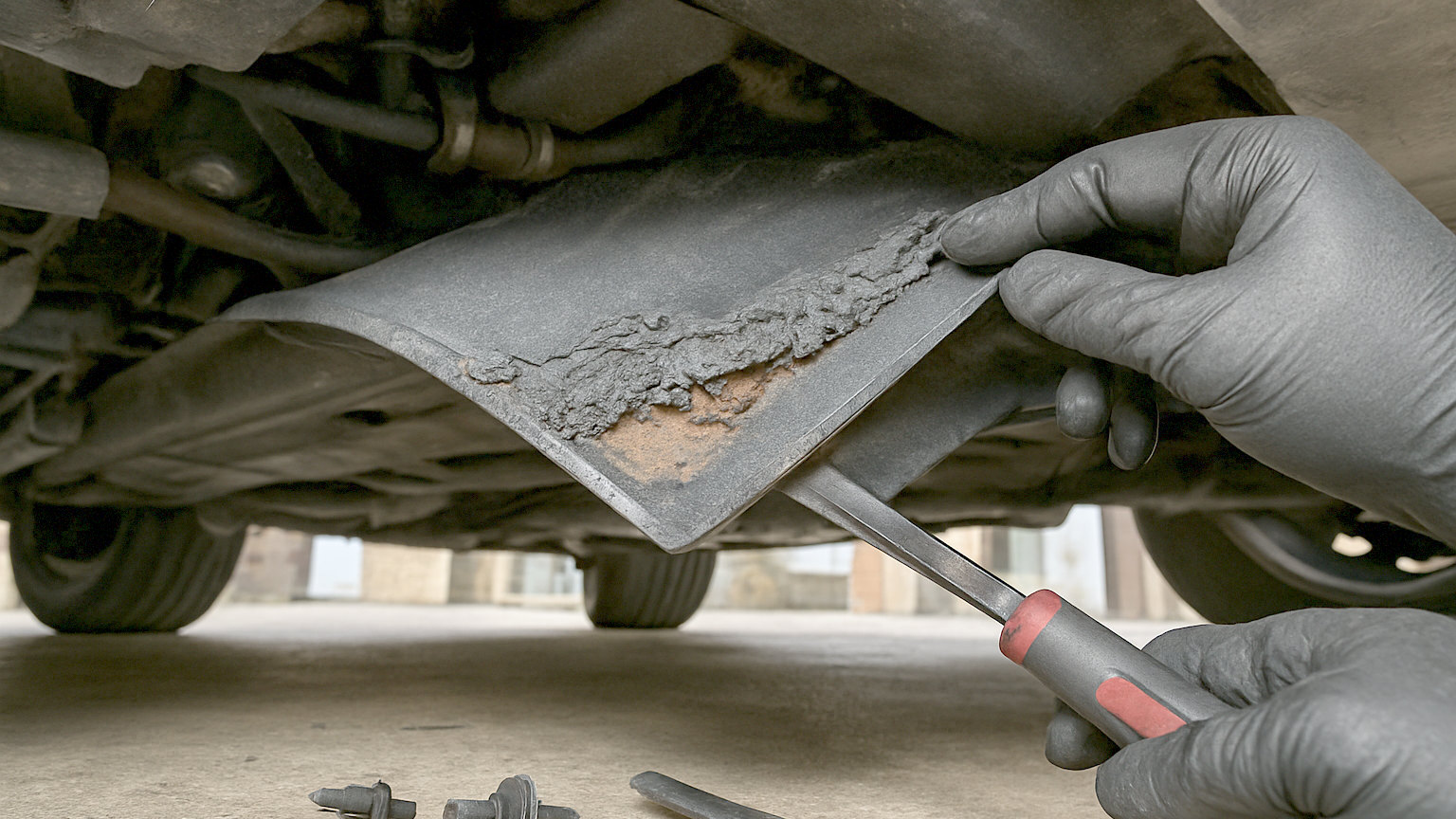
Underseal is widely misunderstood, partly because the word covers two quite different types of product doing different jobs. Applied correctly to sound metal it genuinely extends the life of a car. Applied over existing corrosion, or applied as a hard brittle coating, it seals moisture against the steel and accelerates exactly what it was meant to prevent.
What are the two main types?
Hard coatings, traditionally bitumen based, which form a tough protective shell over the underside. And wax or oil based products, which remain soft and creep into seams, displacing moisture rather than sealing it out. The second type has become the preferred approach for older cars precisely because it does not crack.
Why do hard coatings fail?
Because they become brittle with age and impact, and once cracked they allow water behind while preventing it drying out or being seen. A panel beneath cracked bitumen can rot completely while the coating looks intact. That is why removing old flaking underseal is frequently the first step in any serious underbody restoration.
What does cavity wax do?
Protects the inside of enclosed sections, which is where most serious corrosion begins. It is injected through existing drain holes or small drilled access points using a long flexible lance with a spray head, and it creeps along seams and folds. Since sills, chassis rails and doors rot from within, this is arguably more valuable than anything applied outside.
Why is preparation everything?
Because any product applied over loose rust, mud or moisture seals the problem in. The underside must be thoroughly cleaned, ideally steam cleaned, and allowed to dry completely before anything is applied. Rushing that stage produces a car that looks protected and is quietly corroding beneath a coating nobody will remove for years.
Do modern cars need it?
Less than older ones, since galvanised panels and factory cavity treatments are far better than they were. It remains worthwhile on a car being kept long term in a salted climate, and on any vehicle where a repair has disturbed the original protection. It is also worth considering on a car used on unsurfaced roads or near the coast.
What must be avoided when applying it?
Blocking drain holes, which is a genuinely common mistake and turns a protective treatment into a water trap. Coating exhaust components, brake parts, propshafts or anything that moves or gets hot. And masking suspension bushes, since the products attack rubber. A careful job takes considerably longer than an enthusiastic one.
Is professional treatment worth it?
For cavity work, frequently, since the equipment reaches places that are impossible otherwise and the operator knows where the access points are. For the visible underside, a careful owner with a jack, stands and time can do a perfectly good job. The difference is largely in the preparation and in access to enclosed sections.
How often does it need redoing?
Wax based products typically every couple of years for cavities, since they are designed to remain mobile and gradually migrate. Hard coatings last longer and fail worse. Inspecting annually and touching up where stone damage has removed the coating is the practical approach, rather than treating it as a job done once and forgotten.
Does it affect the MOT?
Indirectly, and not always helpfully. Thick underseal can obscure corrosion from a tester, and a tester who cannot assess a structural area properly may record it as such. Heavy fresh underseal on a car being sold is worth treating with suspicion, since it is an effective way of hiding exactly what a buyer needs to see.
That is not a reason to avoid a car that has been properly treated, and it is a reason to ask when it was done and to look closely at the edges of the coating.
Wax based products are easier to assess than hard coatings, since they stay soft and you can see the metal beneath rather than having to take the coating on trust.


