
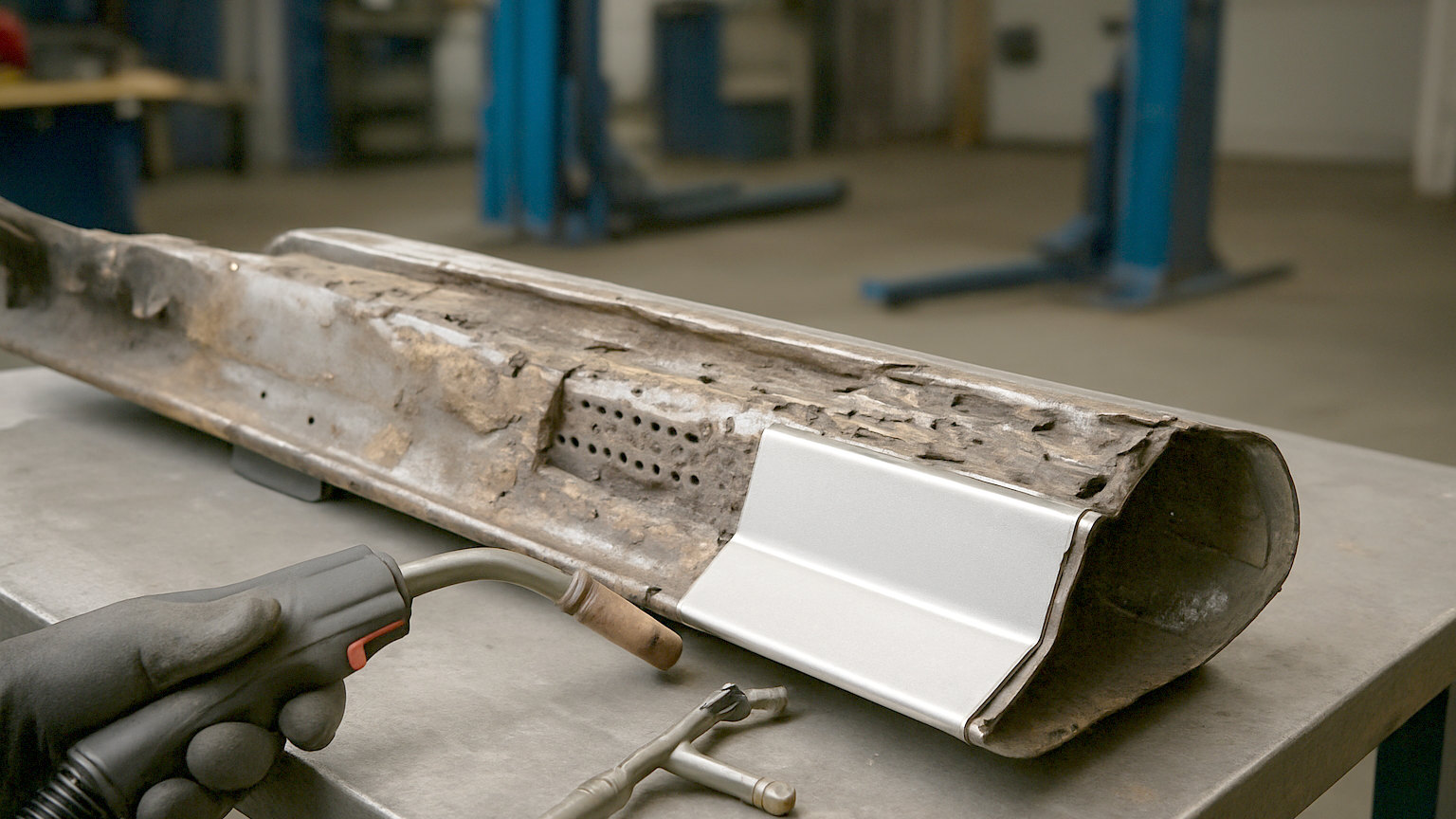
Sills are among the most structurally important parts of a car, running the length of the shell between the wheel arches and providing a great deal of its rigidity. They also corrode readily, because they are enclosed sections positioned exactly where road spray collects. A rusty sill is a welding job, and the variation in cost comes almost entirely from how much of the structure has gone.
What is a sill actually made of?
Usually three parts: an inner sill forming part of the floor structure, an outer sill which is the visible panel, and frequently a central reinforcement between them. The jacking points are attached to it. That layered construction is why a sill can look presentable while the inner section has largely disappeared, and why estimates are provisional.
What is a cover sill?
A repair panel welded over the existing outer sill rather than replacing it. It is quicker and cheaper and it hides whatever is underneath, including any remaining corrosion. On a structural area it is generally not an acceptable repair, and it is one of the more common ways a car is prepared for sale rather than actually repaired.
How should it be done properly?
By cutting out the corroded outer sill, assessing and repairing the inner sill and any reinforcement, then welding in a new outer section, seam sealing both faces and injecting cavity wax through the enclosed space. Where the inner sill has gone, that has to be repaired first, and that is what turns a modest job into a substantial one.
Why do quotes vary so much?
Because nobody knows the extent until the panel is opened. A quote given from the outside is an estimate for what is visible, and inner corrosion frequently doubles the work. Any honest body shop will say so upfront. A quote that seems remarkably low usually assumes the inner structure is sound, or assumes a cover sill.
What about jacking points?
They corrode with the sill and they are individually a failure item, since they carry the weight of the car when raised. A collapsed jacking point also makes future work awkward and can be dangerous if somebody jacks the car there. Repair sections are available separately and they are frequently done alongside sill work.
Does it need to be welded?
In a structural area, yes, with continuous welding where the original was continuous and material of equivalent strength. Bonded, riveted or filled repairs are not acceptable there and will fail an MOT. That requirement is what determines the cost, and it is why a proper sill repair cannot be done cheaply however it is approached.
Is it worth doing?
It depends on the car and on what else is corroded. Sill work on a vehicle worth a few thousand pounds with sound structure elsewhere is frequently sensible. On a car where the sills have gone, the arches are bubbling and the floor is soft, the sills are a symptom of a shell that is failing generally, and the money is better spent elsewhere.
How do you avoid it?
Keep the sill drain holes clear, since a blocked sill holds water permanently. Clean inside the arches where the sill meets them. Deal with stone chips along the lower edge. And have the cavities waxed on a car being kept long term. Those measures cost very little and they address the exact conditions that cause the rot.
How do you know when it is starting?
By tapping along the sill each year and listening for a change in note, and by looking closely where the sill meets the arch, which is where it usually begins. Bubbling paint along the lower edge is a late symptom rather than an early one. Catching it while the metal still rings is what keeps the job small.
Checking at the same time as clearing the drain holes each autumn combines two useful habits into a single job.


