
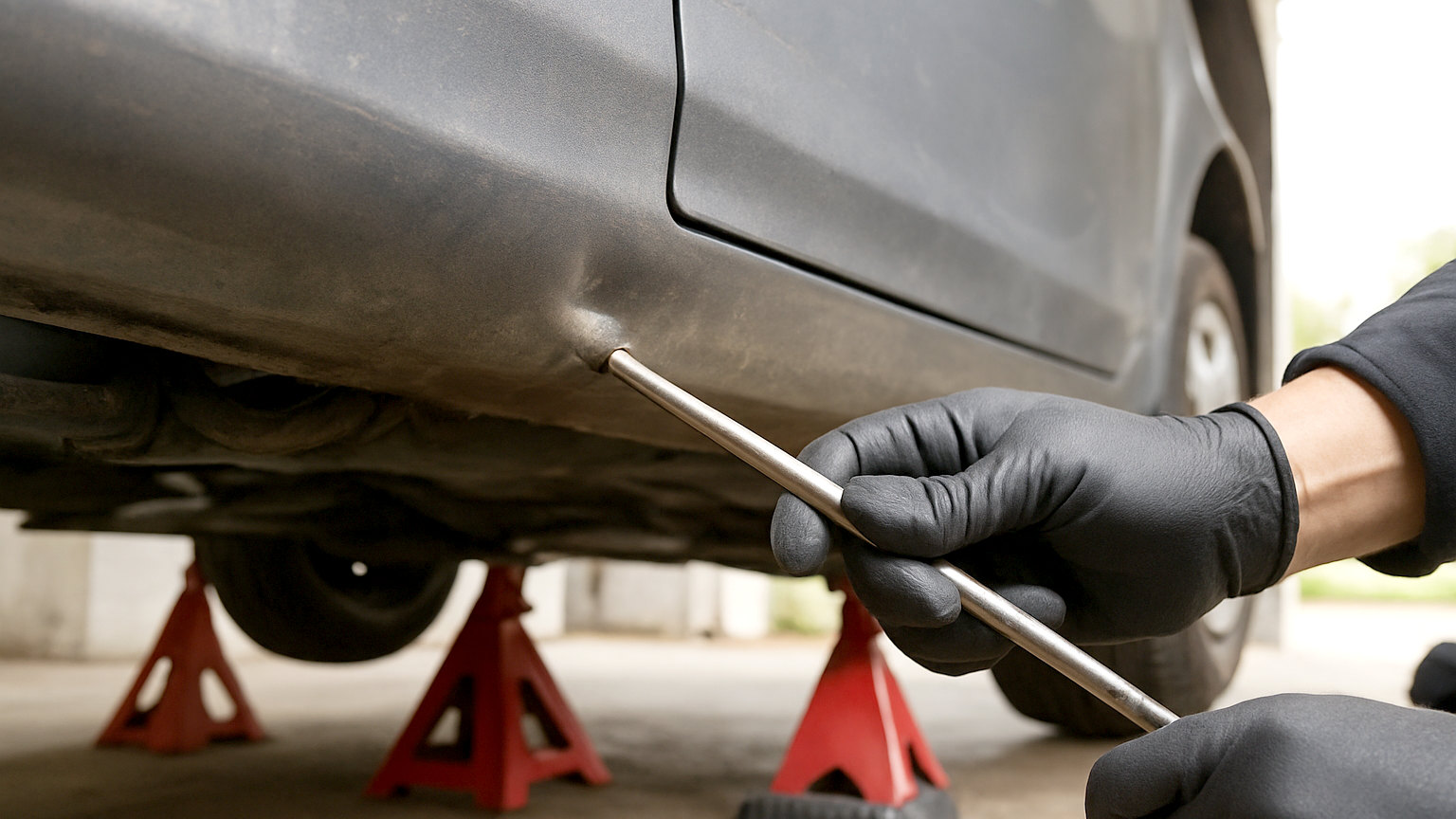
Minor damage is worth assessing before deciding what to do about it, because the difference between a scratch that polishes out in twenty minutes and one that needs painting is genuinely large. The same applies to dents, where a shallow crease with intact paint can frequently be removed without any painting at all.
How deep is the scratch?
The fingernail test answers it. Run a nail lightly across the scratch, and if it glides over without catching, the damage is in the lacquer and can usually be polished out. If it catches, the scratch has reached the colour coat or beyond and polishing will not remove it, though it can improve the appearance considerably.
What does polishing actually do?
Removes an extremely thin layer of lacquer to bring the surrounding surface down to the level of the base of the scratch, so it no longer catches the light. It works because there is meaningful lacquer thickness to work with. It also means there is a limit, since lacquer can only be cut back so far before the colour beneath is exposed.
What if it has reached the colour?
Then it needs paint. A touch in with a matched pen protects the panel and reduces visibility, applied in thin layers with drying time between them and finished with lacquer on a metallic. It will not be invisible, and it prevents the scratch becoming a rust line, which matters far more on any panel exposed to salt.
What is paintless dent removal?
A technique using specialist rods and picks working behind the panel to massage a dent out from the inside, preserving the original paint entirely. It is remarkable when it works and it is the ideal solution for car park dinks and hail damage. Practitioners are widespread and it is far cheaper than a panel repaint.
When does it not work?
Where the paint has cracked or chipped, since the technique cannot repair the finish. Where the metal has been stretched by a sharp impact rather than simply pushed in. Where the dent is on a body line or a tight radius, which resists reshaping. And where there is no access behind the panel, though some practitioners use glue pullers instead.
Are suction pullers any use?
For large shallow dents in a flat panel, occasionally. For anything with a crease or on a curved surface, rarely, and an aggressive attempt can stretch the metal and make a professional repair harder. They are cheap enough to try on a door skin dent, and worth avoiding on anything the panel beater might otherwise have rescued.
What is a smart repair?
A localised repair blending new paint into an area of a panel rather than repainting the whole thing, usually carried out by a mobile technician. It is considerably cheaper than a full panel and the results on modern paints are frequently excellent. It suits bumper scuffs, alloy wheel damage and small localised scratches particularly well.
When is a full respray needed?
Where damage crosses a body line, covers a large proportion of the panel, or where the colour is difficult to blend, which is true of some metallics and pearls. A body shop will advise honestly, since a blend that does not match reflects on them. On an older car with faded paint, blending is harder and a whole panel is frequently the better result.
Does it matter for corrosion?
Considerably, and it is the reason to deal with damage rather than living with it. A scratch through to metal or a dent with cracked paint is an entry point for water, and on the lower half of the car that becomes rust within a winter. Repairing damage promptly is corrosion prevention as much as it is appearance.
That is particularly true of bumper scuffs that have gone through to the substrate and of arch damage, where salt water reaches the exposed edge continuously.


