
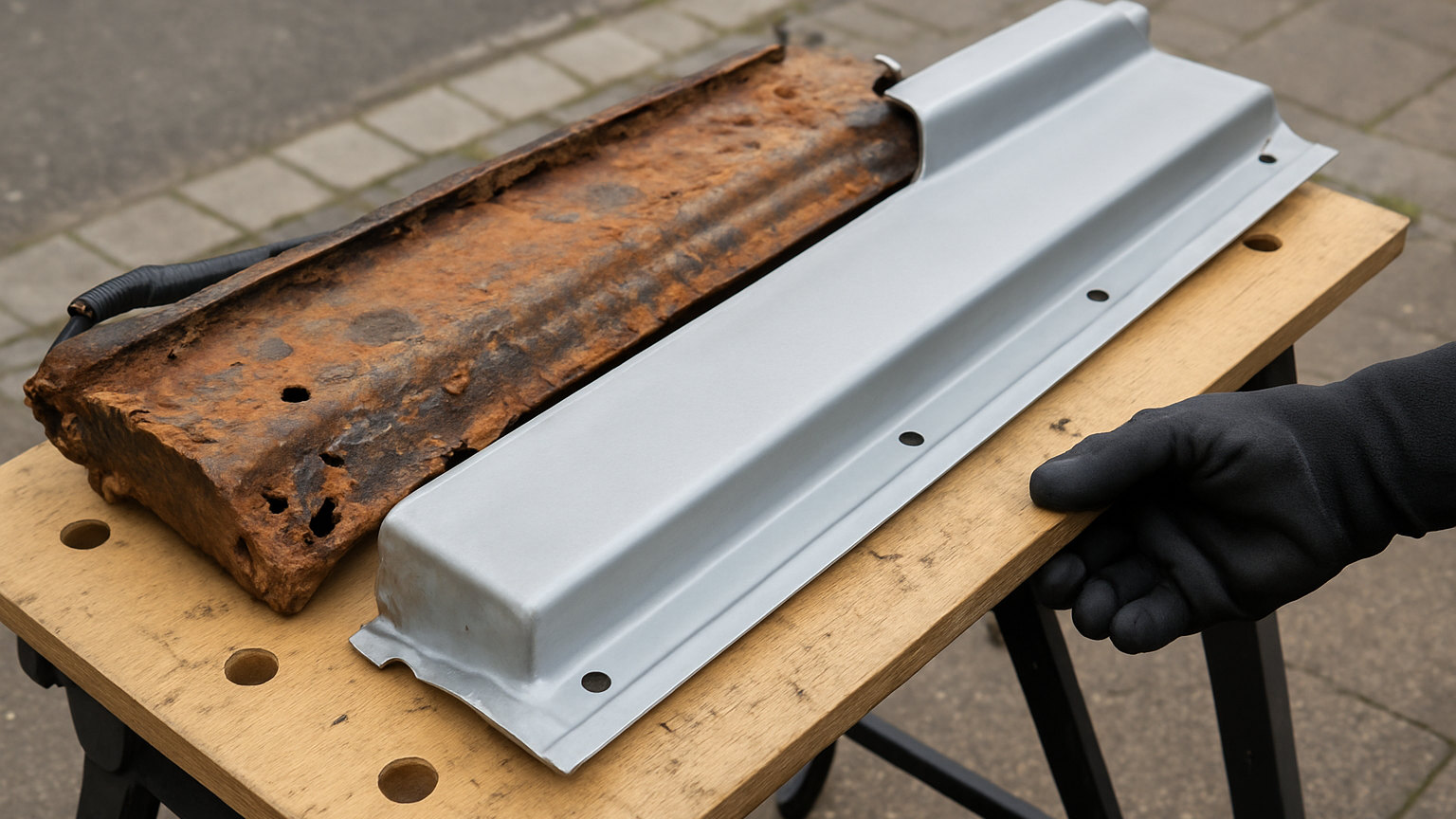
Deciding whether to repair a corroded car is genuinely difficult, because the honest answer depends on things you cannot see until the work begins. The useful approach is to stop thinking about the cost of the visible repair and start assessing the condition of the whole shell, since corrosion is a symptom of conditions that affect the entire vehicle.
Is the rust localised or general?
The single most important question. One corroded arch on a car that is otherwise sound is a repair. Bubbling arches, soft sills, a rotten boot floor and corrosion around the suspension mountings together indicate a shell that has been sitting in the same conditions everywhere, and repairing one area simply means returning for the next.
How do you assess the whole shell?
Get it safely raised and go over the underside systematically with a torch, tapping as you go. Sills, jacking points, floor pans, chassis rails, suspension mountings, subframe attachments and brake pipes. Then lift the boot carpet and check the spare wheel well. An hour spent doing that properly gives an honest picture before any money is committed.
Why do estimates change?
Because nobody knows the extent until the panel is cut open, and corrosion nearly always extends further than the visible damage suggests. Any honest body shop will give an estimate with that caveat. A quote that is remarkably low usually assumes the best case, and the conversation that follows once the work starts is a familiar one.
What is the car actually worth?
Worth establishing honestly, and worth separating from what the car is worth to you. A vehicle with a full service history that suits you and would cost several thousand to replace justifies more expenditure than its book value suggests. A car you were planning to change anyway does not, whatever the emotional attachment.
Does it affect safety?
Structural corrosion certainly does, since the shell is designed to manage crash energy and a rotten sill or floor cannot do that. That consideration sits above the financial calculation. A car with corrosion in prescribed areas is not merely an MOT problem, it is a vehicle whose protection in an accident has been compromised.
Is a classic different?
Considerably, and the arithmetic changes entirely. Where a vehicle has genuine value, historical interest or is simply irreplaceable, extensive restoration makes sense in a way it never would on an ordinary saloon. Panels and expertise are also more readily available for popular classics than for a mainstream car of the same age.
What about selling it as it stands?
A legitimate option, and honesty is essential. Corrosion should be described accurately, since a buyer discovering structural rot has a genuine complaint and misdescription is actionable. Selling a car with known structural corrosion to somebody who will use it on the road carries a moral weight as well as a legal one.
How do you make the decision?
Assess the whole shell, get two estimates from firms that will inspect it properly, establish the realistic replacement cost of an equivalent car, and add a contingency for what will be found once the work starts. If the total approaches what a sound example costs, the answer is usually clear even when it is unwelcome.
Does it change how you use it?
It should, if you decide to keep a car with known structural corrosion. Anything that has been welded or is deteriorating deserves an eye kept on it, and jacking the car on a compromised sill is genuinely dangerous. Knowing where the weak areas are, and telling anybody who works on it, matters more than it might appear.
Marking a compromised jacking point with tape is a small precaution that prevents somebody discovering it the hard way.
It is also worth telling any garage before they put the car on a two post lift, since the lifting points and the sills are frequently the same areas that have corroded.


