
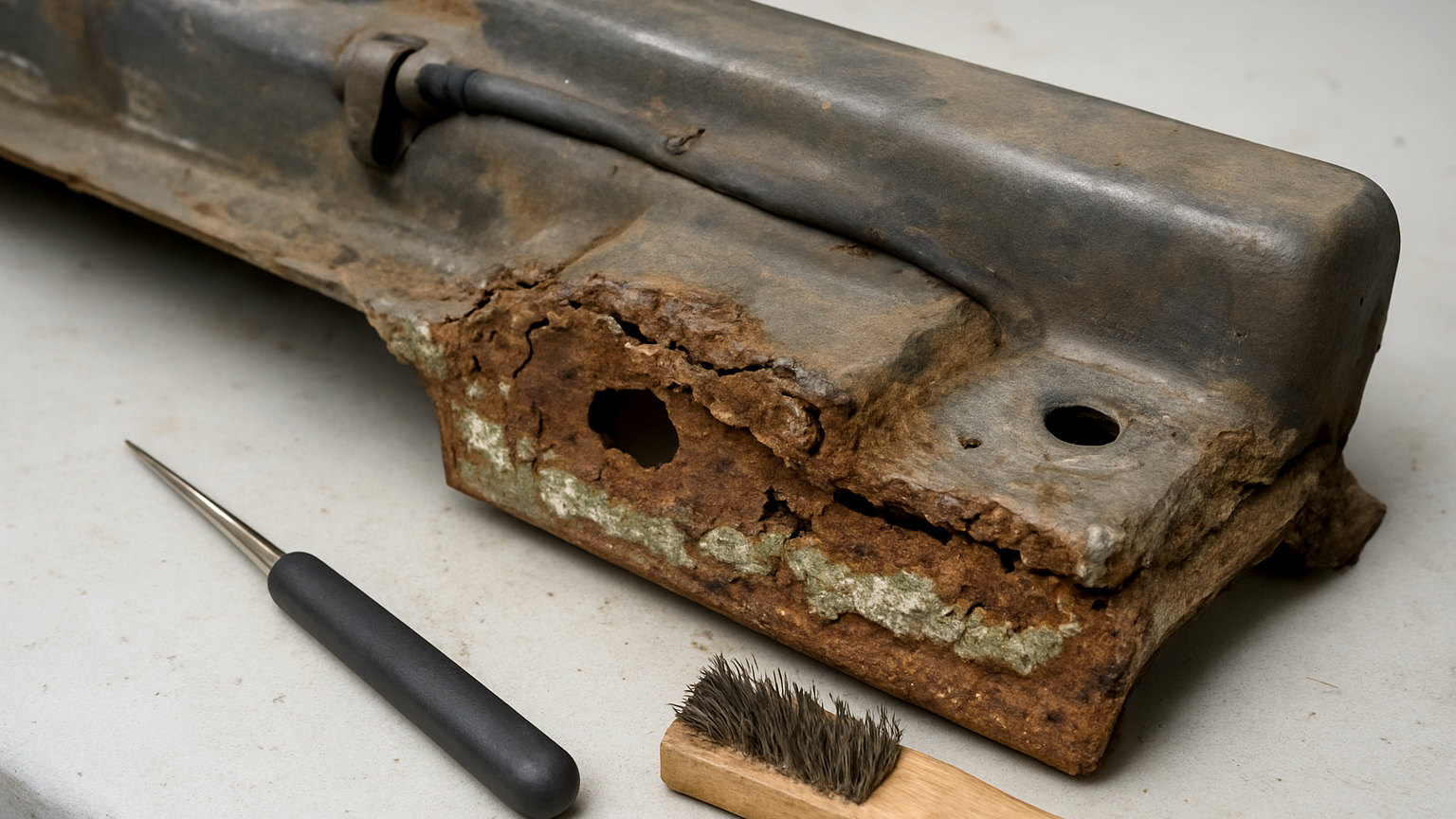
Corrosion is assessed at the MOT on strength rather than appearance, which surprises people in both directions. A car with scruffy paintwork and surface rust on the arches passes without comment, while a tidy looking vehicle fails on corrosion nobody could see. Understanding what the test is actually looking for explains both outcomes.
What is a prescribed area?
A region within a set distance of a structural mounting point, such as a seat belt anchorage, a suspension attachment or a steering component mounting. Corrosion within that area that has weakened the structure is a failure. The precise distance is defined in the testing standards, and it is why rust in one place fails while identical rust elsewhere does not.
How is it assessed?
By finger and thumb pressure and by tapping, since the tester is judging whether the metal retains its strength. Corrosion that is merely on the surface passes. Metal that flexes, that has perforated, or that gives under moderate pressure fails. The test is deliberately not destructive, so a tester will not put a screwdriver through a panel.
Which areas cause most failures?
Sills and jacking points, since they are structural and they corrode from within. Suspension mounting points and subframe attachments. Seat belt anchorages and the floor around them. Brake pipes and their mountings. And the areas around the rear axle mountings, which collect road spray and are rarely inspected by owners.
Are brake pipes included?
Very much so, and they account for a large number of failures on older cars. A rigid pipe corroded to the point of weakness fails even if it is not yet leaking. Because the pipes run the length of the underside and pass through clips where water sits, they corrode in predictable places. It is worth inspecting them before the test.
What about sharp edges?
Corrosion that has created a sharp edge likely to cause injury is a failure in its own right, regardless of whether the area is structural. That covers rotten arch lips and sill edges that have become jagged. It is a separate consideration from strength and it catches cars whose corrosion is extensive but not in a prescribed area.
Is cosmetic rust a failure?
No, and this is worth being clear about. Bubbling paint, surface corrosion on a wing, a rusty bonnet edge and a scruffy tailgate are all cosmetic. They are worth addressing for the car sake and they will not fail the test. What matters is whether the metal still does its structural job and whether anything presents a hazard.
How must repairs be carried out?
Structural repairs in prescribed areas must be by welding with material of equivalent strength, continuously welded where the original was. Riveted patches, filler and bonded plates are not acceptable in those areas. That is why a proper sill repair costs what it does, and why a cheap cosmetic patch will fail at the next test even if it looks tidy.
How can you check beforehand?
Get the car safely raised and inspect the sills, jacking points, suspension mountings and brake pipes with a torch, tapping as you go. Lift the boot carpet and check the spare wheel well and floor. Anything that sounds dull or flexes is worth investigating before the test rather than discovering on the certificate.
What about advisories?
Corrosion advisories are worth taking seriously, since they record metal a tester judged to be deteriorating but not yet failing. Rust does not stabilise, so an advisory this year frequently becomes a failure next year, and dealing with it while the area is still small is considerably cheaper. It is also recorded publicly, which matters when the car is sold.
A buyer checking the history online will see it, so a car with a resolved advisory and paperwork to show it is in a considerably stronger position than one with the note still standing after several years.
It is worth reading the advisories as a sequence rather than individually, since the same area mentioned in successive years tells you the corrosion is progressing rather than static.


