
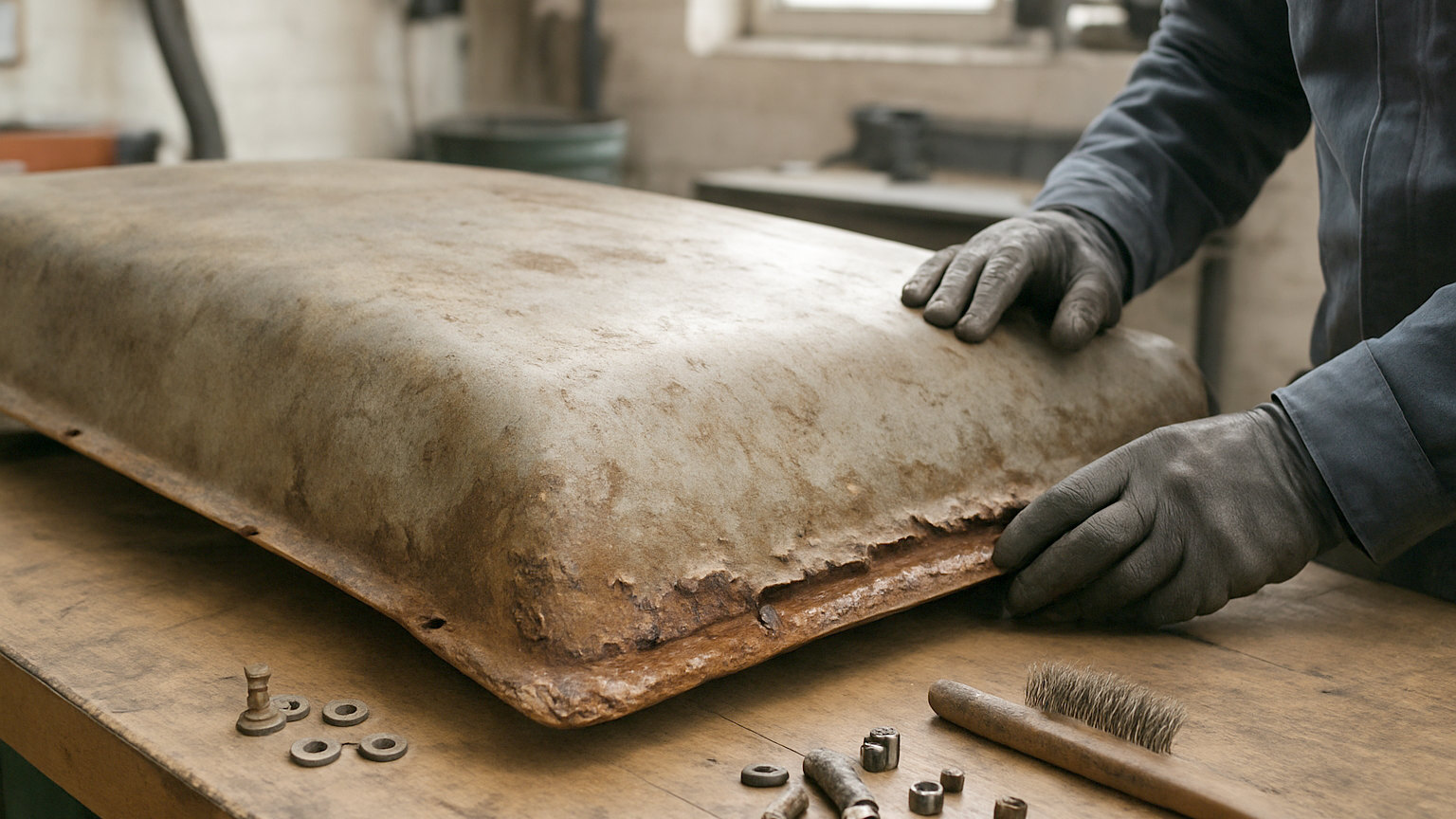
Bonnets, boot lids, tailgates and doors all share a construction that makes their edges vulnerable. An outer skin is folded over an inner frame and crimped, creating a seam with a capillary gap running the full length. Water is drawn into that gap, held there by surface tension, and it dries far more slowly than anything on a flat surface.
Why does the edge go first?
Because the fold traps water and because the paint on a tight radius is thinner than elsewhere, since it flows away from sharp edges during application. Add the fact that these are the lowest points of the panel where water collects, and it becomes the most likely place on the whole car for corrosion to begin.
Do these panels have drains?
Most do, along the bottom edge of doors and tailgates and sometimes at the corners of a boot lid. They are small and easily blocked with dirt and old wax. Clearing them with a piece of wire once a year takes minutes across the whole car and it is one of the more effective corrosion prevention measures available.
Why is the damage always larger than it looks?
Because corrosion starts inside the fold and works outwards, so paint bubbling on the outside is the final stage rather than the first. Opening up a bubbled edge frequently reveals the seam corroded along a considerable length. That is why estimates for edge repairs are provisional and why they so often increase once the panel is stripped.
Do bonnets differ?
Somewhat. A bonnet takes the full force of stone chips along its leading edge, so corrosion frequently begins there from chip damage rather than from the seam. It also gets hot and cools repeatedly, which stresses the paint. The result is that bonnets tend to corrode at the front edge while boot lids and tailgates corrode at the bottom.
Can it be repaired?
Yes, though properly it means opening the crimped seam, cutting out the corroded metal, welding in new material, resealing the seam and recrimping it. That is skilled work. Because these panels are not structural, a good body shop has more latitude than on a sill, and the repair still needs to address the inside or it will return.
Is a replacement panel better value?
Frequently, particularly on a common vehicle where used panels are readily available. A sound second hand bonnet or tailgate in the right colour, or one prepared and painted, is often cheaper than a thorough seam repair. It is worth pricing both, since the answer varies enormously with the model and the colour.
Does it fail an MOT?
Not usually, since these panels are not structural and the corrosion is cosmetic in test terms. What can fail is a sharp edge presenting a risk of injury, or a bonnet or boot lid that no longer latches securely. Beyond that it is a matter of appearance and of the corrosion continuing if left alone.
How do you prevent it?
Keep the drain holes clear, touch in chips along the bonnet leading edge before winter, and wash the seams and edges properly rather than only the flat surfaces. On a car being kept, injecting cavity wax into the fold along the bottom of doors and the tailgate is worthwhile and it costs very little.
How early can it be caught?
Earlier than most people look. Running a finger along the underside of a bonnet edge or the bottom of a tailgate finds roughness well before anything shows on the outside. Doing that once a year across every opening panel takes a few minutes and it catches the seam corrosion while it is still a paint job rather than a welding one.
The bottom of the tailgate and the rear edges of the front doors are the two places most often found first, so they are worth checking before anywhere else.
On a hatchback the tailgate seam sits directly in the path of spray thrown up behind the car, which is why it so often goes before any other opening panel.


