
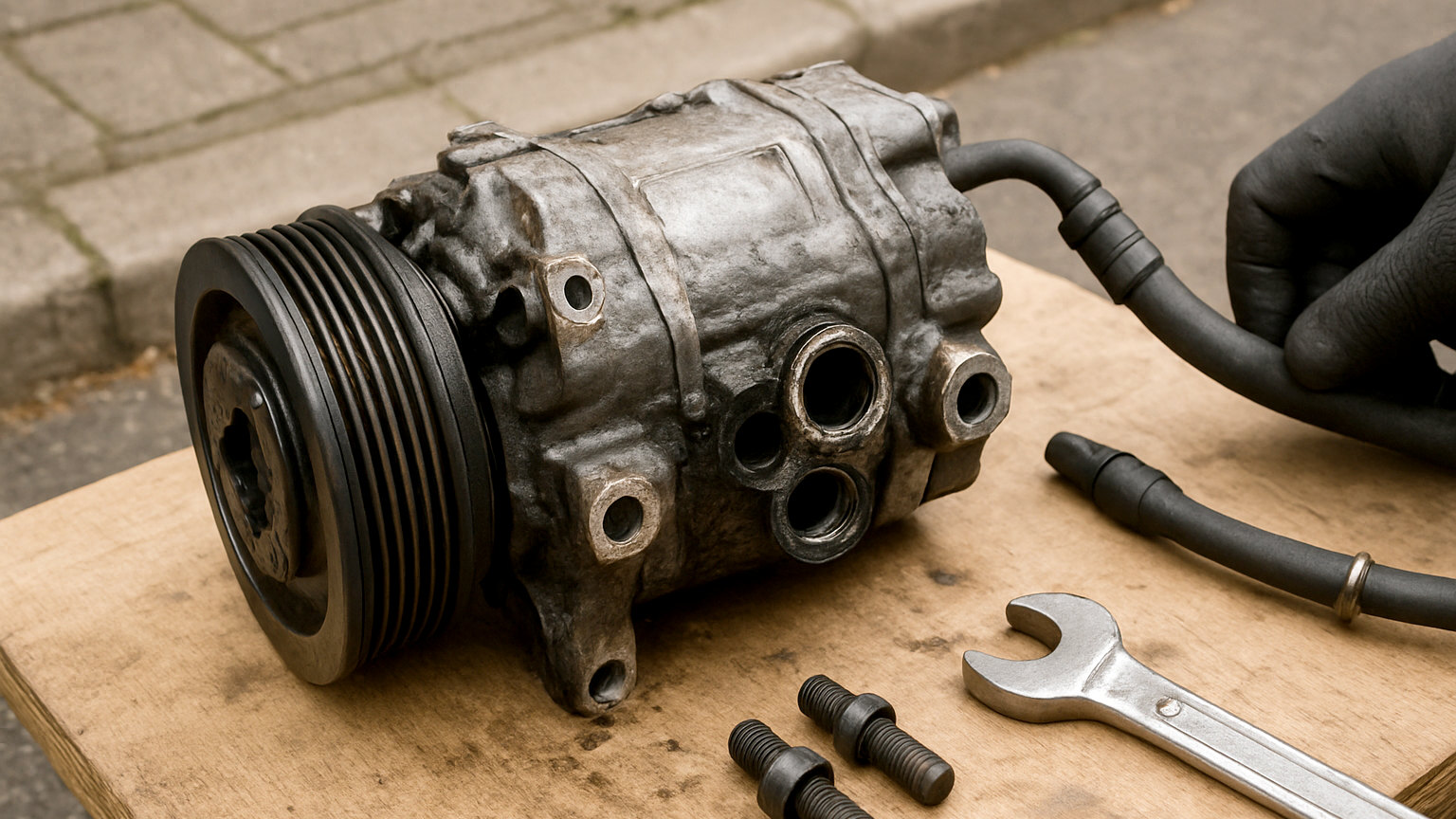
Air conditioning has a reputation for being expensive and unfixable, and that is only partly deserved. Most faults are repairable at component level for reasonable money, and the reputation comes from one specific scenario: a compressor that has failed internally, which contaminates the entire system and turns a single part into a comprehensive job.
Which repairs are straightforward?
A leaking Schrader valve, which is a very cheap part. A perished hose or O ring seal. A condenser damaged by a stone, which is a bolt on component at the front of the car. A failed pressure switch or relay. A cooling fan. All of these are individual components that can be replaced without disturbing anything else beyond recovering and recharging the refrigerant.
Why is a compressor failure different?
Because when one fails internally it sends metal debris around the whole circuit. Those particles lodge in the condenser, the expansion valve and the hoses, and anything left behind will destroy the replacement compressor within months. The correct repair therefore includes flushing the system, a new receiver drier and usually a new expansion valve, which is why the bill is so much larger than the part.
Can the system be flushed?
Hoses and the evaporator generally can, using a solvent forced through and then purged. Condensers with parallel flow construction frequently cannot be flushed effectively, since debris lodges in passages the solvent will not clear, so many specialists replace them after a compressor failure. That is a judgement call worth discussing rather than assuming either way.
Should the drier always be replaced?
Whenever the system has been opened to the atmosphere for any length of time, yes. The desiccant inside absorbs moisture, and once saturated it cannot protect the system. It is an inexpensive part and leaving an old one in place after a repair is a false economy, since moisture in the system forms acids that corrode everything.
What about the evaporator?
It is the awkward one, because it sits behind the dashboard alongside the heater matrix. A leaking evaporator therefore involves the same dashboard out labour as a matrix replacement, which is a full day or more on many cars. It is fortunately less common than a condenser leak, being protected from stones and salt.
Is it worth repairing on an older car?
Often, depending on which component. A condenser or a hose on a ten year old car is usually sensible money. A full compressor failure with system flush on a car worth two thousand pounds is a harder decision, and plenty of owners reasonably decide to live without cooling. What is worth remembering is that the system also demists, which is a genuine loss in winter.
Can you use a bypass?
Where a compressor has seized and the belt drives other components, fitting a shorter belt that bypasses the compressor is a recognised way of keeping the car usable. It is a legitimate solution on a car where a full repair is not economic, and it should be done with the correct belt rather than an approximation.
What should you ask before agreeing?
Which specific component has failed and how that was determined, whether the system needs flushing, whether the drier and expansion valve are included, and what the leak test showed. Those four answers explain the difference between a modest repair and a large one, and they make two quotes comparable rather than leaving you choosing on price.
Is a specialist worth using?
For anything beyond a regas, frequently. Air conditioning specialists have the diagnostic equipment, the flushing gear and the experience of the failure patterns, and they are more likely to identify the actual cause rather than replacing components in sequence. On a compressor failure in particular, the quality of the flush determines whether the repair lasts.
Ask what guarantee is offered on a compressor replacement, since a firm confident in its flushing procedure will usually stand behind the work.


