
Air conditioning systems lose refrigerant for two quite different reasons. A small amount permeates slowly through the rubber sections of the hoses and past seals, which is unavoidable and normal. Everything else escapes through a specific defect, and since refrigerant is expensive and its release is environmentally regulated, finding that defect matters rather than simply topping up.
Why does the condenser leak so often?
Because of where it sits. Mounted at the very front of the car ahead of the radiator, it takes direct stone strikes and constant road salt spray. Its thin aluminium construction corrodes readily, and a stone chip that penetrates a tube empties the system. It is one of the most common leak points on any car more than a few years old.
What about the compressor?
Its shaft seal has to contain high pressure refrigerant while the shaft rotates, and it depends on oil carried in the refrigerant for lubrication. A system used regularly keeps that seal wet and pliable. One left unused for a year allows it to dry and shrink, and it then leaks. That is precisely why running the system in winter is recommended.
Do the hoses fail?
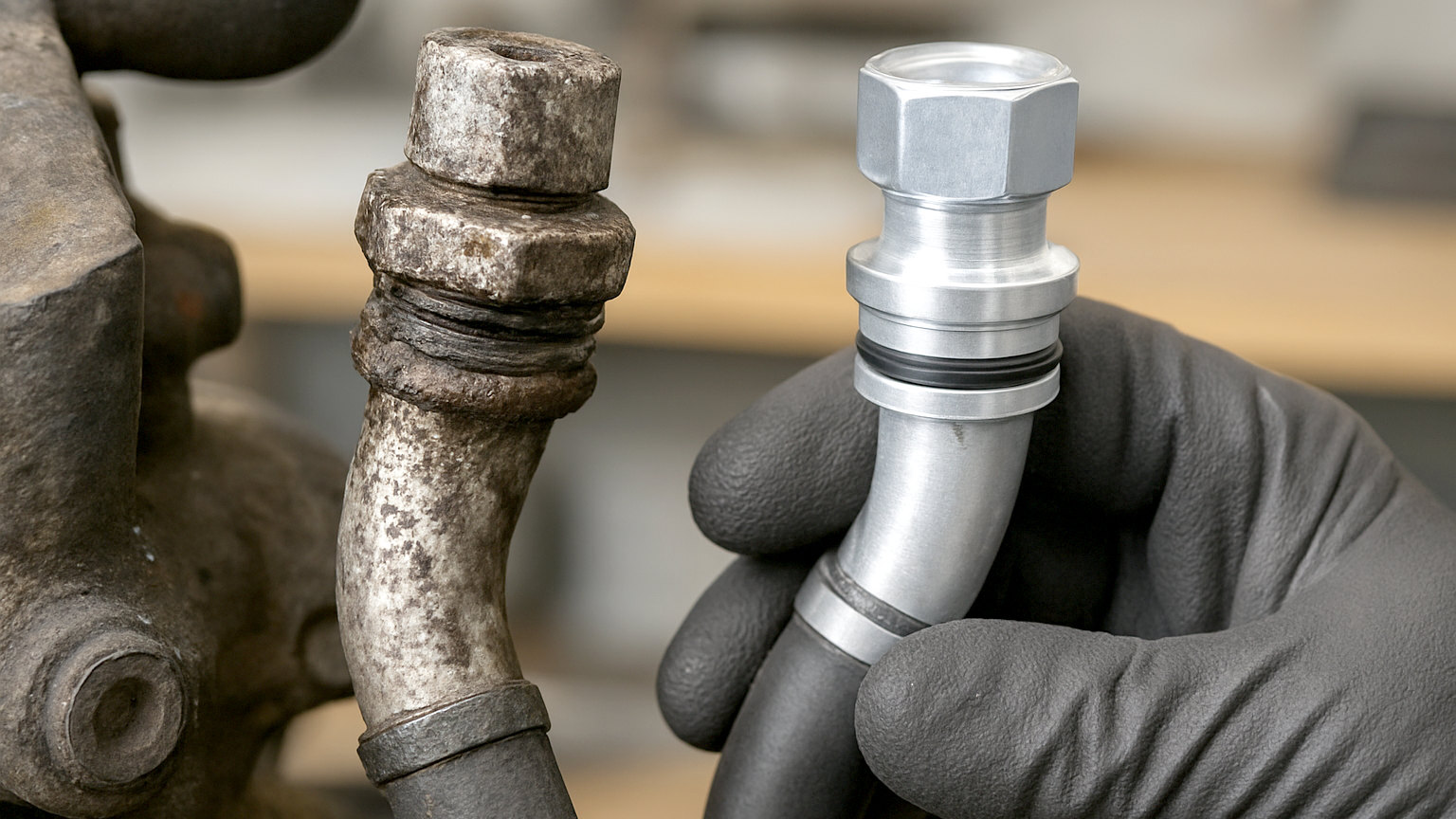
The rubber sections harden and crack with age and underbonnet heat, and the crimped joints where rubber meets metal are a frequent leak point. Vibration works on those joints over years. Replacement hoses are usually available as complete assemblies, since the crimped fittings cannot be repaired in a way that will hold the pressures involved.
What are Schrader valves?
The service port valves, similar in principle to a tyre valve, through which the system is charged. They are inexpensive, they contain a small rubber seal, and they leak surprisingly often. It is worth asking for them to be checked, since replacing one costs very little compared with chasing a leak elsewhere or refilling repeatedly.
How are leaks found?
By vacuum testing first, which shows whether the system holds vacuum and therefore whether there is a significant leak at all. Then by ultraviolet dye added to the oil, which is circulated and then shows as a bright stain at the leak point under a lamp. Electronic detectors sniff for refrigerant vapour and are useful for leaks in awkward positions.
Why does dye take time?
Because it has to circulate and then escape at the leak in sufficient quantity to be visible, which on a very slow leak can take days or weeks of normal use. That is why a workshop may add dye, recharge the system and ask you to return. It is not a delaying tactic; it is the only reliable way to find a small leak.
Is releasing refrigerant a problem?
Yes, and it is regulated. Refrigerants are potent greenhouse gases, deliberate venting is prohibited, and the equipment to recover them properly is why air conditioning work has to be done by an equipped workshop. It is also why aerosol top up cans are frowned upon, since they encourage repeated topping up of a leaking system.
What can you do to prevent leaks?
Run the system for ten minutes every few weeks all year round, which keeps the compressor seal lubricated. Keep the condenser clear of leaves and debris and rinse the front of the car through in winter to reduce salt corrosion. And have any loss investigated rather than repeatedly topped up, since a small leak found early is usually a cheap repair.
Does a leak damage anything else?
It can. A system running low on refrigerant is also running low on the oil that lubricates the compressor, so continued use with a leak wears the most expensive component in the system. That is the practical reason to find and fix a leak rather than topping up repeatedly, quite apart from the cost of the refrigerant itself.
A leak found while it is still slow is usually a seal or a valve costing very little, while the same leak ignored for two summers can end with a compressor replacement.


