
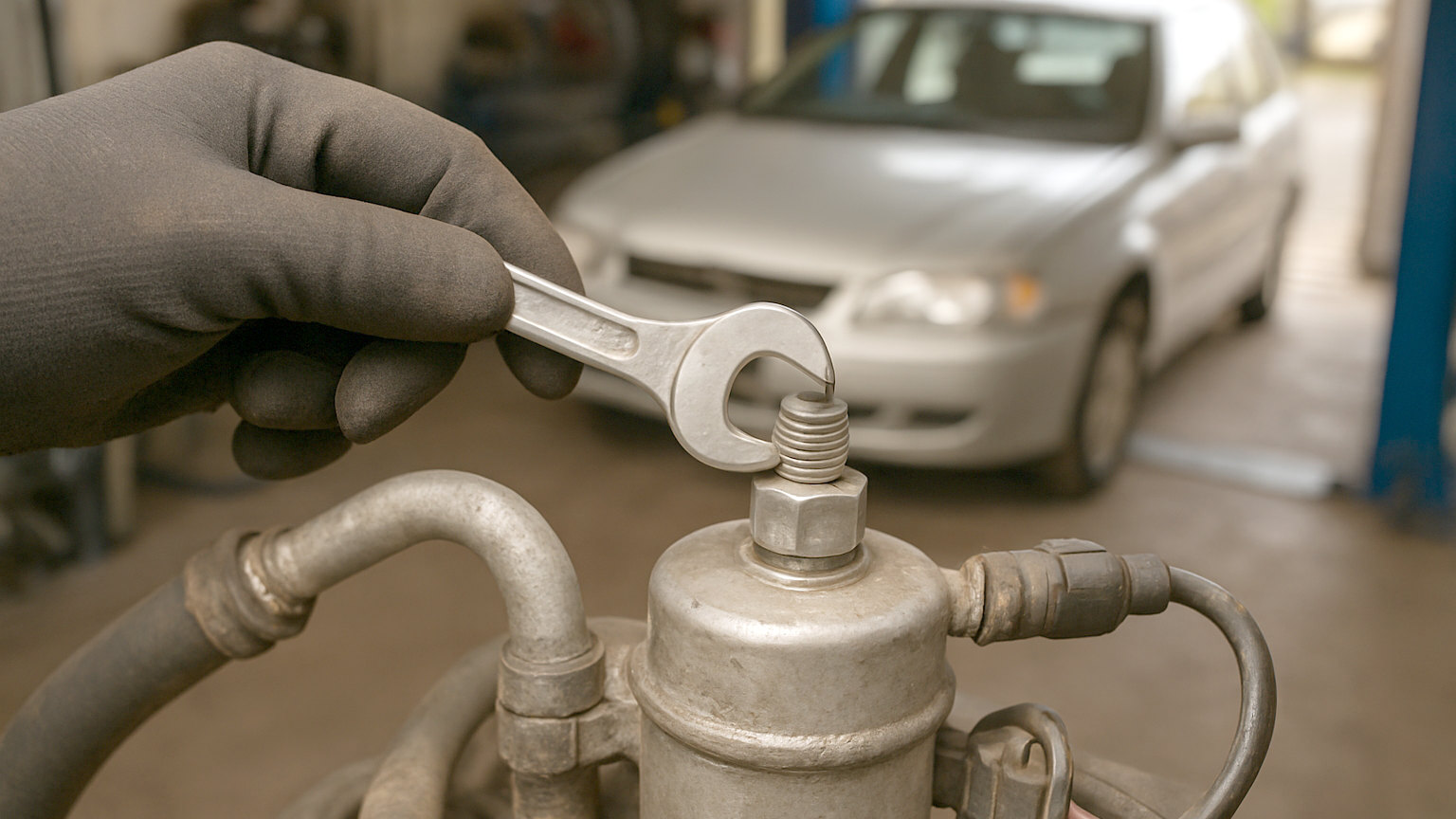
Air conditioning that works, then stops, then starts again is behaving quite differently from one that has simply gone warm. Something is switching the compressor off and on, and in nearly every case that something is a protection device reacting to a pressure or temperature that has gone outside its normal range. The switching is the symptom; the pressure is the fault.
What do the pressure switches do?
They protect the compressor. A low pressure switch prevents it running when the charge is too low, since the oil that lubricates it is carried in the refrigerant. A high pressure switch cuts it out if pressures rise dangerously, usually because heat is not being rejected properly at the condenser. Both are doing their job when they interrupt cooling.
What does rapid cycling indicate?
A compressor clutch engaging and disengaging every few seconds, audible as repeated clicks, usually points at a low charge. Pressure rises just enough to satisfy the low pressure switch, the compressor runs briefly, pressure drops, and it cuts out again. It is a very characteristic pattern and it means the system should be checked rather than simply topped up.
What is evaporator icing?
Ice forming on the evaporator, which blocks the airflow so no cold air reaches the cabin. Cooling stops, the ice melts over several minutes, and cooling returns, then the cycle repeats. Causes include a blocked cabin filter restricting airflow, a failed temperature sensor, or running the system on maximum with recirculation and a low fan speed for long periods.
Does it cut out under acceleration?
Many cars disengage the compressor briefly at full throttle to free up power, which is entirely normal and lasts only seconds. If cooling disappears for longer than that, or under moderate acceleration, something else is happening. Knowing that the behaviour is designed in prevents a normal characteristic being investigated as a fault.
Could it be electrical?
Certainly. A failing clutch coil, a corroded connector, a marginal relay or a chafed wire all produce intermittent operation. The clutch air gap widening with wear is another common cause, since the electromagnet eventually cannot pull the plate in reliably, particularly when everything is hot. That produces cooling that works from cold and fails once warmed through.
Does the engine temperature matter?
It can. Many systems cut the compressor out if the engine coolant temperature rises too high, to reduce load and protect the engine. Air conditioning that disappears in slow traffic while the temperature gauge climbs is describing an engine cooling problem rather than an air conditioning one, and the fan or the radiator is the place to look.
How is it diagnosed?
By connecting gauges and watching what the pressures do at the moment it cuts out, which distinguishes a low charge from a high pressure condition immediately. Live data from the climate module often shows evaporator temperature and pressure sensor readings, and a fault code may name the specific switch. It is a measurement job rather than a guessing one.
Is it damaging to keep using?
Rapid cycling on a low charge is, since the compressor is running with inadequate lubrication each time it engages. That is the version worth stopping and having checked rather than living with through a summer. Icing and normal full throttle cut outs are not damaging, though icing usually points at a blocked filter that is worth changing anyway.
What should you note before booking?
How long it works before cutting out, whether it returns on its own, whether it happens in traffic or at speed, and whether the engine temperature changes at the same time. Those four observations point at a low charge, an airflow problem or an electrical fault respectively, and they save considerable diagnostic time.
Listening for how often the compressor clutch clicks in and out with the bonnet up is also worth doing, since rapid cycling is a very recognisable indicator of a low charge.


