
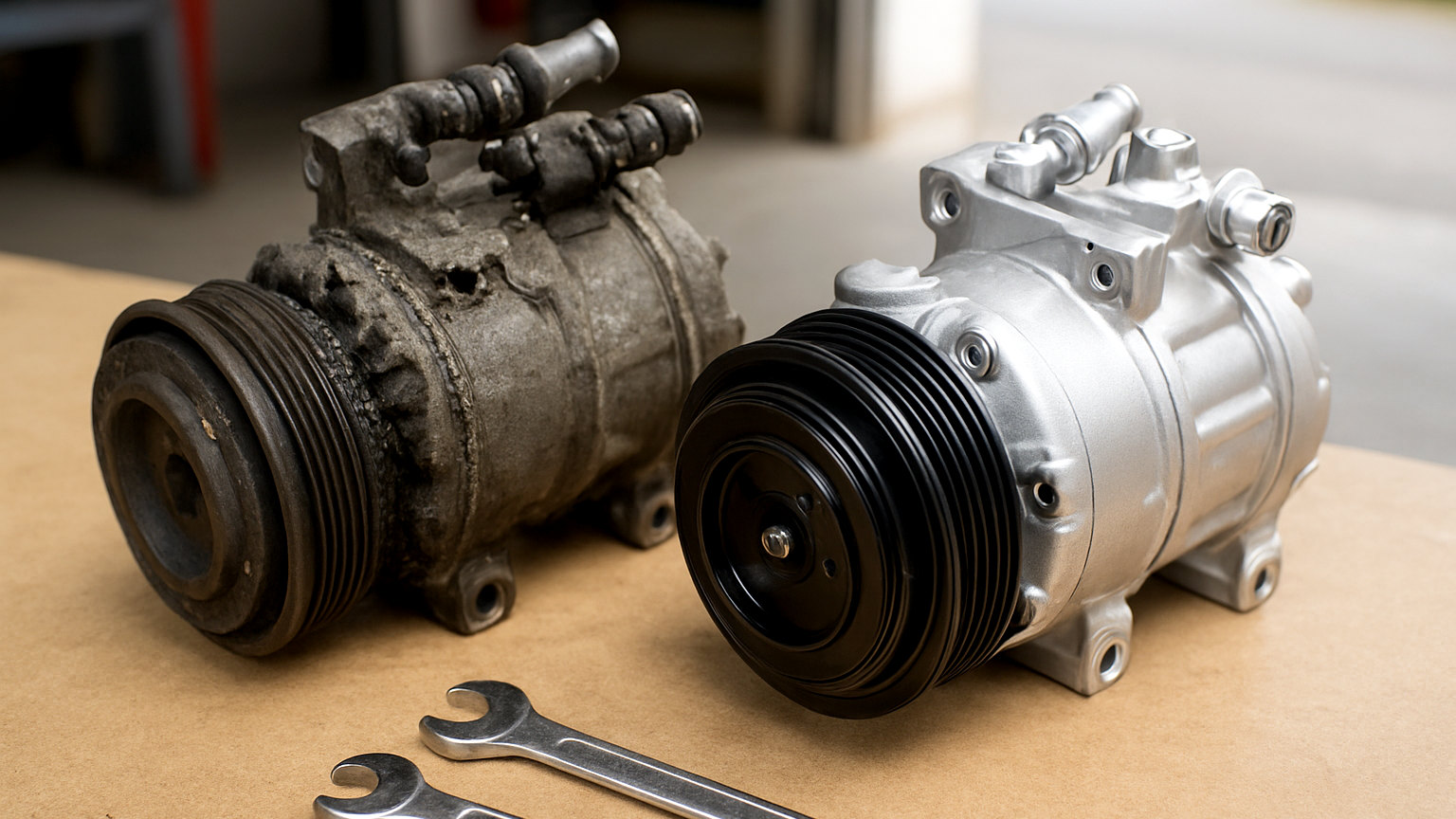
The compressor is the heart of an air conditioning system and by some distance its most expensive component. It compresses refrigerant vapour into a high pressure gas, which drives the entire cooling cycle. It is also the part most easily destroyed by neglect elsewhere in the system, which is why understanding what damages it is worth more than knowing what it costs.
How is it driven?
On most cars by the auxiliary belt, through an electromagnetic clutch on the front of the pulley. The pulley spins whenever the engine runs, and the clutch engages the compressor shaft only when cooling is required. That click you hear when switching the system on is the clutch pulling in, and it is one of the quickest checks available.
How does it get lubricated?
By oil carried around the system dissolved in the refrigerant, rather than by an oil supply of its own. That is the crucial point. A system low on refrigerant is also low on oil reaching the compressor, so running it in that state causes rapid internal wear. It is why pressure switches prevent the clutch engaging when the charge is too low.
Why does the clutch fail?
The friction surfaces wear and the air gap grows until the electromagnet can no longer pull the plate in, so the compressor stops engaging even though the coil is working. The coil itself can also fail electrically. On some designs the gap can be adjusted with shims, which is far cheaper than replacing the whole compressor.
What happens when a compressor seizes?
The belt is dragged over a locked pulley, which usually shreds it. Since the same belt drives the alternator, water pump and power steering on most cars, that means an immediate loss of charging and often cooling too. A seized compressor is one of the few air conditioning faults that stops the car rather than merely making it uncomfortable.
Why does failure contaminate the system?
Because a compressor that fails internally sends metal particles around the entire circuit. Those particles lodge in the condenser, the expansion valve and the hoses, and any left behind will destroy a replacement compressor quickly. That is why a compressor failure means flushing the system, replacing the drier and usually the expansion valve, which is why the bill is so much larger than the part alone.
What noises indicate trouble?
A rattle or grinding that appears when the system is switched on and stops when it is switched off. A squeal at the moment of engagement, which suggests the belt is slipping or the clutch is dragging. A rumble from the pulley bearing, which can be present even with the system off since the pulley always turns. All are worth investigating before something seizes.
What about electric compressors?
Hybrids and electric vehicles use a compressor driven by its own high voltage electric motor, so cooling works with the engine stopped. They use a specific electrically insulating oil, and using the wrong type is dangerous as well as damaging. Work on these systems involves high voltage components and is genuinely not a home repair.
How do you protect it?
Run the system regularly all year, which keeps oil circulating to the seals and bearings. Have any loss of refrigerant investigated promptly rather than running the system at low charge. Avoid aerosol top up cans, since the sealant in some of them can damage the compressor. And treat any new noise as a reason to investigate rather than to turn the radio up.
How do you know if it has failed?
No cold air combined with no click when the system is switched on, and no movement at the centre of the compressor pulley. That could equally be low refrigerant or an electrical fault, so it needs measuring rather than assuming. A noise that appears only when the system is on, or a shredded belt, points more firmly at the compressor itself.


