
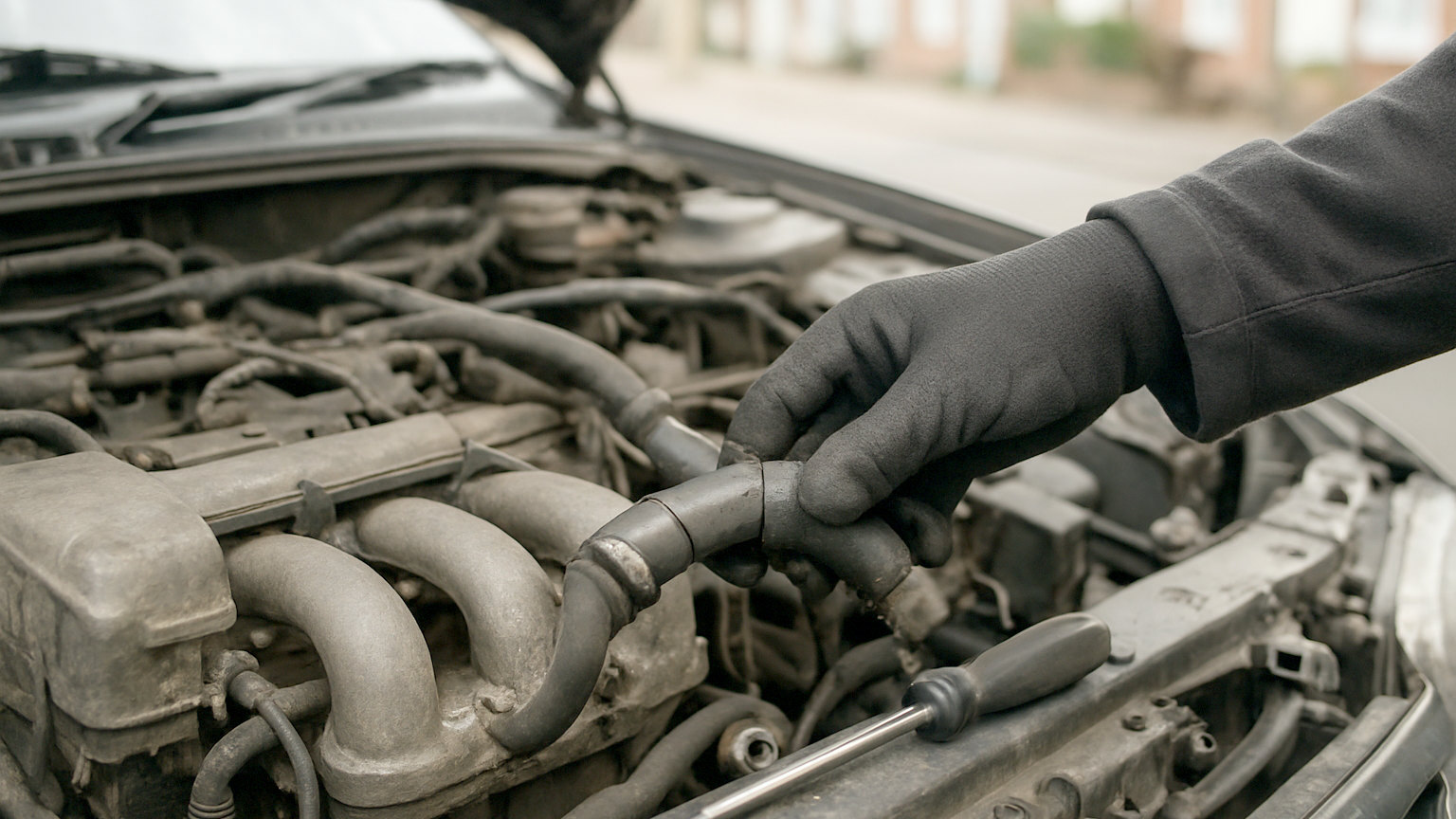
Vacuum leaks are behind a very large share of stalling and rough idle complaints, and they are frequently missed because the offending component is a piece of rubber hose costing a few pounds hidden underneath something else. Understanding why a small leak has such a large effect makes the diagnosis much more intuitive, and it explains why the same fault causes no symptoms whatsoever when driving.
What is a vacuum leak?
A running petrol engine draws air past a nearly closed throttle at idle, which creates a strong vacuum in the inlet manifold. Any crack, split, perished hose or failed gasket downstream of the airflow sensor allows air to be drawn in through that opening. Because that air has not passed the sensor, the management does not know about it, so the fuelling calculation is based on a smaller air quantity than actually entered the engine. The mixture goes lean.
Why does it matter so much at idle?
Proportion. At idle the total airflow into the engine is very small, so a leak admitting a modest quantity might represent a substantial percentage of everything entering. At three thousand revolutions with a wide open throttle, the same leak is a fraction of a percent and makes no measurable difference. That is precisely why a car with a vacuum leak stalls at junctions, idles roughly and surges, yet drives perfectly well once moving.
What are the symptoms?
A rough, unstable or hunting idle, stalling when coming to a stop, an idle speed that is higher than normal, hesitation on light throttle, and sometimes a whistling or hissing noise from the engine bay. The engine management light often appears with lean running codes, and fuel trim values will show the system adding significant extra fuel to compensate. That trim reading is effectively a measurement of the leak and is the most reliable indicator there is.
Where are leaks usually found?
Crankcase breather hoses top the list, because they carry hot oily vapour and harden and split with age, often on the underside where the crack is invisible. Inlet manifold gaskets fail, particularly on engines with plastic manifolds. The flexible ducting between the airflow sensor and throttle body cracks along its folds. Brake servo hoses and their one way valves perish. Small vacuum lines to solenoids and actuators become brittle. An oil filler cap with a failed seal or a dipstick not seated fully can also do it.
How can you find one yourself?
Listen at idle in a quiet space with the bonnet up, since larger leaks hiss audibly. Follow each hose to both ends and flex it gently, because splits often open only when the rubber is bent. Check that the oil filler cap and dipstick are properly seated, which takes seconds and occasionally solves the whole problem. Take care around belts, the fan and hot components while doing any of this.
What is a smoke test?
The professional method, and it finds in minutes what can take hours by hand. A machine fills the intake system with a dense harmless vapour at low pressure, and the vapour escapes visibly wherever there is a leak. It finds cracks that are inaudible and invisible, including those hidden underneath the manifold. It is not expensive as diagnostic procedures go, and it is far cheaper than fitting a sensor that was never at fault.
Why not just replace the sensor the code names?
Because a lean running code describes a condition, not a component. The management has detected that the mixture is leaner than expected, which is exactly what a vacuum leak produces, and it is also what a failing airflow sensor or a weak fuel pump produces. Fitting an airflow sensor to a car with a split breather hose changes nothing except the bill. Reading the fuel trims and carrying out a smoke test first is the sequence that gets it right, and it usually costs less than the sensor would have done.


