
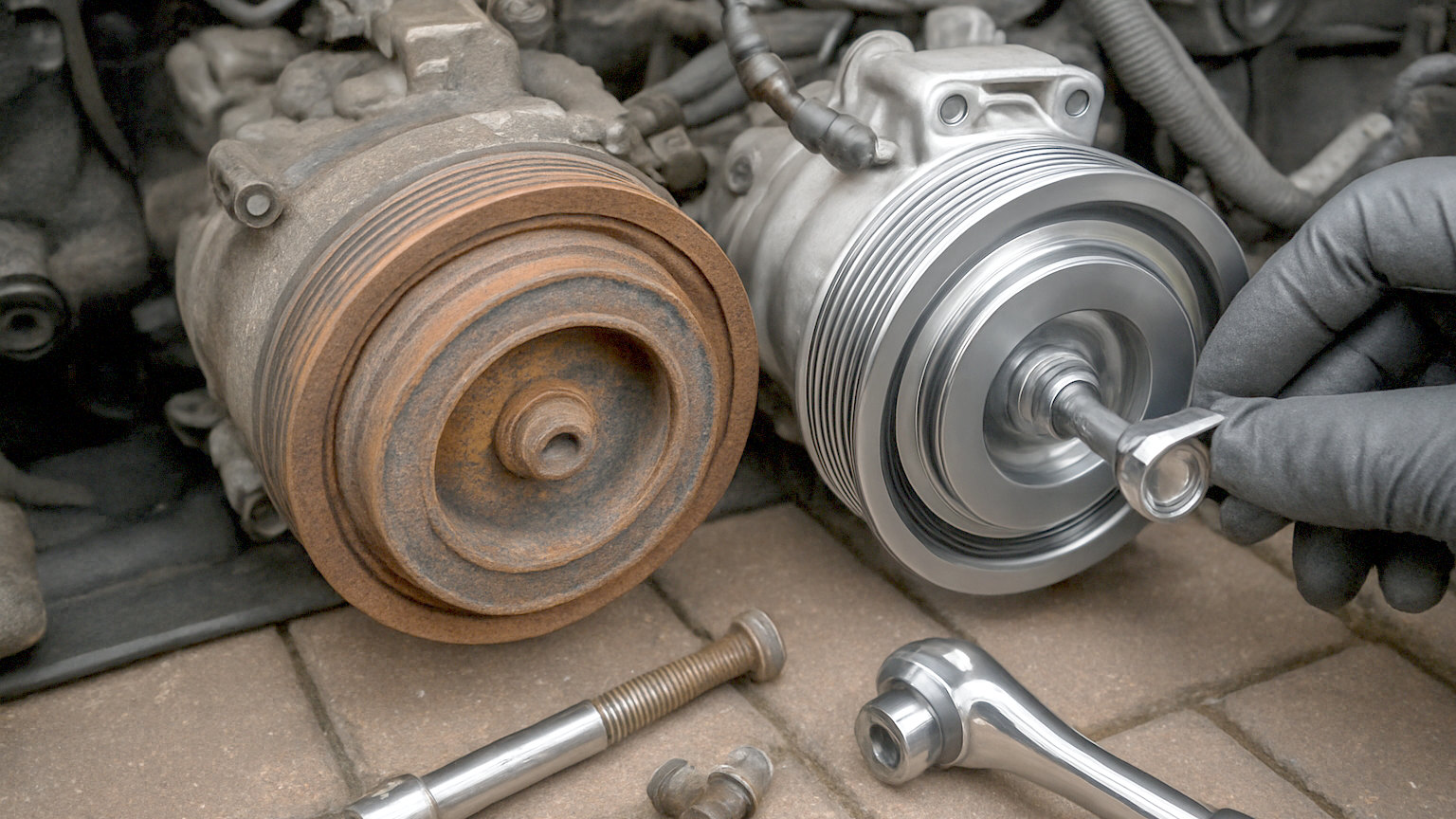
Switching on the air conditioning engages a compressor driven by the auxiliary belt, and that compressor absorbs a genuinely significant amount of engine power. On top of that, the condenser fans come on and load the alternator. At idle, where the engine is producing very little power in the first place, those two loads together are substantial, and a car that stalls when you press the button has an idle control system with no margin left.
What is the engine supposed to do?
The engine management knows when the compressor is about to engage, because it controls the clutch that engages it. It raises the idle speed a moment beforehand so the extra load arrives on an engine already spinning slightly faster. This is called idle up, and when everything is working the driver notices nothing more than a small change in engine note. A stall means either the idle up did not happen or the engine could not deliver it.
Why would the idle fail to rise?
Usually because the idle control cannot admit any more air. A throttle body coated with carbon, a sticking idle air control valve, or an electronic throttle that has run out of adaptation range all limit how much extra air can be supplied on demand. An unmetered air leak elsewhere means the system is already holding the throttle closed further than normal to compensate, leaving nothing in hand when the compressor arrives.
Could the compressor itself be the problem?
It can. A compressor with failing internal bearings or one that is seizing takes far more power to turn than a healthy one, and in the worst case it locks solid and stops the engine outright or shreds the auxiliary belt. Warning signs include a loud clunk or a grinding when the system engages, a squeal from the belt at the moment of engagement, and air conditioning that has become progressively less cold. Any of those need looking at before the belt fails.
Does refrigerant pressure matter?
It does. An overfilled system or one with a blocked condenser runs at very high pressure, which makes the compressor much harder to turn. A condenser matted with insects and leaves, or condenser fans that are not running, both cause pressure to climb. This is worth checking because it is a cheap fix and because it also explains air conditioning that works reasonably at speed and poorly in traffic, which frequently accompanies the stalling complaint.
What if it only stalls with the steering turned as well?
That combination is common and confirms the diagnosis rather than complicating it. Air conditioning and power steering together are two substantial loads at idle, and a car that copes with either alone but dies with both has an idle control that is already marginal. Switching the air conditioning off while manoeuvring is a workaround, not a fix, and it does not mean the air conditioning is faulty.
What should be checked?
Have the throttle body inspected and cleaned if fouled, the fuel trims read to reveal any unmetered air, and the intake and breather hoses checked for splits. On the air conditioning side, ask for the system pressures to be measured and the condenser and its fans to be inspected. Between them those checks cover both possible directions, and they distinguish an engine that cannot supply the power from a system that is demanding too much of it.
Is it worth just leaving the air conditioning off?
Not really, for two reasons. The first is that the underlying idle weakness will eventually cause stalling without the air conditioning too, since these faults progress. The second is that air conditioning systems deteriorate when unused, because the compressor seals depend on the oil circulating with the refrigerant, and a system left switched off for a year is more likely to develop a leak. Running it briefly every few weeks is better for it, which is one more reason to fix the idle rather than avoid the button.


