
There is a meaningful difference between a car that will not idle at all and one that idles perfectly happily but dies during the second or two it takes to get there. The first is a steady state problem. The second is a handover problem, where the management has to catch falling revs and hold them at a target, and a great many cars that stall at junctions are failing at exactly that transition rather than at idle itself.
What happens during that transition?
As you lift off the accelerator, fuel is often cut entirely to save consumption while the wheels are still driving the engine. When the revs approach idle, fuelling resumes and the idle control opens the air bypass to catch the engine before it falls too low. That handover has to be timed precisely, and it relies on the throttle position, engine speed and airflow readings all being accurate at the same moment. If the revs undershoot the target, the engine dies.
Why does pressing the clutch make it worse?
Because it removes the momentum of the car from the equation. While in gear, the wheels are turning the engine and holding the revs up. The instant the clutch goes down, the engine is on its own and has to sustain itself, and any weakness in idle control is exposed immediately. This is why so many stalls happen in the moment between pressing the clutch and coming to a halt, and why the same car will idle perfectly once it has survived that transition.
What are the usual causes?
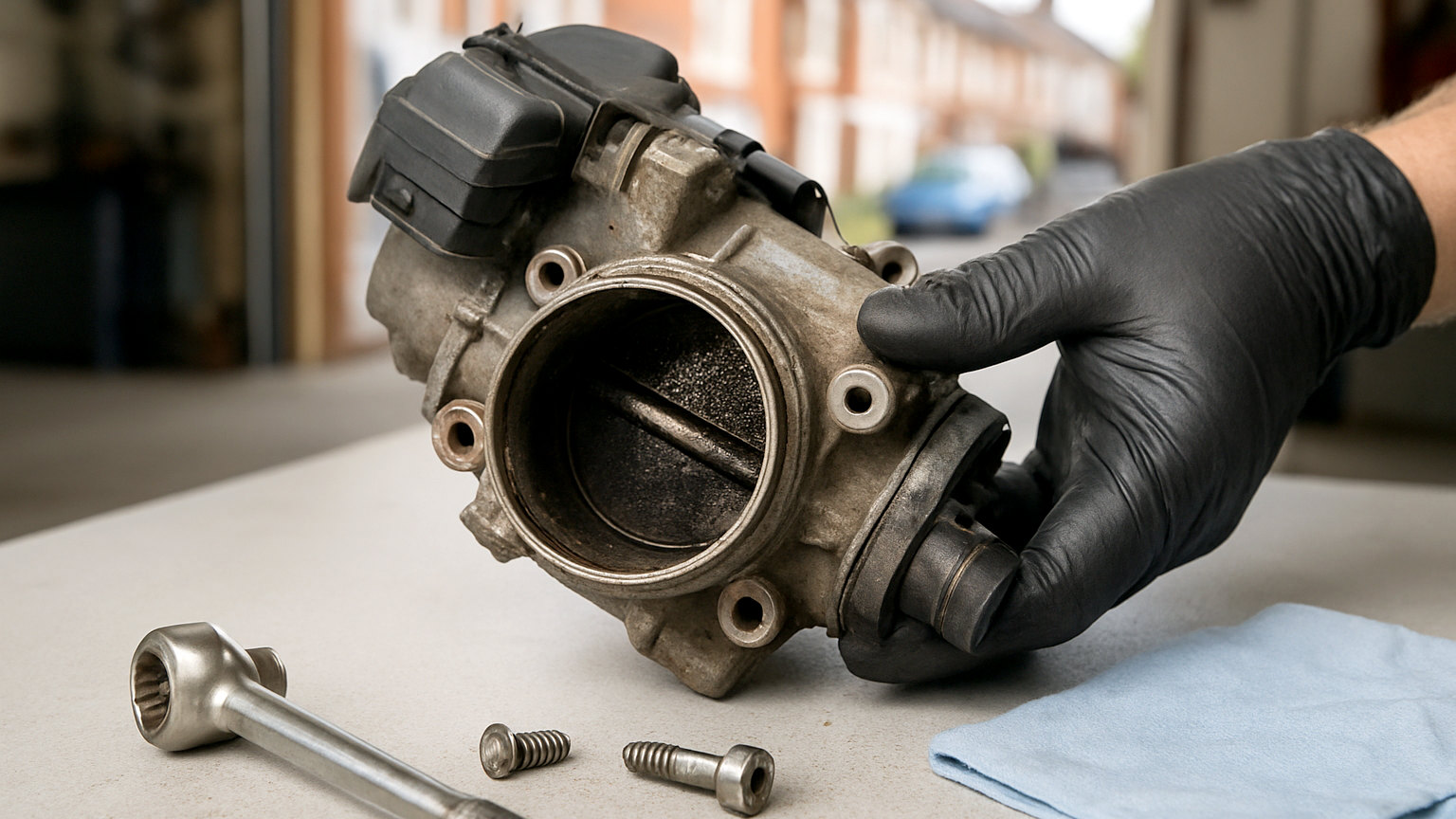
Deposits around the throttle plate or in the idle bypass are the most common, because they slow how quickly extra air can be admitted at the critical moment. Unmetered air entering through a split hose confuses the fuelling calculation. A dirty airflow sensor responds too slowly to the rapid change in flow. A weak fuel pump that cannot maintain pressure during the transition has a similar effect. All are relatively inexpensive to address.
Could the brakes be involved?
They can, and this is worth knowing because it is easy to miss. The brake servo uses engine vacuum, and a failed servo diaphragm or a perished hose lets air into the manifold every time the pedal is pressed. Since you press the brake at exactly the moment you are slowing to a stop, a car that stalls only when braking and not when coasting to a halt in neutral is describing a servo leak fairly precisely. The pedal often feels harder than normal as well.
What about automatics?
An automatic stalling as it comes to a stop in drive is a slightly different situation, because the torque converter is still coupling the engine to a stationary gearbox and applying a real load. A torque converter lock-up clutch that fails to disengage will stall the engine exactly like letting the clutch up too quickly in a manual, and that is a transmission fault rather than an engine one. Low transmission fluid can produce similar behaviour.
Is there anything you can do while driving?
Coming to a stop more gradually, and giving the engine a little throttle as you press the clutch, will usually keep it alive. That is a workaround rather than a solution, and it is worth noting that a car which needs it has a fault that is going to get worse. Stalling in traffic also means losing power steering assistance and, after two or three pedal presses, brake assistance too, which is a genuine safety consideration.
What should you have checked?
Ask for the fuel trims and idle control data to be read, for the throttle body to be inspected, and for the brake servo and its hose to be checked for leaks. Mention specifically that the stall happens during deceleration rather than at a settled idle, because that detail points a mechanic towards the transition rather than the idle itself and saves a good deal of time.


