
An idle that rises and falls rhythmically, often over a range of several hundred revolutions, looks alarming but is describing something quite specific. The engine management is trying to hold a target idle speed, finding it is wrong, correcting it, overshooting, and correcting again. That oscillation happens when the system is working from information that does not match reality, so the question is always which piece of information is wrong.
How does the car control idle speed?
The management has a target idle, adjusted for coolant temperature, electrical load, air conditioning and gear selection. It reaches that target by controlling how much air bypasses the closed throttle, then trims the fuelling to suit. It is a feedback loop, so it constantly measures the result and adjusts. A loop like this becomes unstable when there is an unmeasured variable in it, which is exactly what an air leak represents.
Why do air leaks cause hunting specifically?
Because the extra air is invisible to the system. The management sees revs that are higher than it commanded, so it closes the idle bypass to compensate. That drops the revs too far, so it opens again, and the cycle repeats. The result is the classic surge. Since idle airflow is very small, even a modest leak is proportionally large, which is why a leak that has no effect at all when driving produces a dramatic surge at a standstill.
Where are the leaks usually found?
Crankcase breather hoses are the most common, because they are rubber, they run hot, and they harden and split with age, often on the underside where they cannot be seen. Inlet manifold gaskets fail. The flexible ducting between the airflow sensor and the throttle body cracks along its folds. The brake servo hose and its one way valve perish. A dipstick not seated properly or an oil filler cap with a failed seal can also do it, and both are worth checking simply because they take seconds.
Which sensors cause a hunting idle?
The coolant temperature sensor is a frequent culprit, because the management uses its reading to set both the target idle and the fuelling. A sensor reporting the engine as colder than it is will hold a raised idle and enrich the mixture, and if the reading is erratic the idle will wander accordingly. A contaminated mass airflow sensor gives lagging readings that make the loop unstable. Failing oxygen sensors cause the fuel trims to swing, which shows up most obviously at idle.
Can a dirty throttle body cause it?
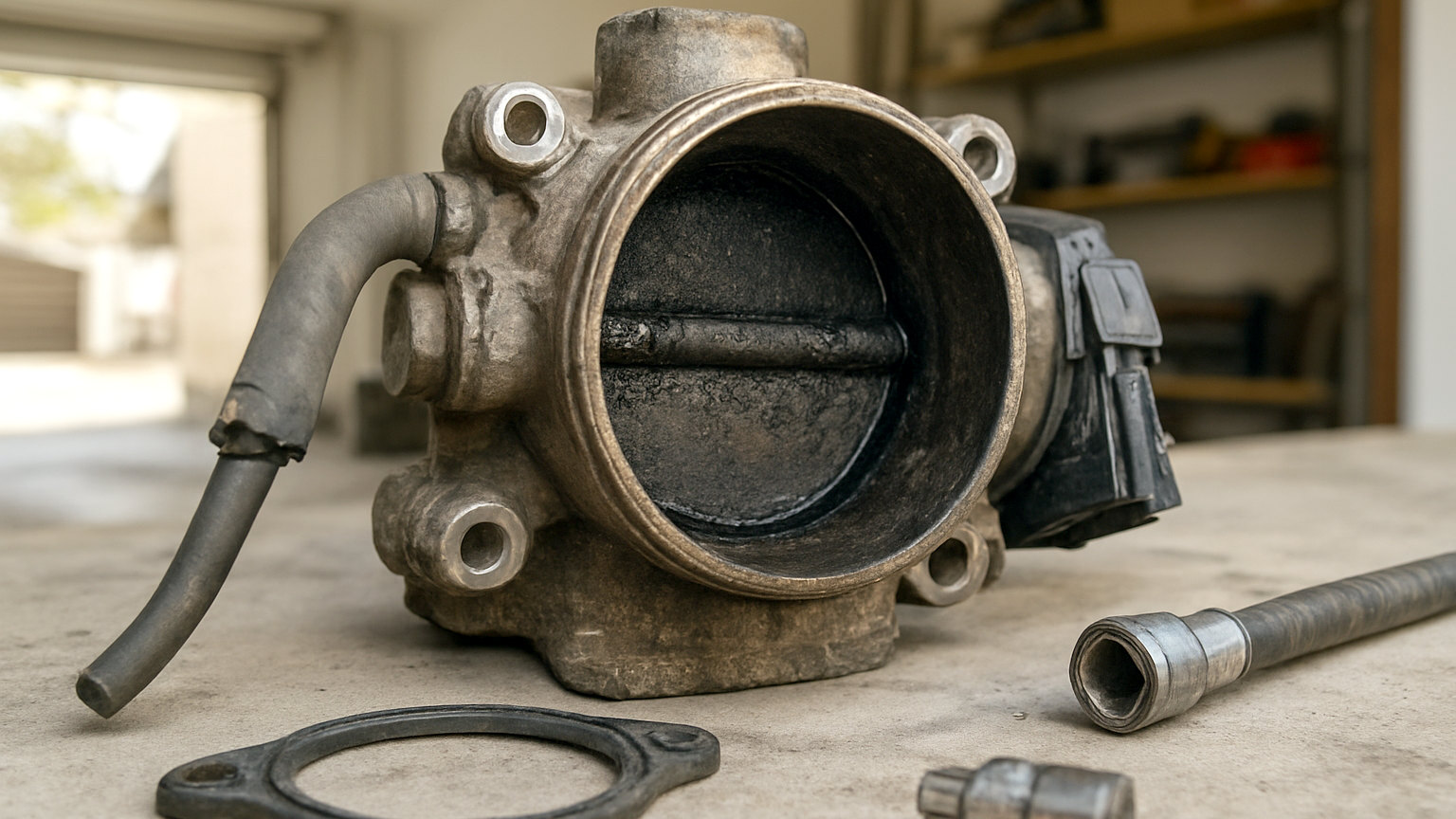
Frequently, and it is one of the more satisfying repairs because it is cheap and the improvement is immediate. Carbon builds up around the throttle plate and the small bypass passages, changing the airflow for any given position. The management adapts up to a point and then runs out of adjustment. Cleaning the throttle body restores normal behaviour, though many cars require a throttle relearn procedure afterwards, and cleaning without doing that occasionally makes the idle worse for a while.
What should you do about it?
Have the codes and live data read, paying particular attention to fuel trims, since large positive trim values are the signature of unmetered air entering the engine and effectively confirm an air leak before anyone starts looking for it. Then have a smoke test carried out if nothing is visible, because small leaks are impossible to hear over a running engine and a smoke machine finds them in minutes. Replacing sensors on suspicion, without that data, is how people end up fitting three parts to fix one split hose.
Is a hunting idle harmful?
Not immediately, but it is not something to live with. The oscillation makes low speed manoeuvring awkward, it wastes fuel, and on an automatic it produces a car that surges gently against the brakes at a standstill. More to the point, the underlying cause is usually a split hose or a fouled throttle body, and both of those get worse rather than better while being ignored.


