
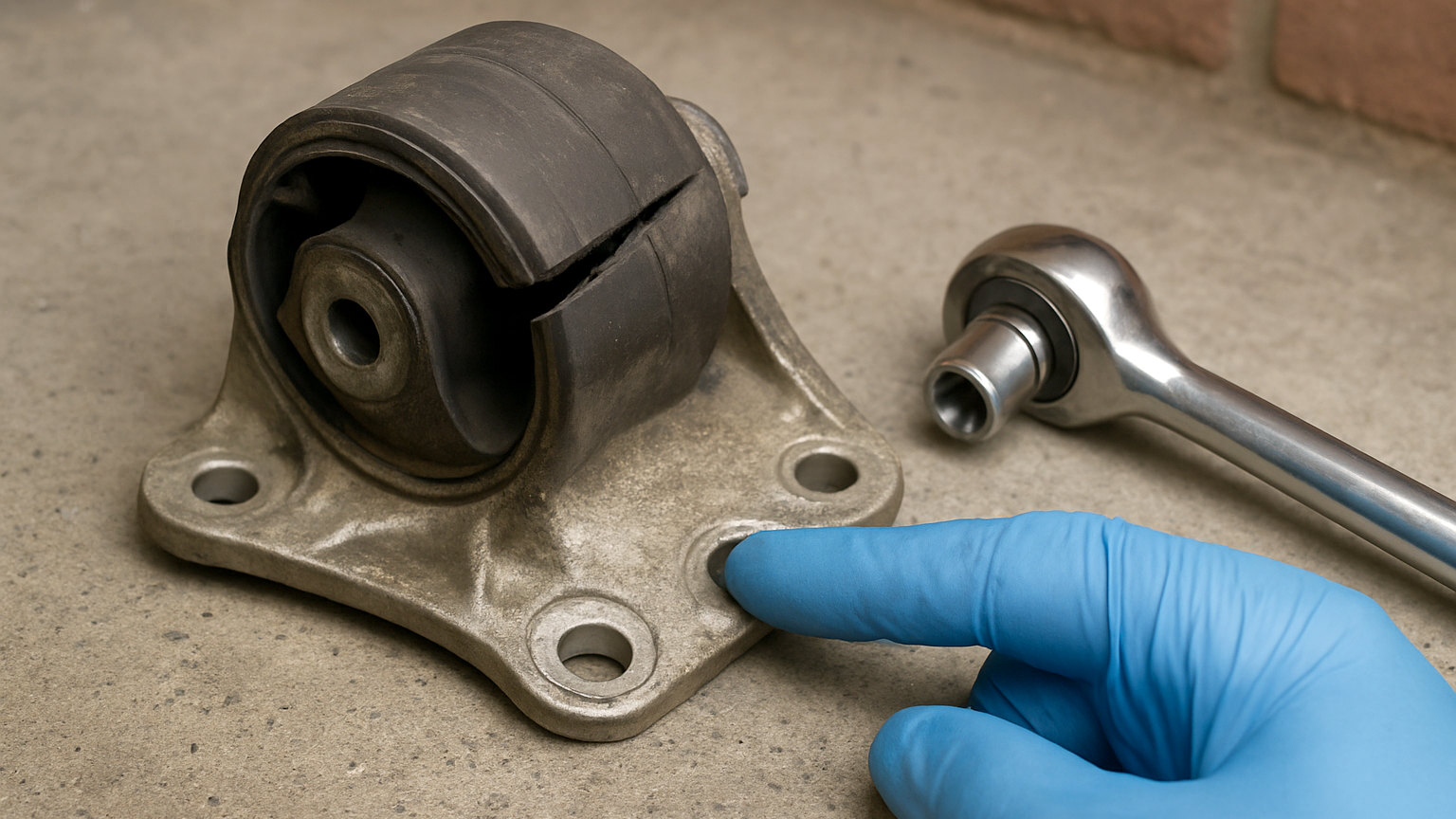
A car that shakes noticeably when you are sitting at a junction is describing one of two quite separate problems. Either the engine is genuinely running unevenly and shaking itself, or the engine is running perfectly smoothly and its normal vibration is being transmitted into the body because the mounts that should absorb it have failed. The repairs are entirely different, and the test that separates them is simple.
How do you tell the two apart?
Listen to the engine note rather than feeling the vibration. A misfiring engine sounds uneven, with a lumpy irregular beat, and the shaking follows that rhythm. A healthy engine on worn mounts sounds completely smooth while the car shakes. The second test is even more revealing on an automatic: put the car in neutral and note the vibration, then select drive with the brake held. Vibration that appears or worsens dramatically in drive points at the mounts, because the load twists the engine against them.
What do engine mounts actually do?
An engine is not bolted rigidly to the car. It sits on rubber or hydraulic mounts designed to hold it in position while absorbing the vibration inherent in a reciprocating engine, particularly at idle where the pulses are furthest apart. Hydraulic mounts contain fluid and are tuned to damp specific frequencies. When the rubber perishes or a hydraulic mount leaks its fluid, that damping disappears and the vibration goes straight into the shell.
What are the other signs of failed mounts?
A clunk when selecting drive or reverse, a thump when you lift off or accelerate sharply, vibration through the steering wheel and seats that is worst at idle and improves once moving, and in bad cases visible engine movement when someone blips the throttle from outside. A leaking hydraulic mount often shows a wet oily residue around its base. Mounts are cheap parts, though access varies enormously and the labour can outweigh the components.
Which engine faults cause genuine shaking?
A misfire on one cylinder is the most common, and the causes are the usual ones: worn spark plugs, a failing coil pack, a blocked or leaking injector. A significant vacuum leak causing lean running produces a rougher and less stable idle. Low compression on one cylinder, from a burnt valve or a failed gasket, causes shaking that no amount of servicing will resolve. In each case the engine sounds wrong as well as feeling wrong.
Why does the shaking stop when the car is moving?
Because road speed brings its own noise and vibration that masks it, because the engine is running at higher revs where the pulses come more frequently and feel smoother, and because the load path through the mounts changes once the car is driving. This is why almost every mount complaint is described as a problem at idle even though the mounts are just as worn at seventy. It also explains why the fault is easy to ignore for a long time.
Does it matter beyond comfort?
It does. An engine moving excessively puts strain on everything connected to it, including exhaust joints, coolant hoses, wiring looms and driveshafts, and a badly failed mount allows enough movement to damage those over time. A misfire that is shaking the car is also pushing unburnt fuel into the exhaust and is capable of destroying a catalytic converter. Neither is a purely cosmetic problem.
What should you do first?
Do the neutral versus drive test, or on a manual note whether the shaking changes when you rest the clutch at the biting point. Have the fault codes read, since a misfire will normally have recorded one. If the codes are clear and the engine sounds smooth, ask for the mounts to be inspected specifically, because a general appointment for a car that vibrates often ends up chasing the engine when the answer turns out to be a modest piece of perished rubber underneath it.


