
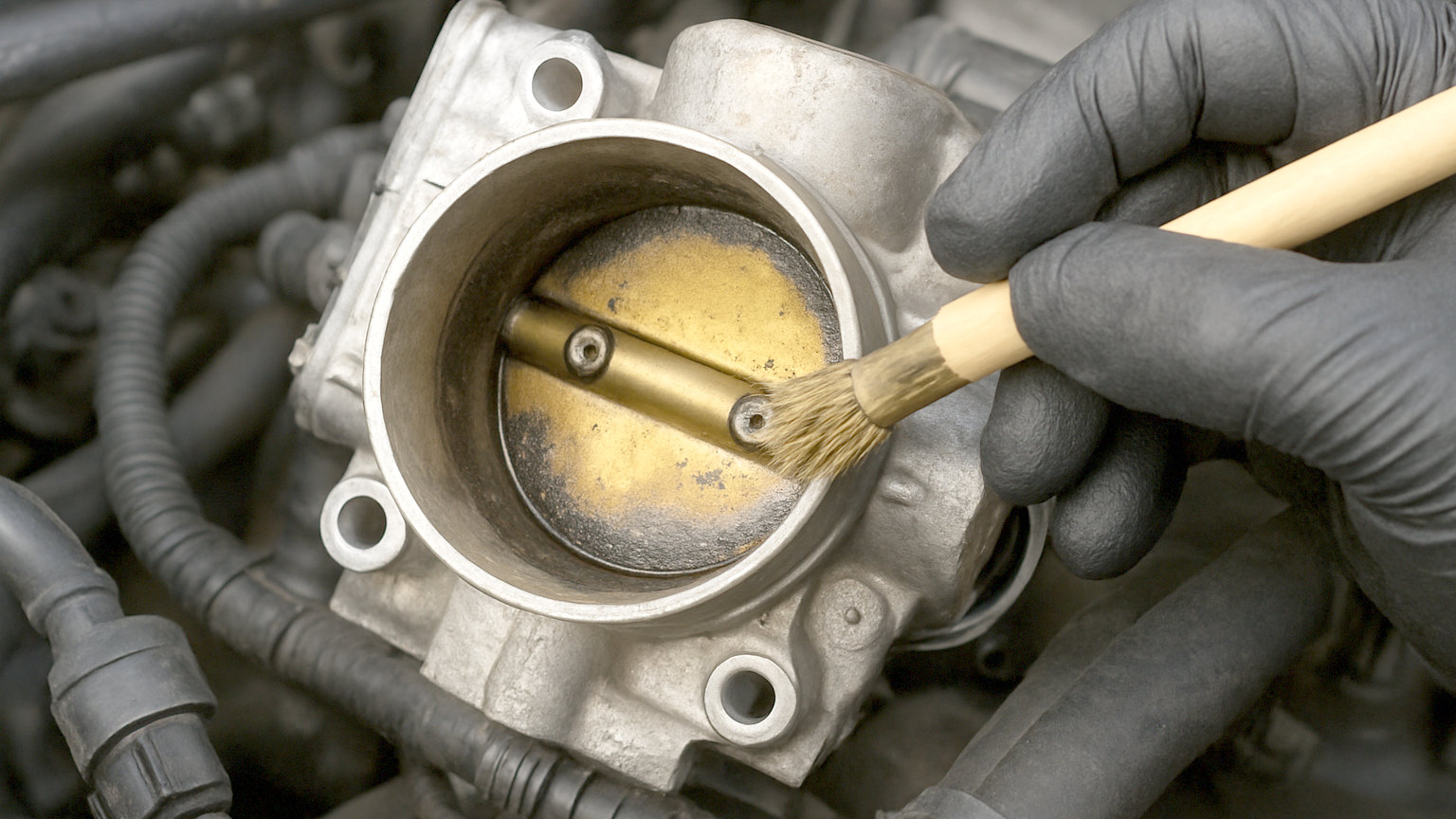
The throttle body controls how much air enters the engine, and at idle it is almost completely closed, allowing only a tiny trickle through. Because that quantity is so small, anything that changes it has a disproportionate effect. A layer of carbon a fraction of a millimetre thick around the throttle plate is irrelevant at full throttle and entirely capable of causing stalling, surging and rough running at idle.
Where does the carbon come from?
Mostly from the crankcase breather system, which routes oil vapour from inside the engine back into the intake to be burned rather than vented. That vapour condenses on the throttle plate and the walls of the throttle body, where it mixes with dust and, on engines with exhaust gas recirculation, with soot. Over tens of thousands of miles it builds into a sticky black deposit. Short journeys make it worse, and engines that consume any oil worse still.
What are the symptoms?
An idle that is lower than it should be, stalling when coming to a stop, a surge or hunt as the management overcorrects, hesitation when pulling away, and a throttle response that feels sticky or uneven at small openings. On electronic throttle cars the management may store a fault code relating to throttle position or idle control adaptation, since it has run out of adjustment trying to compensate. Cold weather often makes everything worse because the deposits are stiffer.
How is it cleaned?
The intake ducting is removed to expose the throttle plate, and the deposits are cleaned off with a proper throttle body cleaner and a soft cloth. The important points are that the plate must be cleaned on both faces and around its edge where it seats, that the bore behind it needs cleaning too, and that carburettor cleaner and brake cleaner should not be used, since some throttle bodies have a coating that these will strip. On electronic units the plate should not be forced open by hand, since the motor and gears can be damaged.
Why does the idle sometimes get worse afterwards?
Because the management had adapted to the restriction. It had learned to hold the throttle further open to achieve a normal idle, and once the deposits are gone that same position lets in far too much air. The result is a high or erratic idle until the system relearns. Many cars need a specific throttle adaptation reset carried out with a diagnostic tool, and some relearn automatically over a few driving cycles. Checking which applies before starting the job avoids an unpleasant surprise.
Is cleaning always the answer?
Not always. On heavily fouled engines, particularly direct injection ones, the inlet manifold and valves are usually just as coated, and cleaning only the throttle body treats the most accessible part of a wider problem. Electronic throttle bodies also fail internally, with worn position sensors or failed motors, and no amount of cleaning will help those. If the symptoms return within a few thousand miles, the underlying cause is oil vapour or exhaust soot volume rather than the throttle body itself.
How often should it be done?
There is no universal interval, but inspecting it every forty or fifty thousand miles is reasonable on most cars, and sooner on engines with a known reputation for carbon build up or on cars used exclusively for short journeys. It is a job that takes under an hour on many engines and needs only a cloth and a can of cleaner, which makes it one of the better value maintenance tasks available.
What else is worth checking at the same time?
Look at the crankcase breather hoses and the valve that regulates them, since a blocked or failed breather increases the vapour reaching the throttle and is often the reason the deposits built up quickly. Check the intake ducting for splits while it is off, and inspect the air filter. All three take a few extra minutes with everything already apart, and dealing with the cause rather than the symptom is what stops the same job being needed again next year.


