
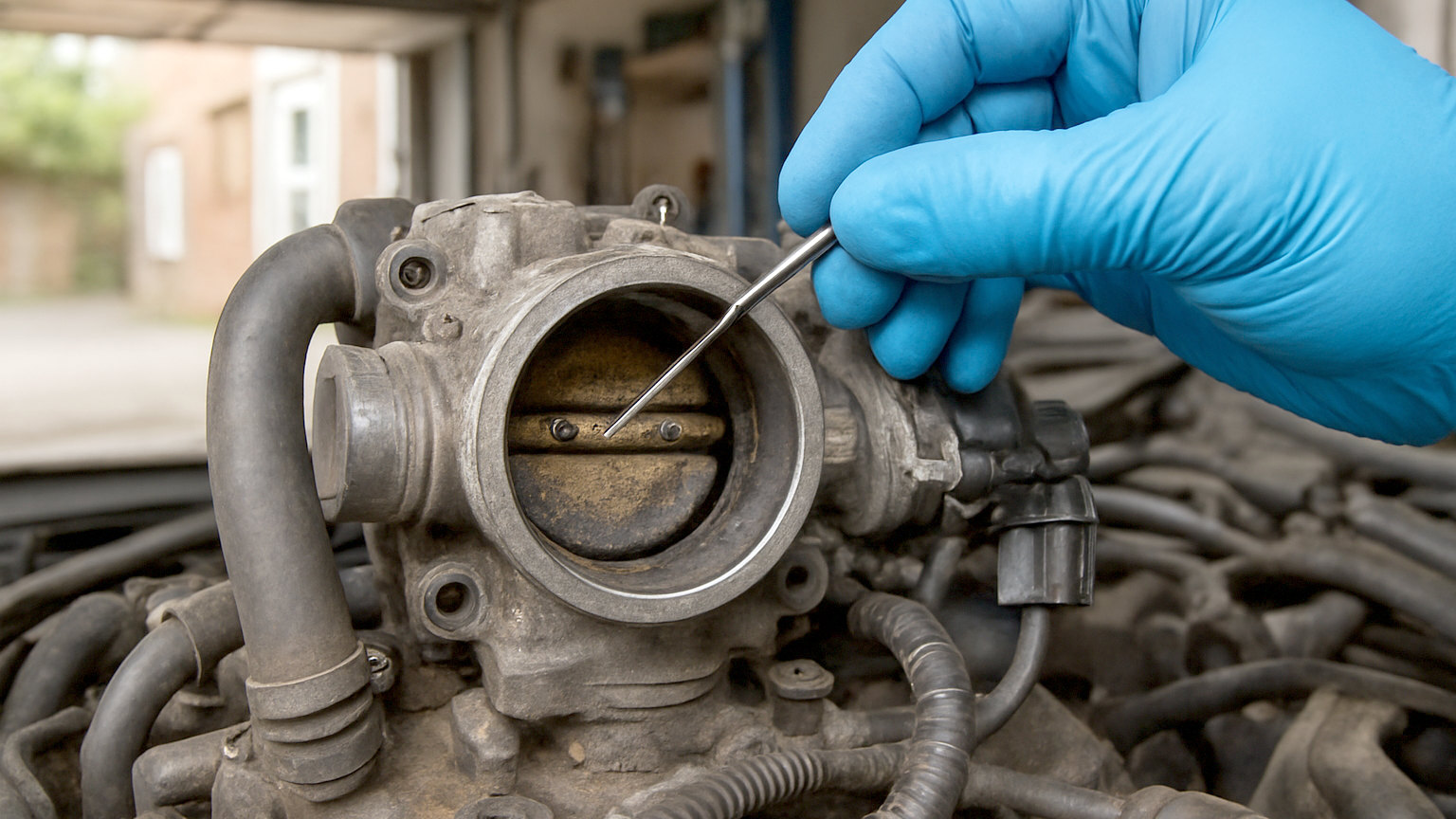
Idle is the hardest thing an engine does. At any other point the throttle is open, air is flowing freely and there is plenty of momentum in the flywheel to carry the engine through any brief hesitation. At idle the throttle is almost closed, the airflow is tiny, and the engine is turning barely fast enough to keep itself going. Any small disturbance at that moment is enough to stop it, which is why stalling happens at junctions rather than on motorways.
What is the engine trying to do as you slow down?
As you lift off and press the clutch, the engine has to move from a fuelled, loaded state to a very low idle within a second or two. The management does this by controlling a small bypass of air around the closed throttle, either through an idle control valve or by holding the electronic throttle slightly open, and by adjusting fuelling and ignition timing to catch the falling revs. If any part of that process is impaired, the revs undershoot and the engine dies.
What are the most common causes?
A dirty throttle body is at the top of the list, because carbon deposits around the throttle plate change the tiny airflow the management is relying on. A failing idle control valve on older cars does the same. Unmetered air entering through a split hose upsets the mixture badly at idle while barely mattering at speed. A dirty or failing airflow sensor gives the management poor information exactly when it needs good information. All four are common and none are expensive.
Could it be a fuel supply problem?
It can. A weak fuel pump or a blocked filter usually causes problems under load first, but a pressure that has fallen far enough will also cause stalling at idle. Dirty injectors that atomise poorly make the mixture unreliable at very low flow rates. On diesels, air drawn into the fuel system through a perished pipe produces stalling that gets worse the longer the car sits idling. These generally come with other symptoms elsewhere in the rev range.
What if it stalls only when something else is switched on?
That is a valuable clue. Stalling when the air conditioning engages, when the headlights and heated screen are switched on, or when the steering is turned to full lock all indicate that the engine cannot cope with an additional load at idle. The management is supposed to raise the idle speed to compensate, and if it cannot the underlying idle control is already marginal. Noting exactly what you were doing at the moment it stalled is worth more than any description of the sensation.
Is it the engine or the driver?
Worth asking honestly on a manual car, because a heavy clutch, a high biting point or simply unfamiliar gearing will cause stalling that has nothing to do with any fault. The distinction is straightforward: a mechanical stall happens with the clutch fully depressed and the car in neutral, where the engine should be perfectly capable of idling on its own. If the car dies while sitting in neutral at a junction, the fault is in the engine.
Which checks are worth doing first?
Have the fault codes read even without a warning light, because idle related faults and fuel trim values are recorded regardless. Listen for hissing around the intake at idle with the bonnet up. Look at the intake pipework and breather hoses for splits, particularly at the bends where the rubber has hardened. Ask when the throttle body was last cleaned, since many cars have never had it done and it is a straightforward job on most engines.
Is it dangerous to keep driving?
It is more hazardous than most people assume. A car that stalls pulling out of a junction loses power steering assistance and, after a couple of pedal presses, brake servo assistance too, at exactly the moment it is sitting in the path of other traffic. Get it looked at promptly rather than developing a habit of holding a few revs to keep it alive, because the underlying fault will keep getting worse.


