
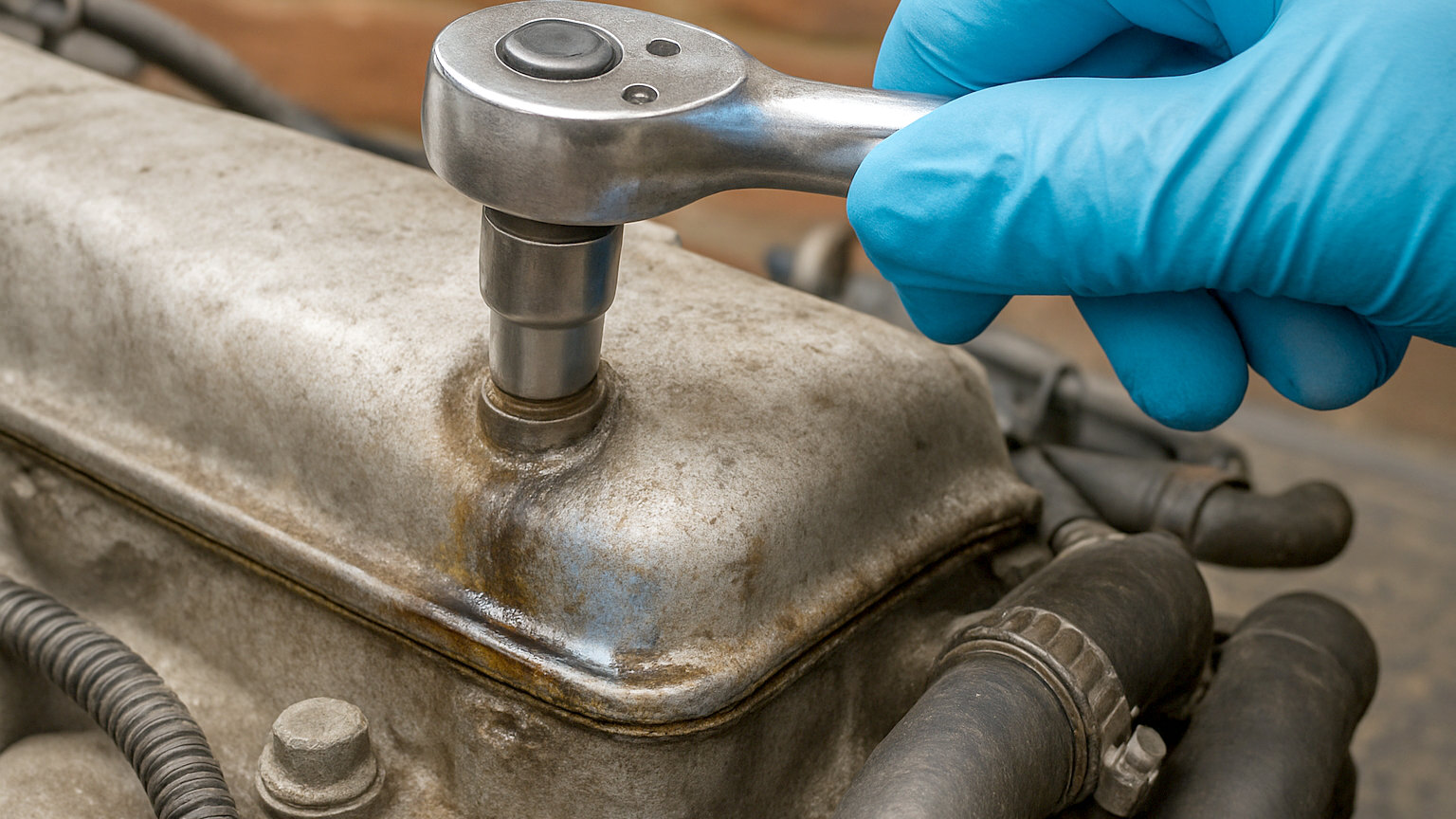
Garages will always recommend fixing an oil leak and they are not wrong to, but the honest answer for an owner is more nuanced. A twelve year old car with a slight weep from the sump gasket, using no measurable oil between services, is in a different position from a three year old car dripping onto its exhaust manifold. The decision comes down to where the oil goes, how much is lost, and what the repair costs relative to the car.
What is the difference between a seep and a leak?
A seep leaves a damp film around a gasket that collects dust over time but never forms a drip. A leak produces drips that reach the ground and reduce the level on the dipstick between checks. Most older cars have at least one seep somewhere and it is essentially cosmetic. The transition from seep to leak is the point at which the decision changes, and it is usually visible as fresh wet oil rather than an old grimy stain.
Which leaks are urgent regardless of size?
Any oil reaching the exhaust manifold or turbocharger, because that is a fire risk and the quantity does not need to be large. Any oil landing on the auxiliary belt, since it causes slipping and can shred the belt, taking the water pump and alternator drive with it. Any oil near a brake disc or caliper. And any leak losing enough that the level falls near minimum between weekly checks, since that risks the bearings.
How do you judge how much is being lost?
By measurement rather than impression. Fill to maximum, note the mileage, and record how far the level drops over the next thousand miles. A car losing a hundred millilitres over that distance is not in any danger provided you check regularly. A car needing half a litre a week is a different proposition. Puddle size is misleading, because a very small quantity of oil spreads dramatically on tarmac.
Does a leak affect the MOT?
It can. An engine oil leak is generally recorded as an advisory rather than a failure, but a leak severe enough to be dripping onto the road can be recorded as a defect, and oil contaminating brake components or leaking onto hot exhaust parts is a more serious matter. An advisory is worth treating as an early warning rather than an inconvenience, since it means the tester saw something worth mentioning.
What are the risks of leaving it?
Beyond the obvious loss of oil, leaks tend to worsen rather than stabilise, and oil degrades rubber over time, so a leak near a mount, a bush or a hose is quietly shortening the life of those components too. It also makes any future work more expensive, because mechanics charge for cleaning before they can diagnose anything else in the area. And a car being sold with an oily engine bay invites suspicion out of proportion to the actual fault.
Do stop-leak additives work?
They swell rubber seals slightly, and on a hardened crankshaft seal or an old rubber gasket that can genuinely reduce a weep for a time. The drawbacks are that the effect is temporary, that they swell every seal in the engine rather than only the failing one, and that they do nothing for a gasket that has been distorted or a cover that is cracked. On an old car being run cheaply for a limited period, they are a defensible pragmatic choice. On a car you intend to keep, they are not a repair.
How should you decide?
Find out which component it is and get a quote for that specific repair, since the range is enormous. A sump plug washer costs almost nothing, a rocker cover gasket is a modest job, and a rear crankshaft seal requires the gearbox to come out. Then weigh that figure against the car value, the loss rate and whether the oil is landing anywhere dangerous. Monitoring a seep on an old car is a legitimate decision; ignoring oil on a hot manifold is not.


